


How to choose a corporate video production company: 7 criteria to check before you sign
When the board asks marketing to choose a production company, whoever recommends it is held responsible if the project goes wrong. The showreel and the quote are both necessary, but neither tells you how a company will handle a schedule change or rain on the shoot day. The 7 criteria for choosing a corporate video production company are experience with the right type of film, who actually runs the project, how the company questions the brief, process and approval stages, contingency for the shoot day, delivery and storage terms, and transparency on changes; each one needs concrete evidence rather than a sales pitch, and this article shows how to present them to leadership in a comparison table. A backup shoot day is rarely included by default: according to Filmciti's pricing page, only packages from 200 million VND (excluding VAT) upwards include one.

In this article
- Choosing a production company means choosing who will make hundreds of small decisions on your behalf
- The 7 criteria should be checked against evidence, not against a sales pitch
- Contingency planning is the criterion few people ask about, yet it decides who pays when a shoot day goes wrong
- Present your recommendation to leadership with a comparison table, not an impression of the showreel
- A sunny showreel does not tell you what a company will do when the shoot day is rained out
- Checklist before signing with a corporate video production company
- Further reading
The first conversation with a producer often says more about how a production company works than its showreel does.
Choosing a production company means choosing who will make hundreds of small decisions on your behalf
Once the contract is signed, the producer and director will decide many things the business never sees directly: who appears on camera, which scene to shoot first, what to do if it rains, where to cut an interview. A beautiful showreel shows that a company can create beautiful images, but not how it makes those decisions.
For the person who recommends the supplier, the biggest risk is usually not a film that looks less polished than hoped, but avoidable incidents: a shoot rescheduled at the last minute, a number of feedback rounds different from what you understood, or an extra cost that leadership was never warned about. These incidents come from process and communication, so the selection criteria also need to measure process and communication. A company with a clear process usually sends a production schedule that marks each approval stage, states how many feedback rounds come with each stage and who gives final sign-off, and confirms in writing when a request goes beyond the contract. If a meeting only covers the showreel and the price, you have no basis for knowing how the project will run once something changes.
That is why, before meeting the candidates, you should send all of them the same brief so their proposals can be compared within the same frame. If you do not have a brief yet, the article on writing a corporate video brief can help you prepare one in a single working session.
The 7 criteria should be checked against evidence, not against a sales pitch
Each criterion for choosing a corporate video production company only counts when it is backed by specific evidence, such as a sample production schedule or a written change confirmation, rather than by what is said in the pitch.
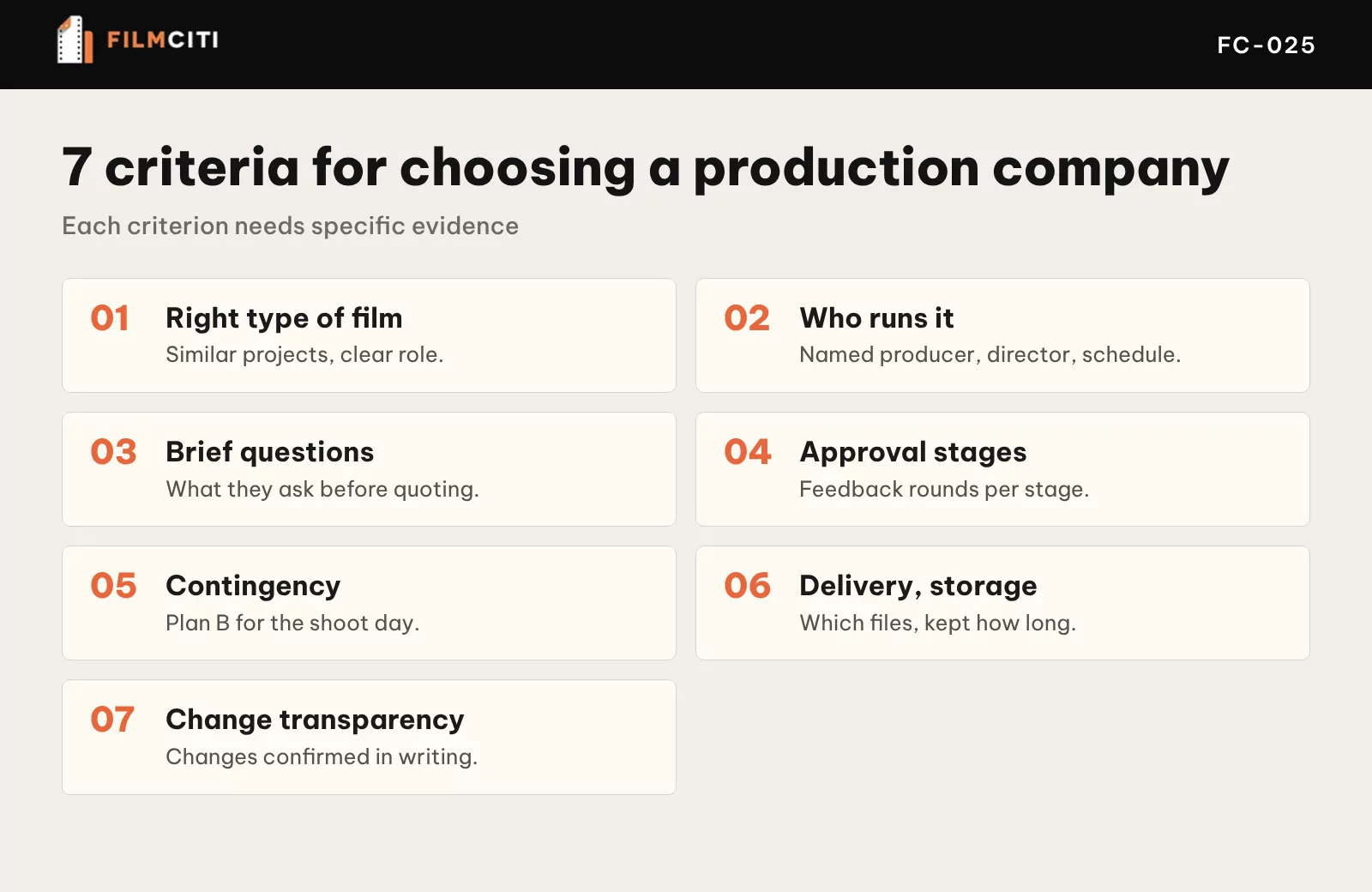
The table below sets the 7 criteria against the question to ask, the evidence to request and the signs that you need to dig deeper.
| Criterion | Question to ask | Evidence to request | Signs you need to dig deeper |
|---|---|---|---|
| Experience with the right type of film | Have they made this type of film in a similar context? | 1–2 recent projects of the same type, with their role | Only commercials when you need a factory or internal film |
| Who actually runs the project | Which producer and director will work on it? | Names of the people in charge and their availability during the project | The person pitching is not the person doing the work |
| How they question the brief | What do they ask before quoting? | Their list of questions or notes from the meeting | A quote straight away without asking about viewers or venue |
| Process and approval stages | How many feedback rounds, and who signs off at each stage? | A sample production schedule with approval stages | "Revisions until you're happy" with no number of rounds |
| Production organisation and contingency | What happens if an interviewee is absent or it rains? | A contingency plan for the shoot day | No concrete answer |
| Delivery and storage | Which files does the business receive, and how long is the raw footage kept? | Clauses on delivery, storage and usage rights | The contract only says "delivery of the final film" |
| Transparency on changes | How do they flag requests that go beyond the scope? | A sample written change confirmation | Extra costs only raised at sign-off |
The first meeting is where the third criterion is easiest to test. An experienced producer usually asks where the film will be shown, who will watch it, who signs off and when the film is needed, before talking about ideas or price. If you want to verify a company's real role in the films on its showreel, the article on verifying a production house's role project by project explains how to read showreels and case studies.
Contingency planning is the criterion few people ask about, yet it decides who pays when a shoot day goes wrong
A showreel is the product of shoot days that went well, so it cannot tell you how a company handles rain, an absent interviewee or a location cancelled at the last minute. For projects shot outdoors, in a distant province or around leadership's diaries, this is exactly the kind of risk that turns into an extra cost the person who recommended the supplier has to explain.
A clear contingency plan answers 4 questions: which day is the backup day, and has the crew's time been held for it; who decides to call off a shoot day, and how far in advance; which scenes can be moved indoors; and how travel, accommodation and equipment costs are split if the shoot is rescheduled. If the quote only says "schedule subject to weather", ask the company to spell it out in writing. A good answer comes with specific conditions: the decision to cancel is made the afternoon before, based on the forecast; a list of indoor scenes is ready so the crew is not left waiting; and the approver on the client side knows the time window in which they must reply. When these conditions are in the quote, rescheduling becomes a planned step rather than a negotiation on location.
There is a trade-off. Holding a backup day means the company has to keep its crew and equipment available, so the cost may be higher, but the business knows its maximum exposure in advance. Without one, the quote is lower but the business carries most of the risk. How much this matters depends on the project: a film shot in a factory or an office is barely affected by weather and may not need a backup day, while a resort film, an outdoor construction site or a one-off event should have one. When comparing, check whether the higher quote already includes a backup day, because that difference may be exactly the risk the business will not have to carry later. The raw footage delivery clause deserves the same careful reading; what each line means is explained in the article on production terms in quotes.
Present your recommendation to leadership with a comparison table, not an impression of the showreel
When you present your recommendation, a comparison table helps leadership see the reasons behind the choice and gives you a solid basis if the project runs into problems later. The table should record the evidence gathered for each criterion, not just a score.
| Criterion | Company A | Company B | Company C |
|---|---|---|---|
| Experience with the right type of film | 2 recent factory films, shot and edited in-house | Mostly TVCs | 1 factory film, supplied the camera crew only |
| Who runs the project | Named producer and director, available | Not yet confirmed | Named, currently on 2 parallel projects |
| Process and approval stages | 3 approval stages, 2 feedback rounds each | Number of rounds not stated | 3 stages, 2 rounds |
| Delivery and storage | Raw footage delivered on request | Final film only | Storage for 12 months |
| Notes | Contingency plan to be clarified | Scope to be confirmed | Crew availability to be confirmed |
What goes wrong: after the table has been presented, Company A reports that its director has just taken on another project in the very week of the shoot. There are three ways to handle it:
- Move the shoot to fit the director's schedule: you keep the person who convinced you, but the film arrives later and the date it is needed must be checked again.
- Accept another director from Company A: the schedule holds, but you need to see that person's most recent project and update the table.
- Switch to Company C: the people in charge are known, but you need to clarify their 2 parallel projects and the fact that their experience is mostly as a camera crew supplier.
Each option means presenting again, and a table that records evidence makes the second presentation quicker. Once you have shortlisted 1–2 companies whose way of working fits, you can compare their quotes line by line using the article on comparing corporate video quotes.
A sunny showreel does not tell you what a company will do when the shoot day is rained out
In early September 2026, a resort in Phu Quoc needed a 2-minute brand film to send to travel agencies before peak-season sales opened on 1 November. Ms Quỳnh, the marketing manager, had 2 weeks to choose a production company and present it to Mr Sơn, the general manager. Out of 3 companies, she picked the one with the most beautiful showreel and a mid-range quote. Mr Sơn approved it quickly: "If the showreel looks that good, go ahead."
The contract set 2 shoot days, 24 and 25 September 2026, with a 9-person crew flying in from Ho Chi Minh City. The quote carried one line in small print: "Schedule subject to weather conditions." Nobody asked what that meant: every film in the company's showreel had blue skies and golden light, and the last week of September was the only week the resort could keep the pool and two show villas free.
On the morning of 24 September it was raining from 5 a.m. The director switched to the spa, the restaurant and the villas. On the 25th it stayed overcast until noon, then rained again in the afternoon. The infinity pool at sunset and the drone shot along the beach, the opening and closing scenes of the script, still had not a single frame.
On the evening of the 25th, the producer messaged: "Hi, we suggest either keeping the crew on for 1 more day or coming back for another round when the forecast is sunny. Both mean extra travel, accommodation and equipment costs, I'll send the details tomorrow morning."
Ms Quỳnh called straight back: "It's just one more day, I'll sort out rooms for the whole crew."
The producer explained that rooms were not the issue: the forecast for the 26th was still showers, the director of photography was booked on a shoot in Ho Chi Minh City from the 27th, the equipment was hired by the day, and both show villas had guests checking in from noon on the 26th. Staying might still bring no sunset while the extra costs ran anyway, and the contract said nothing about who pays when a shoot day is rained out.
At the weekly management meeting, Mr Sơn asked exactly the question Ms Quỳnh had been dreading: "When we chose the company, did we think about September being the rainy season?" She had compared exactly what leadership had asked her to compare, and the shoot week had been the resort's own choice. When she called back, the producer owned their side too: "We knew it was the rainy season in Phu Quoc, yet the quote had only one line saying 'subject to weather'. We should have proposed a backup day and a cost split from the start."
In the end, Ms Quỳnh submitted the extra cost in writing, the two sides split it, and a small crew of a camera operator and a drone pilot went back on 9 October. That morning was clear, so the pool was filmed at sunrise instead of sunset. The film reached the travel agencies on 30 October, in time for sales but 2 weeks behind plan, and the quarterly budget gained a line she had to justify.
The next time the resort chose a production company, the comparison table Ms Quỳnh presented to Mr Sơn had one more row that every company had to answer: "If it rains on the shoot day, who decides to call it off, which day is the backup, and how are the rescheduling costs split?"
The story above is a hypothetical situation, reconstructed from things that often happen in corporate filmmaking.
With the Filmciti crew, we build a weather plan into the quote whenever a project includes outdoor scenes in the rainy season: the backup day, who decides to call off a shoot, when that call is made, and how travel, accommodation and equipment costs are split if the shoot moves. Shots that are hard to replace, such as sunrise, sunset or drone footage, are scheduled so they can be reshot on the backup day.

A backup day agreed in advance lets the crew return for the shots it needs without renegotiating.
Checklist before signing with a corporate video production company
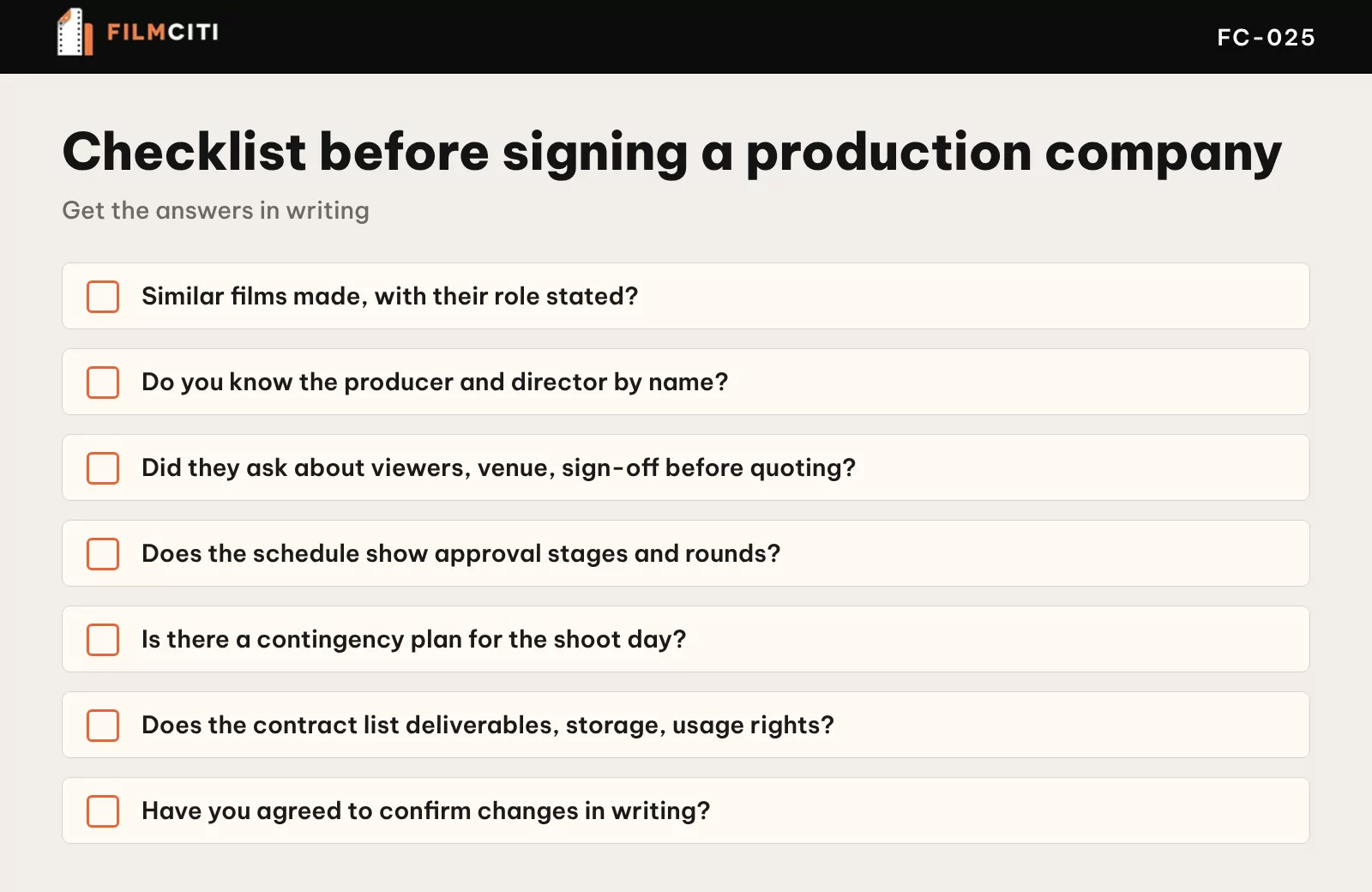
- Has the company made similar films and stated its role in those projects?
- Do you know the names of the producer and director who will run the project?
- Did the company ask about viewers, venue and final sign-off before quoting?
- Does the production schedule show the approval stages and the number of feedback rounds at each stage?
- Has the company offered a contingency plan for the shoot day?
- Does the contract list the deliverables, the raw footage storage period and the usage rights?
- Have both sides agreed how changes will be confirmed in writing?
Go back to the production company with questions when the contract only says "delivery of the final film" without mentioning raw footage, or when the person presenting at the meeting is not the person who will run your project.
Download the Production company selection criteria comparison table (Excel) — Vietnamese template to record each company's evidence against the 7 criteria and present them to leadership in one table.
Further reading
- Choosing a production house in Hanoi: verifying its role project by project
- Filmciti's corporate video production service: process, approval stages and scope of deliverables.
If you are choosing a production company, use the comparison table above to record each company's evidence, then send Filmciti a brief with where the film will be shown, the date you need it and the planned locations, to receive a proposal that names the people in charge, the approval stages, the backup day and the deliverables.
Related service: Corporate film production
FAQ
Only compare costs once the companies have quoted on the same scope. A lower quote may come from fewer shoot days, fewer feedback rounds, no backup day or no raw footage delivery. Ask every company to break down its quote using the same template so you can compare it line by line.
No. A showreel shows image quality, but not which parts the company actually did, who was in charge or how problems were handled. Ask about a similar project in more detail, request its production schedule and meet the person who will run your project.
Yes, if the business plans to reuse the material for short videos, vertical formats or later versions. This may add storage and copying costs, so the contract should specify the format, timing and method of delivery. If you do not need it straight away, both sides can agree how long the production company will keep the material.