



Corporate video shoot checklist: 7 things to tell your team before the shoot day
The shooting date for your company film is locked, the crew has held the day, and you are the one who has to tell the whole company. Sales has client meetings booked, customer service is in its end-of-month peak, and the person chosen for the interview has not yet confirmed. Many businesses send a single all-staff email, then discover on the shoot day that the meeting room has already been booked. An effective corporate video shoot checklist covers 7 things drawn from the shotlist, sent separately to each department in 3 timed stages, with a named contact confirming for every team. This article walks through each item, how to time the notices and what to do when a department cannot keep to the schedule.

In this article
- A corporate shoot day passes through many departments, so the schedule needs many departments to confirm it
- The seven things to communicate come from the shotlist, not from an all-staff email
- Sending notices in 3 stages gives departments time to plan without being reminded too often
- The internal schedule should show which scenes can move and who decides when something changes
- An "everyone please help out" email is not enough to hold a shoot day in a 12th-floor office
- Checklist for a corporate video shoot before sending the internal notice
- Further reading
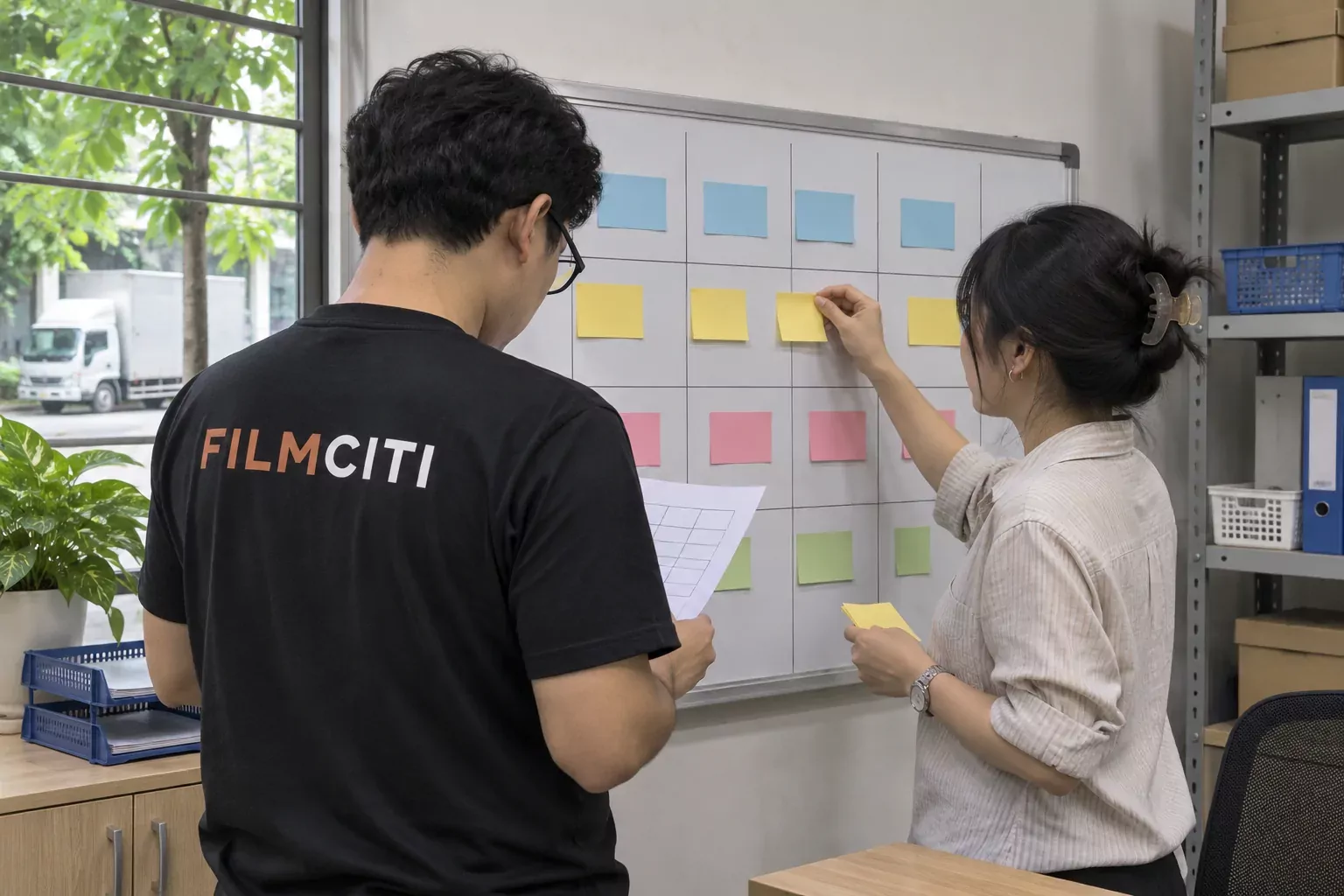
The project lead checks the shooting schedule against each department's working calendar before the shoot day.
A corporate shoot day passes through many departments, so the schedule needs many departments to confirm it
A shoot day for a company film rarely happens in a single room. The crew usually moves through reception, the open-plan office, meeting rooms, the production floor or the warehouse, and each area belongs to a different department. Every scene therefore needs someone in that department to agree on the time, the space and the people who will appear on screen. For example, a call-centre scene needs the customer service lead to route calls to another team for 30 minutes. The interview in the large meeting room needs admin to hold the room and tell other teams not to book meetings at the same time. The open-plan office scene needs the department head to ask staff to clear their desks and switch off screens showing customer data. Each request is small, but if a single person has not confirmed, the crew ends up waiting beside equipment that is already set up.
When all they receive is a general notice, each team assumes the shoot is marketing's business, and only realises it is involved when the crew is already at the door. An effective notice therefore answers, for each department: what the crew needs from your team, at what time, for how long, and who in your team confirms it.
The seven things to communicate come from the shotlist, not from an all-staff email
A shotlist is the list of scenes to be filmed, with location, people and planned time slot, drawn up by the director and producer once the script is approved. If you read the shotlist by its location and people columns and group the scenes by department, you get the list of who needs to be told. From that come 7 things to communicate, summarised in the table below with who receives each one and when to send it.
| What to communicate | Details | Send to | When to send |
|---|---|---|---|
| 1. Date, time and filming areas | Which scene is shot where, from what time to what time | Heads of departments whose areas are filmed | About 2 weeks before |
| 2. People appearing on screen | Interviewees, staff appearing in the background | Each person selected and their manager | As soon as the script is approved |
| 3. Wardrobe | Uniform, colours to avoid, name badges | Everyone appearing on screen | 3–5 days before |
| 4. Space and building access | Rooms to hold, route for equipment, parking | Admin, reception, building management | 1 week before, reconfirm the day before |
| 5. Information that must not appear | Screens showing customer data, internal figures | Heads of departments whose areas are filmed | 3–5 days before |
| 6. Activities to adjust | Pause noisy work, shift rotas, switch off PA announcements | Teams affecting sound or lighting | 3 days before |
| 7. Contacts and fallbacks | Contact person per department, replacement scenes if someone is absent | Each department contact and the producer | The afternoon before the shoot |
Item 4 is the one most often missed by businesses renting offices in a building. Many buildings require advance registration before bulky equipment comes in, limit the hours the freight lift can be used and ask for a list of people entering. The business is best placed to ask building management and confirm on the crew's behalf.
Item 2 needs to happen first, because everyone on camera has their own calendar; the article on choosing who appears in a corporate film helps you decide before sending the notice.
Sending notices in 3 stages gives departments time to plan without being reminded too often
A notice sent too early gets forgotten; one sent too late leaves no time to rearrange. What suits most businesses is to split the notices into 3 stages, each with its own purpose, plus a short confirmation on the morning of the shoot.
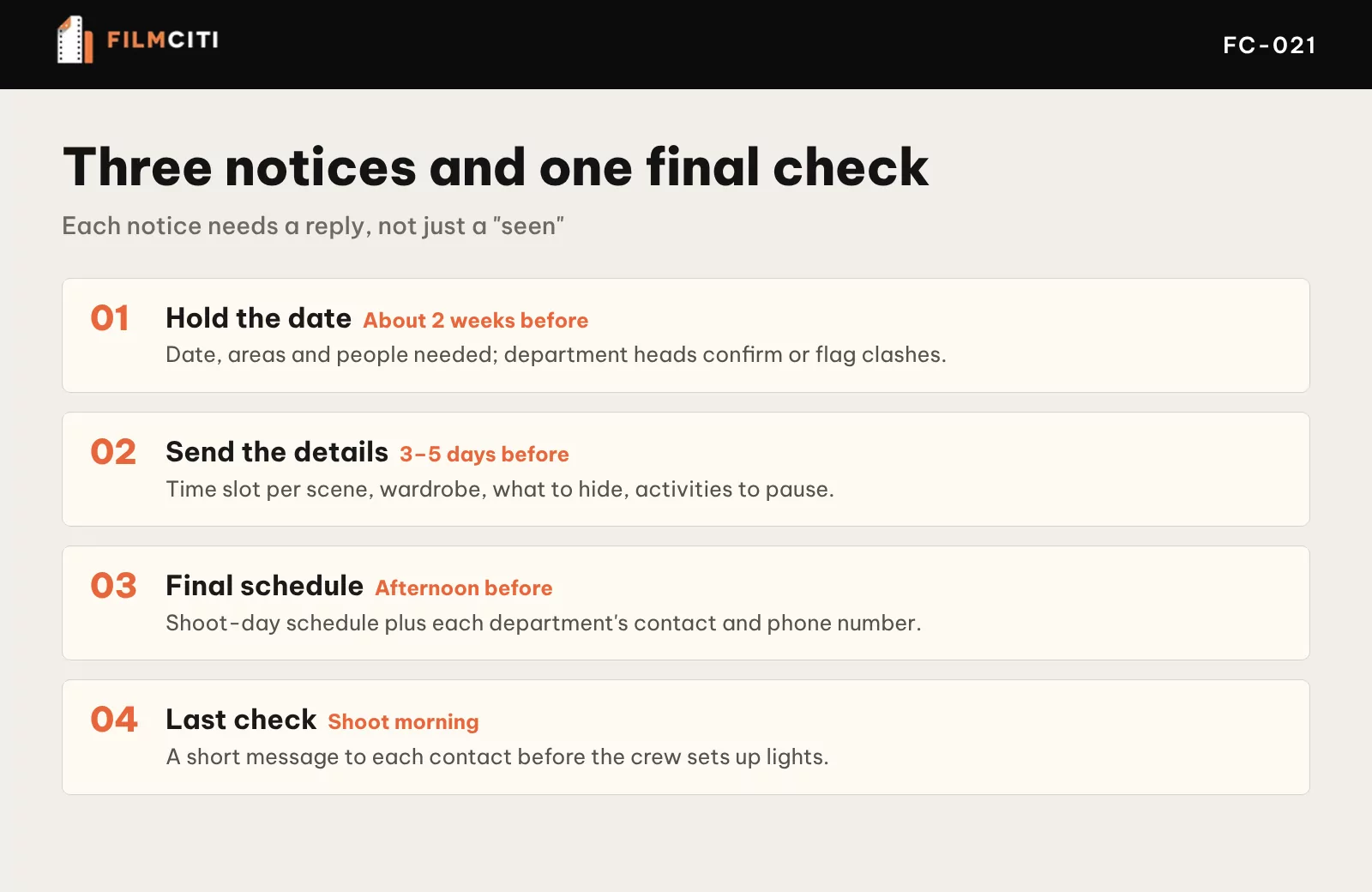
The first stage, about 2 weeks ahead, is for holding the date: tell department heads the shoot date, areas and people needed, and ask them to confirm or flag any clash. The second stage, 3–5 days ahead, is for the details: the time slot for each scene, wardrobe, information to hide and activities to adjust. The third stage, the afternoon before, is for the final shoot-day schedule with the list of contacts and phone numbers. Each stage has its own reason: 2 weeks gives a department head time to move a meeting or a client appointment, while 3–5 days gives staff time to sort out wardrobe and tidy their work area. A final schedule sent the afternoon before helps everyone remember their own time slot without digging out an old email.
Each stage needs a reply, not just a "seen". Each department's contact should confirm specifically, for example "Customer service agrees to filming from 9:00 to 10:00, Ms Ngân is responsible". If a department has not replied by the deadline, call them directly rather than sending another email.
The internal schedule should show which scenes can move and who decides when something changes
However carefully you communicate, the business's day-to-day work can still change on the shoot day. That is why the internal schedule should state which scenes can be moved and which must stay. Producers usually put the scenes that are hardest to move, such as the leadership interview, into the lowest-risk time slot.
Example brief: a furniture company films its company video in 1 day at its office and showroom. The table below sets out each time slot with its scene, the department to notify and whether the scene can move.
| Time | Scene | Department to notify | Can it move? |
|---|---|---|---|
| 7:00–8:00 | Bring in equipment, light the showroom | Admin, security, showroom manager | No, the showroom opens at 8:30 |
| 8:00–9:30 | Interview with the director | Director's assistant | No, the director has a meeting at 10:00 |
| 9:30–11:30 | Sales consultation in the showroom | Showroom manager | Yes, can move to early afternoon |
| 13:30–15:30 | Design team at work | Head of design | Yes, can be cut to 1 hour |
The twist: at 10:00 the showroom manager reports that a project client group of 12 people will arrive to view samples at 10:30, a day earlier than planned, while the showroom scene is half shot. There are 3 ways to handle it:
- Move straight on to the design team and return to the showroom in the early afternoon. The overall schedule holds, but the crew loses about 30–45 minutes packing down and relighting.
- Ask the visiting clients for permission to film a few real consultations, filming only those who agree. The scenes may feel more natural, but the business is responsible for getting permission and the crew has less control over framing.
- Keep the showroom schedule and invite the visitors to view samples on another floor for an hour. The shoot stays on track, but client hospitality is affected, and only the company's leadership can make that call.
No option guarantees the full shotlist; what matters is that the person with the authority to decide has been named in advance. Every reshuffle during the day costs the whole crew time, and if scenes are still missing at the end of the day, the business has to consider a pick-up shoot. According to Filmciti's pricing page, all-inclusive production packages start from VND 70 million (excluding VAT) and are priced per shoot day; only Package B (VND 200 million) and Package A (VND 300 million) include 1 standby day, reserved for weather or other events beyond anyone's control. So before signing the contract, ask how a pick-up shoot caused by internal reasons will be charged, and write the name of the person who can change the schedule into the internal shoot plan.
An "everyone please help out" email is not enough to hold a shoot day in a 12th-floor office
At the end of October 2025, an accounting software company serving small businesses, with offices on the 12th floor of a building on Duy Tân Street in Cầu Giấy, Hanoi, needs a 3-minute company film to open its customer conference on 28 November. The schedule is worked back from the conference: a single shoot day on 13 November, two weeks of editing, two rounds of feedback. Ms Vân, a marketing executive, is put in charge of coordination. Her manager tells her: "Everyone's chasing year-end targets, so don't call lots of meetings, just keep the notice short."
On 10 November, Ms Vân emails the whole company: "On 13 November a crew will be filming our company video. Please wear your uniform, tidy your desks and help the crew out." The email goes to more than 40 people; only 3 reply "ok". The shotlist is clear: 9:00 the customer service call centre, 10:00 an interview with Mr Khải, head of implementation, in the large meeting room.
At 7:15 on 13 November, the equipment van is stopped by security at the car park entrance. The building requires equipment to be registered 24 hours in advance, with a list of people and the vehicle's plate number. Ms Vân calls building management, signs an undertaking, and only at 9:20 does the last case of lights reach the 12th floor.
Upstairs, the call centre is in its end-of-month peak. The customer service team leader shakes her head: "Customers are calling about their year-end accounts, if it gets even a bit noisy they'll hear everything." A sheet of paper is taped to the large meeting room door: "Sales – client demo 10:00–12:00". Then Mr Khải texts: "Vân, a client in Hải Phòng has a data issue, I have to go now. I'll be back this afternoon."
Ms Vân messages the producer: "Can we just film in the small room for now, and interview Mr Khải over Zoom and cut it in? It's only a small change."
The producer explains that Mr Khải's interview carries almost half the film's narration. A webcam recording would be completely out of step with the rest in lighting, framing and sound. The small room is only about 12 square metres, not enough space for the two-camera set-up that had been agreed. By 17:00 the crew has shot 11 of 20 scenes; Mr Khải gets back at 16:30, when the sun outside the window has already gone.
Ms Vân had her reasons for keeping it short: leadership did not want departments disturbed at year end, and an all-staff email is how the company always communicates. On the crew's side, the mistake lay in the preparation: the producer had the shotlist a week earlier but only sent it as a PDF, without turning it into a task list for each department, and never asked whether the building had rules for bringing in equipment, even though the crew had run into this in many office buildings.
The two sides agree a 3-hour pick-up shoot on the morning of 18 November, adding the cost of half a crew day. This time Ms Vân messages each department head individually and registers with the building two days ahead. The first cut is delivered on 24 November instead of 20 November, leaving only one round of feedback. The film is ready in time for 28 November, but the call centre scene has to be picked up during the lunch break, with 3 staff in headsets in front of screens with no calls coming in.
Instead of the 10 November email, Ms Vân and the producer needed to answer just one question together: "Who does the shoot day need, in which room, in which time slot, and has the person responsible for each place, including building management, confirmed by name?"
The story above is a hypothetical situation, reconstructed from things that often happen in corporate filmmaking.
With the Filmciti crew, we turn the shotlist into a task list for each department as soon as the script is approved and send it to the client's project lead. During the office recce, the producer asks building management about equipment registration, freight lift hours and parking, then submits the registration before the shoot day so the equipment van gets into the building on time.
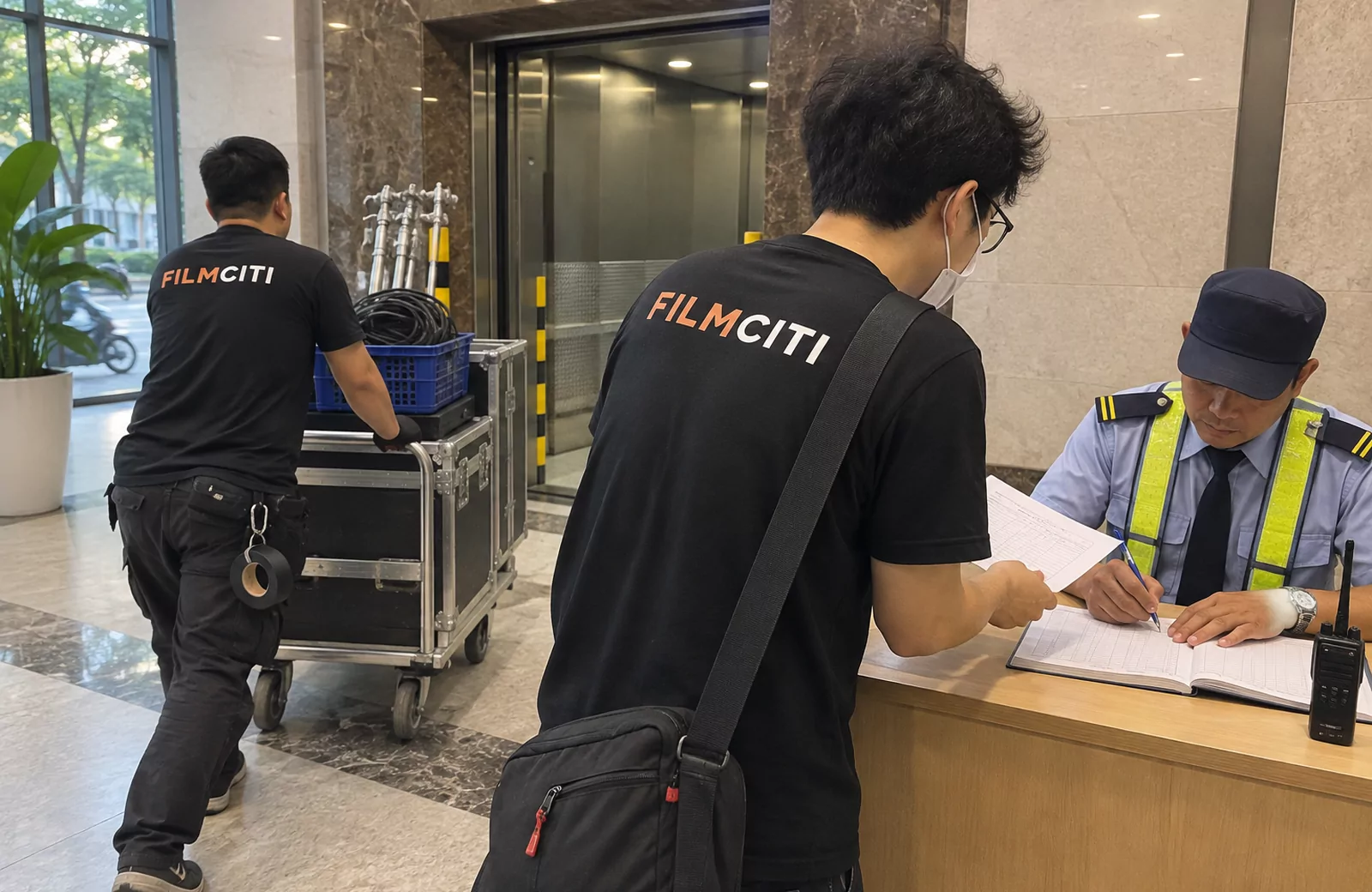
Registering equipment with the building in advance lets the crew start the shoot day on time.
Checklist for a corporate video shoot before sending the internal notice
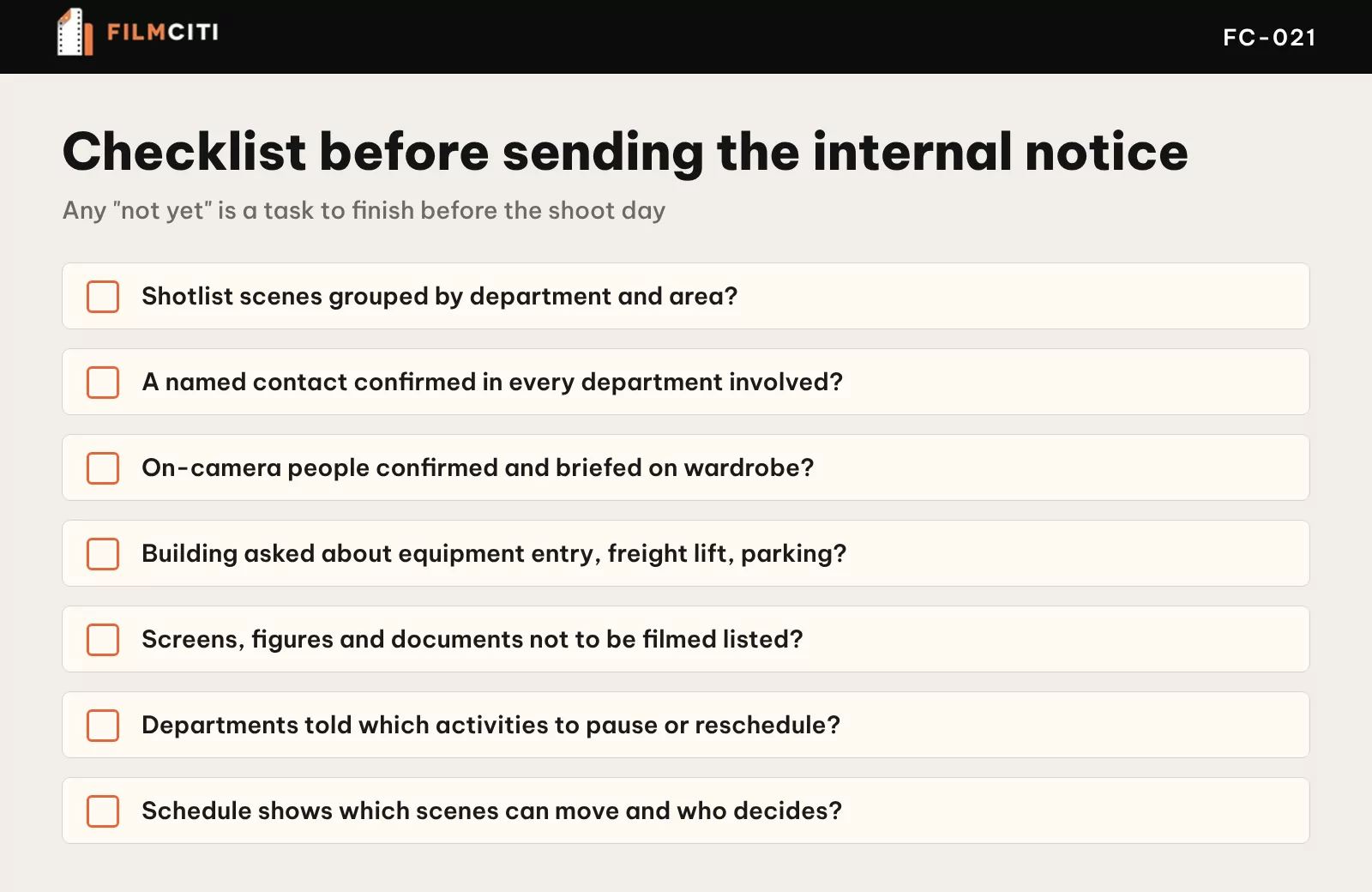
- Have you grouped the shotlist scenes by department and area?
- Does every department involved have a named contact who has confirmed?
- Have the people on camera confirmed their schedule and been told about wardrobe?
- Have you asked building management about equipment registration, the freight lift and parking?
- Have the screens, figures and documents that must not appear on camera been listed?
- Do departments know which activities need to pause or move during filming?
- Does the internal schedule show which scenes can move and who decides when something changes?
Go back to the producer if the shotlist does not give an area and time slot for each scene, or if the leadership interview is placed at the end of the day with no fallback.
Download the Corporate video shoot checklist and internal notice template — Vietnamese template to list notices by department, plan the internal shoot-day schedule and track each contact's confirmation.
Further reading
- How long does a corporate film take.
- Filming in a factory that is still running.
- Filmciti corporate film production services.
If your business is preparing a shoot day, you can use the checklist that comes with this article to build your list of notices, then send Filmciti a brief with the filming location, the departments involved and the planned date. A Filmciti producer will work with you to arrange scenes by area and time slot around your working hours.
Related service: Corporate film production
FAQ
Hold the date with the departments involved about 2 weeks before the shoot, send the details on time slots, wardrobe and areas 3–5 days before, then send the final schedule with the list of contacts the afternoon before. If the shoot falls in a busy trading period or at month end, notify them earlier.
Yes, you should ask the people whose faces will be clearly visible before the shoot day and keep a record of their agreement. Anyone who does not want to be on camera can be kept out of frame. How consent is recorded should follow your internal rules and current regulations on personal images.
Tell the producer as early as possible so they can reorder scenes, move the scene to another slot or shift it to a pick-up shoot. If you know a few days ahead, the adjustment mostly happens on paper; if you only find out on the shoot day, every option involves a trade-off in time and cost.