




How long does a corporate film take? What determines production time?
Work back from screening or broadcast day, allowing time for production, approvals and playback testing.

In this article
- Before estimating the time, agree how the film will be made
- Some decisions must be made before the next task can move forward
- A workable schedule includes time to produce and time to review
- Work back from playback testing to find your start date
- To shorten the schedule, decide what can change
- Before signing off, look at the conditions behind the dates
The film's conference screening is already booked, and the shoot itself is expected to take just one day. When should production begin? A corporate film's timeline needs to cover the whole journey: finding the story, preparing and filming it, then editing and approving a film that is ready to screen.
Start with the screening or broadcast date and work backwards through delivery, playback testing, edit approval and script sign-off. That tells you whether there is time for the approach you want, or whether something needs to change early.
This article uses an illustrative 20-working-day schedule: four weeks with five working days per week and no public holidays.

Before estimating the time, agree how the film will be made
“A film of about three minutes” describes the finished length, but says little about the work behind it. One film might use an existing footage library; another might build its story through interviews, follow a production shift or require filming at several locations. The difference lies in what it takes to create those three minutes.
Before asking for a delivery date, agree which production approach fits:
| Approach | Clarify at the start | Work that is easy to overlook |
|---|---|---|
| Edit existing material | Enough suitable footage, usable quality and permission to use it | Searching and organising footage, narration, graphics and voice recording |
| Film interviews and business activities | Participants, locations, interview topics and filming dates | Location scouting, preparing interviewees and filming additional material |
| Film several sites or processes | Operating hours, travel, safety and site access | Waiting for the right shift or participant, and rearranging the shoot |
| Add languages or versions | Subtitles or a new voice track, aspect ratios and version reviewers | Translation, recording, adjusting the edit and graphics, and checking each version |
Existing footage reduces the need to shoot only if it supports the film's story. A wide factory shot may show scale, but it cannot explain a process the audience needs to understand. Even a large video library needs checking for current information, usable audio and footage that still reflects the business.
“An English version” also needs defining. A separate voice track means translation, recording and adjustments to the pace of the edit; a subtitled version still needs someone to check names, job titles and figures. Those tasks need a place in the schedule from the outset.
When you receive an estimated timeline, ask: where does the clock start, and what counts as finished? Does it begin with the initial enquiry, or once the content is agreed and the materials are ready? Does it end with the first cut, or with delivery of every approved file?
Two people can quote the same number of days and still be imagining different schedules.
Some decisions must be made before the next task can move forward
Once the production direction is clear, the crew can scout locations, find people and prepare props in parallel. Other tasks need a decision before work can begin.
To finalise a shoot, both sides need to agree what the film will say, which shots it needs and whether the location can support them. To edit a story built around an interview, the editor needs the interview itself. Adding more people has limited value if everyone is waiting for footage that has not been shot or content that has not been approved.
The milestones usually need to connect like this:
Script approval → storyboard or visual-plan approval → pre-shoot meeting → filming → content-cut approval → finishing and delivery.
This sequence makes it easier to see where work is waiting. If one milestone moves, check which later tasks it affects; finishing an unrelated task early may not make up for the delay.
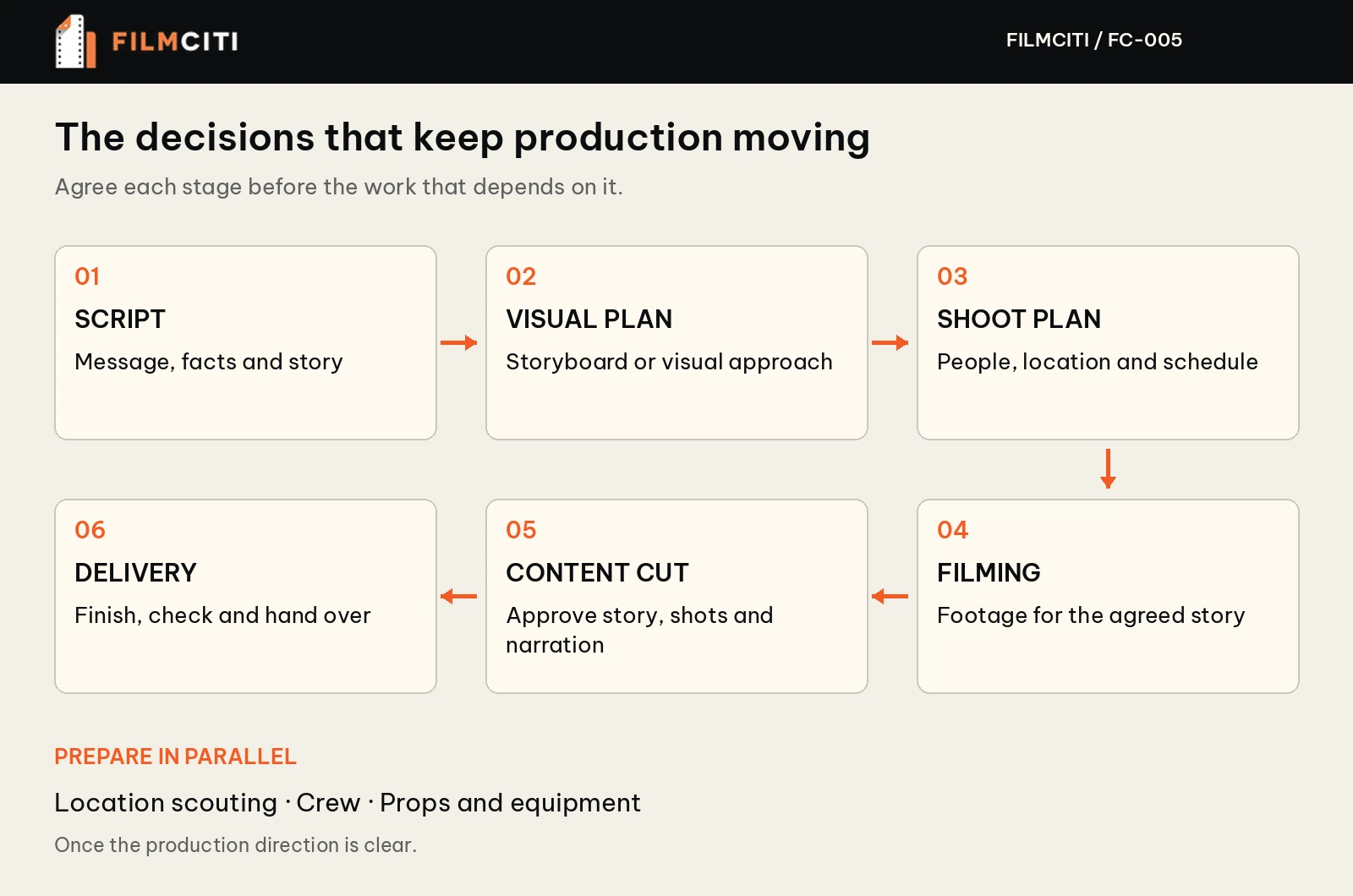
For example, if the director's interview carries the story, its timing directly affects the edit. If the director appears only in a closing greeting, the team may have more freedom to progress with the rest. The effect of postponing a shoot depends on the material that shoot is meant to provide.
The producer should explain these connections when proposing the schedule. The business also needs to reserve time for approvals, alongside the shoot and delivery dates.
A workable schedule includes time to produce and time to review
“Post-production: five days” leaves several questions unanswered: when does the business see the cut, who comments, who approves it and how much time remains for revisions? If the decision-maker can only watch after a weekly meeting, sending the film earlier may not bring delivery forward.
Each review should have a clear purpose. Script approval covers the message, facts and story; content-cut approval settles structure, shots and narration before colour, sound and graphics are finished. Reviewers know what to focus on, and the crew knows which decisions it can build on.
Both sides can put their responsibilities directly into the schedule:
| Stage | The crew prepares | The business reviews and confirms | Agree before moving on |
|---|---|---|---|
| Script | Story approach, writing and revisions | Message, figures and participants | Content approved by the authorised decision-maker |
| Shoot preparation | Recce, production plan and filming schedule | Participants, locations and site access | Production approach and filming arrangements |
| Content edit | Footage selection, structure and narration | Story, images and wording | A content cut approved for finishing |
| Finishing | Colour, sound, graphics and versions | Information and each required version | The complete set of agreed deliverables |
Response deadlines and revision rounds should be agreed for each project. A specific review time gives both the crew and the reviewer something they can plan around.
Information should be checked when it first appears. A figure changed late may require a new voice recording, revised graphics, translated subtitles and another check of the affected versions. When a new request arrives, the crew should explain its effect on the work and delivery date; both sides should distinguish correcting an error from changing previously approved content.
Work back from playback testing to find your start date
For a conference film, the deadline that matters may fall before the event: the moment the organiser needs the file for a playback test. Start there and work backwards through checking, finishing, edit approval, filming and preparation.
The schedule below runs forwards to make the sequence easy to follow. In practice, place delivery and testing first, then count backwards to the start.
For example, a business needs a film of about three minutes for a conference, filmed at one factory with an interview with its director. Deliverables are a Vietnamese version and a version using the same pictures with English subtitles, without a separate English voice track. For the schedule below to work, materials must be ready, participants must keep their appointments and reviews must arrive on time.
| Working day | Crew tasks | Business responsibilities |
|---|---|---|
| 1–4 | Clarify the brief, review materials and write the script | Provide and check information; name the final approver |
| 5 | Receive script feedback | Consolidate comments and approve the script that day |
| 6–8 | Finalise the visual plan, scout and prepare | Confirm participants, filming areas and operating schedules |
| 9 | Hold the pre-shoot meeting | Approve the visual plan, interview topics and shoot schedule |
| 10 | Film to the agreed plan | Make participants available and support site access |
| 11–13 | Assemble the first content cut | Arrange reviewers for the agreed time |
| 14 | Receive one consolidated set of comments | Resolve internal differences before sending feedback |
| 15 | Revise the cut | Decide any points that still need clarification |
| 16 | Lock the content cut | Final approver confirms the move to finishing |
| 17–18 | Finish colour, sound, graphics and English subtitles | Check the translation, names and job titles |
| 19 | Check the finished film and correct errors within the agreed work | Confirm the full set of versions |
| 20 | Deliver files and support playback checks | The event operator receives and tests the files |
This schedule does not include a separate contingency allowance: day 19 is for checking and correcting errors, and cannot automatically absorb a new editing direction. A real schedule needs additional contingency suited to the project's risks.
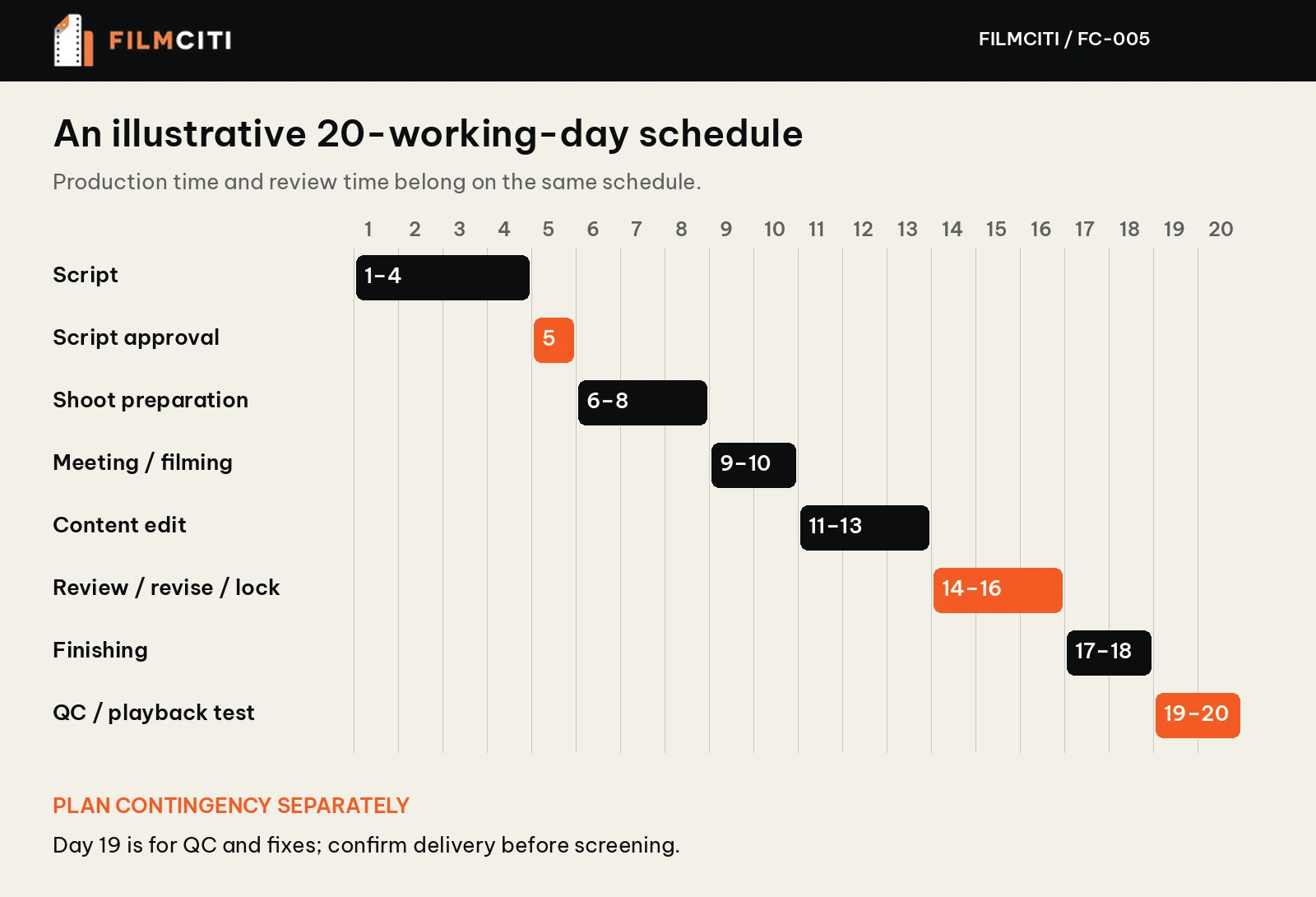
Now suppose the director's interview moves from day 10 to day 13. The crew can still film factory activities as planned, select footage and prepare graphics. But if the interview leads the story, the editor will not have all the material expected on day 11.
Both sides have three options to consider: find another time or place to keep the interview on schedule; change the storytelling approach if it still meets the objective; or agree new approval and delivery dates. Each option needs to be considered alongside the work that can happen beforehand and the remaining crew availability. A three-day delay to filming alone does not establish a three-day delay to delivery.
The schedule helps identify the decision that needs attention now. Here, that means understanding the interview's role in the story before rearranging individual days.
To shorten the schedule, decide what can change
With the screening or broadcast date fixed, what can be reduced or changed while preserving the film's purpose? Each option should make its consequences clear enough for the business to weigh them up.
| Adjustment | Useful when | What needs accepting |
|---|---|---|
| Reduce locations or participants | The omitted material is not essential to the film's evidence or message | Fewer perspectives and potentially less sense of scale |
| Use existing footage | Quality, currency and usage rights have been checked | Less control over angles, style and shot content |
| Deliver the main version first | Only the main version is needed for the first screening | Other channels or languages must wait |
| Add crew | Work can be divided, materials are ready and someone can coordinate | Additional cost and more consistency checks |
| Bring reviewers together to decide | The business can arrange a shared review with decision-makers | Reviewers must keep the appointment; revision rounds need agreeing in advance |
Graphics can be simplified if a simpler treatment still communicates the point. Spending time on decoration while cutting the time available to check figures leaves a risk in the published film. Return to the film's purpose when deciding what deserves protection.
The crew should explain a shorter schedule in practical terms: what is being reduced, what can run in parallel, whether more people are needed and whether costs change. An earlier delivery date becomes credible when the way production is organised changes with it.
The Epic Split shows Jean-Claude Van Damme performing a split between two reversing trucks. In a Volvo Group interview, driver Mikael Rosell recalls several days of rehearsal before a single take with Van Damme at sunrise.
Those days describe rehearsals, not the entire production. They show how a brief shot can have a long stretch of preparation behind it.
For a corporate film, the lesson is to choose where to shorten the schedule: fewer locations, less waiting or a simpler treatment. If a technical demonstration stays in the film, protect the time to test and prepare it; a short shot alone is no basis for cutting its preparation.
Driver interview — Volvo Group · Volvo Trucks' 2013 release · Watch the official video
Before signing off, look at the conditions behind the dates
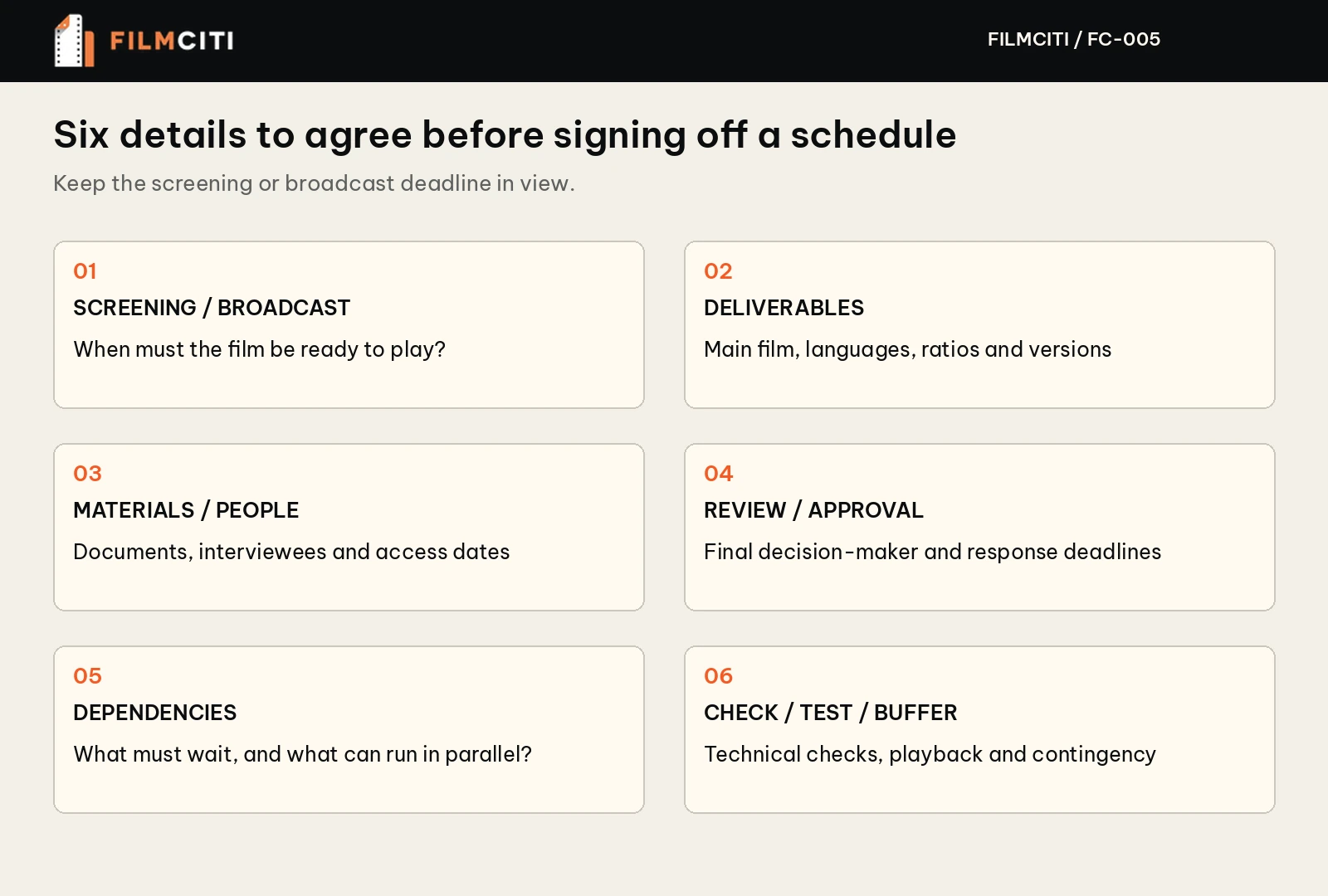
Before presenting the schedule to your manager or confirming it with the producer, read it through with these questions:
- Does it list the main film, languages, aspect ratios and every required version?
- Where does the timeline start and end, and does it use working or calendar days?
- When must materials, figures, participants and locations be ready?
- Who gives final approval, who consolidates comments and when is feedback due?
- How many revision rounds are included at each stage, and what is reviewed then?
- Which tasks must wait, and which can run in parallel?
- Is there time for technical checks, playback testing and contingency?
- If materials arrive late or requirements change, who explains the impact and agrees a revised schedule?
A very short schedule that leaves out review time deserves another conversation. When adding versions, the producer should also explain the extra work and its effect on delivery.
If you need to report to your manager while a few details remain open, send them alongside the expected delivery date: an interview awaiting confirmation, for example, or a script that needs approval by a particular point. The decision-maker can then see where support is needed, rather than receiving a date and waiting until the deadline approaches.
Read more about how Filmciti works and commissioning your first corporate film before the production discussion.
Related service: Corporate film production
FAQ
If filming takes one day, when will the film be ready?
One shoot day does not establish a delivery date. Allow for preparation before filming, editing and finishing afterwards, and the business's review, feedback and approval milestones.
Does the 20-day example use working days or calendar days?
It uses 20 working days: four weeks with five working days per week and no public holidays. The actual schedule also needs contingency suited to filming arrangements and review availability.
What should be shortened first to meet a broadcast deadline?
First look for waiting time that can be reduced: confirming participants, consolidating feedback and arranging approvals. If more time is needed, consider fewer locations or delivering the main version first, while protecting fact-checking and playback tests.