




Where do you start with a year-end review film? 5 tasks for the first week
On the first Monday of November, you get a message from your manager: "You're in charge of the year-end film this year." The gala is only about six weeks away, you have never made a film, and the first thing you think of is finding an idea. However, when you start a year-end review film, the idea is not the most urgent task. What decides whether the film is ready on time is the rehearsal date, the approver, the footage and the schedules of the people appearing on screen, and all four are pieces of information you need to gather yourself. This article arranges them into five tasks, in the order you should tackle them over your first five working days.
In this article
- Confirm the rehearsal date and the screen first; every other milestone is counted back from there
- Find out who gives final approval and what they want the audience to take away
- Check the footage against the list of achievements, not against its size
- The people appearing on screen are busiest at year-end, so book them this week
- Turn the results of these four tasks into a one-page brief before contacting a production company
- 300 GB of footage can still be missing the one image of the year's biggest achievement
- Checklist at the end of kick-off week
- Further reading
Start with the overview: Writing a corporate video brief when the initial request is a single sentence
Confirm the rehearsal date and the screen first; every other milestone is counted back from there
The gala date is the only fixed milestone, but the film has to be finished earlier than that, because there is a rehearsal at the venue beforehand. The event production company needs the file in advance to build it into the programme and to check sound and colour on the actual screen. The milestone you should count back from is therefore the rehearsal date, not the night of the show.
The screen determines how the film is edited from the very beginning. A stage LED wall often has a different aspect ratio from a TV, and some venues use a long horizontal screen at 32:9. If a 16:9 image is placed in the middle, both sides of the screen are left empty; to fill it, the crew has to lay out graphics and text for that exact ratio. When the screen specifications arrive late, the graphics usually have to be redone.
In your first week, ask the event organiser three things: the size and aspect ratio of the screen, the file format they accept, and the rehearsal date. From the rehearsal date, count back to set the final delivery date, then count back again to arrange the review rounds.
Find out who gives final approval and what they want the audience to take away
A year-end film usually receives feedback from many sides: the board, department heads, the trade union and HR. If it is unclear who has the final say, each round of feedback pulls the film in a different direction, and the edit gets revised back and forth between opinions.
The final approver is usually the CEO, and what they want sometimes differs from what your department expects. For the same year of revenue growth, a film whose message is "thank you, everyone" and one whose message is "next year we accelerate" will choose very different shots, music and storytellers. The concept can only be written once this goal is clear.
Ask for a conversation of about 15 minutes with the final approver and put three questions to them: who is in the audience (all staff, or families and partners too); how they want the audience to feel after watching; and which achievements must be mentioned. After the conversation, write down the answers and send a message for the approver to confirm. That message becomes your reference point when later feedback pulls the film away from its original goal. If the final approver cannot make time for a meeting, send these three questions by email and ask for answers by a specific date, so the concept schedule does not stall while you wait.
Check the footage against the list of achievements, not against its size
A year's worth of footage is usually scattered across many places: department Zalo groups, the fanpage, or the phone of whoever usually photographs events. Photos and videos sent through Zalo are usually compressed unless the sender chose to send the original file; livestream videos are usually vertical, and event photos are mostly group shots. On a big screen, this material easily breaks up, or it exists but does not show any real work.
That is why a hard drive holding several hundred gigabytes may still not contain a single usable shot of the biggest achievement of the year. Size only tells you there are many files, not that they include the images the film actually needs.
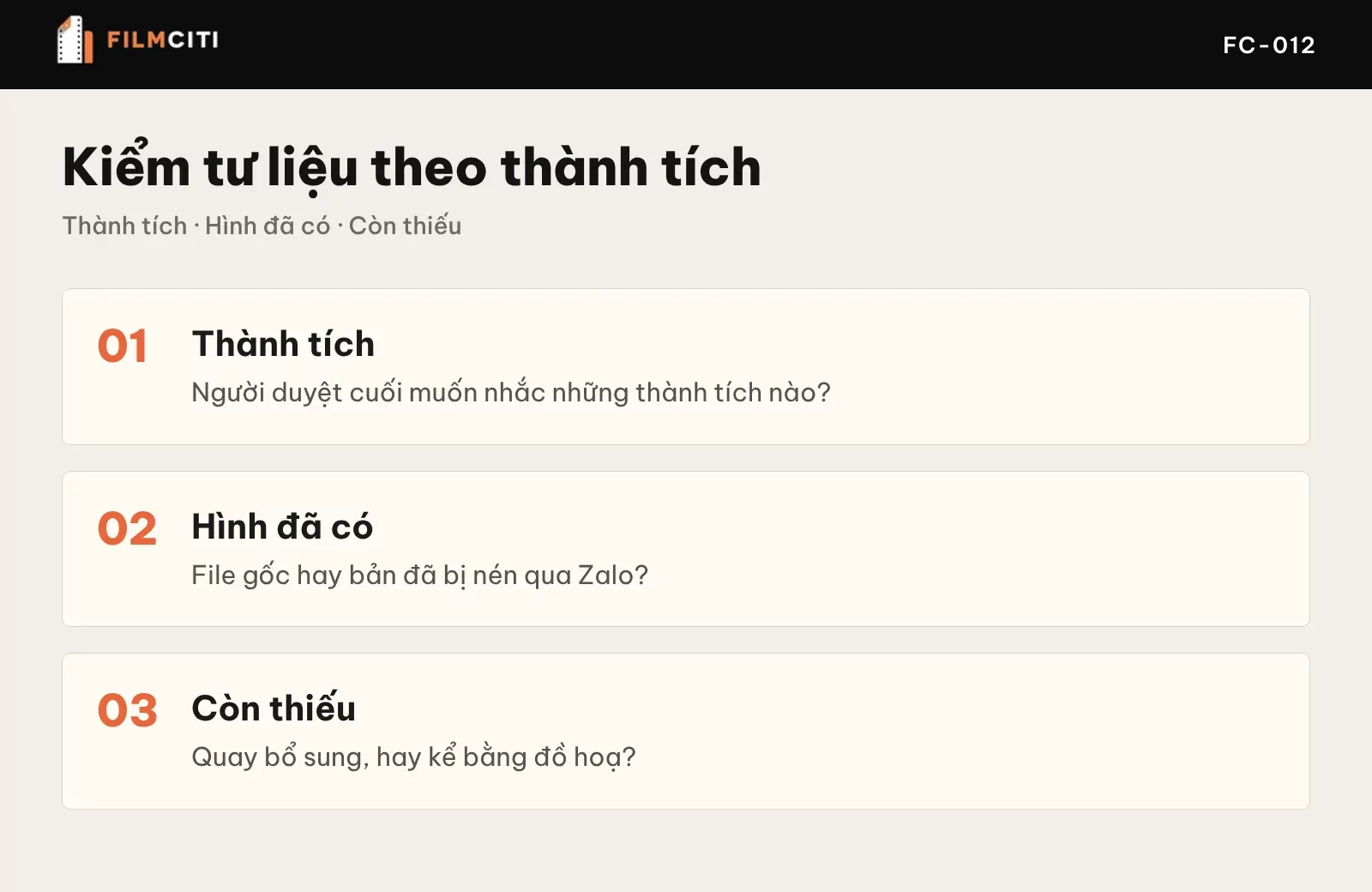
Make a small table listing each achievement the approver wants to mention, the images already available, whether each file is an original or has passed through Zalo, and what is still missing. For any achievement without usable images, mark it for an extra shoot or for graphics. Graphics do not need a shooting day, but they usually carry less emotion than real people at work. For example, if the biggest achievement is a newly opened factory, check whether you have shots of the line running and of workers at their stations, or only photos of the ribbon cutting. This table is also what the production company uses to estimate extra shooting sessions, so send it with your request for a quote instead of just a link to the whole footage archive.
The people appearing on screen are busiest at year-end, so book them this week
December is when the management meets partners, the sales team pushes to hit targets and accounting enters the year-end closing period. Although an interview may last only 30 minutes, the crew needs to arrive early to set up lights, position the camera and test the sound. The person on screen often has only one free slot, and that slot dictates the schedule for the entire shooting day.
If the film includes interviews with the director and three outstanding employees, schedule them on the same day at the same location so the crew does not have to set up lights several times. To make that possible, you need to ask about their availability early, before their year-end calendars fill up.
When you send the invitation, state the exact time slot, how long it will take, suitable clothing and the topic of conversation. Each person appearing on screen should have a backup. You should also ask whether they agree to their image being used in the film, including if the film is shown again or posted on social media after the gala.
Turn the results of these four tasks into a one-page brief before contacting a production company
By the end of the week, you will have enough information for a production company to give a realistic quote and schedule: the rehearsal date, the screen specifications, the audience, the message the approver wants to convey, the required achievements, the footage you have and what is missing, the people appearing on screen and their schedules, a budget range, and the single point of contact for feedback. One page is enough, as long as every line is confirmed information. To put down a budget range with some basis, you can refer to Filmciti's pricing page: all-inclusive production packages start from VND 70 million (excluding VAT) for 1 shooting session, and packages with an extra backup session start from VND 200 million. This is only a reference point, because the cost of a year-end film also depends on how much footage needs processing and how many people need to be interviewed. The table below suggests how to spread the 5 tasks over your first 5 working days.
| Day | Task | Who to ask | Result needed |
|---|---|---|---|
| Monday | Ask for the rehearsal date and screen specifications | Event organiser | Rehearsal date, aspect ratio, file format |
| Tuesday | Talk to the final approver | CEO | 3 answers confirmed by message |
| Wednesday | Gather and check the footage | Departments, IT team | Achievement table with images available and missing |
| Thursday | Book the people appearing on screen | Each person and their department head | List of people on screen and their backups |
| Friday | Write and send the brief | Production company | One-page brief |
If any information is still missing, write "not yet available" with the date you expect it, so the crew knows which parts of the production schedule still depend on it.
300 GB of footage can still be missing the one image of the year's biggest achievement
The year-end gala of a logistics company in Hưng Yên is set for 27 December 2025. On 10 November 2025, Ngân, a marketing executive who joined the company eight months earlier, is given the year-end film. The company's biggest achievement of the year is the new cold store opened in June.
Ngân asks the IT guy to gather the footage. Two days later he hands her a hard drive: "300 GB, the whole year's in there." That week Ngân is also running the year-end customer appreciation programme, so as soon as she gets the drive she sends it to the crew along with the brief. The concept is approved in just one day.
In week four, the editor opens the drive to start cutting and finds more than 4,000 photos of birthday parties and team building, plus vertical livestream videos downloaded from the fanpage. The opening of the cold store has exactly six photos taken at the ribbon cutting, mostly of the guests' backs. There is not a single shot from inside the store.
Ngân messages the crew: "Let's just do one extra shoot inside the store, it'll be quick."
That shoot is anything but quick. At year-end the store is moving Tết goods day and night, so filming requires a slot from the operations manager and is only allowed when there are few vehicles. The store is kept at minus 18 degrees, camera batteries drain fast, and every time the camera is taken outside the lens fogs up, forcing the crew to wait for it to adjust before carrying on; the people on screen also need protective jackets. The earliest free slot is the morning of Saturday 13 December, which squeezes all the editing and reviewing into the 11 days before the rehearsal on 24 December.
On the company side, the IT guy gathered everything the company had, and Ngân believed 300 GB was plenty; all that was missing was opening the drive once and checking it against the list of achievements. The production crew was a step behind too: on the day it received the drive, it did not open a sample and check it against the list of achievements, and only found the gap once the edit began.
What Ngân and the crew needed to ask each other on the day the drive was handed over was: "Which achievements absolutely must be in the film, and what usable images do we have for each one?"
The story above is a hypothetical scenario, reconstructed from situations that commonly happen in corporate filmmaking.
With the Filmciti crew, we open the footage drive on the day we receive it, view samples and check them against the list of achievements before writing the concept. For any achievement without usable images, our producer contacts the operations manager early to request a filming slot, and checks the access route, the temperature and a place in the buffer zone where the camera can adjust before the shoot.

Checklist at the end of kick-off week
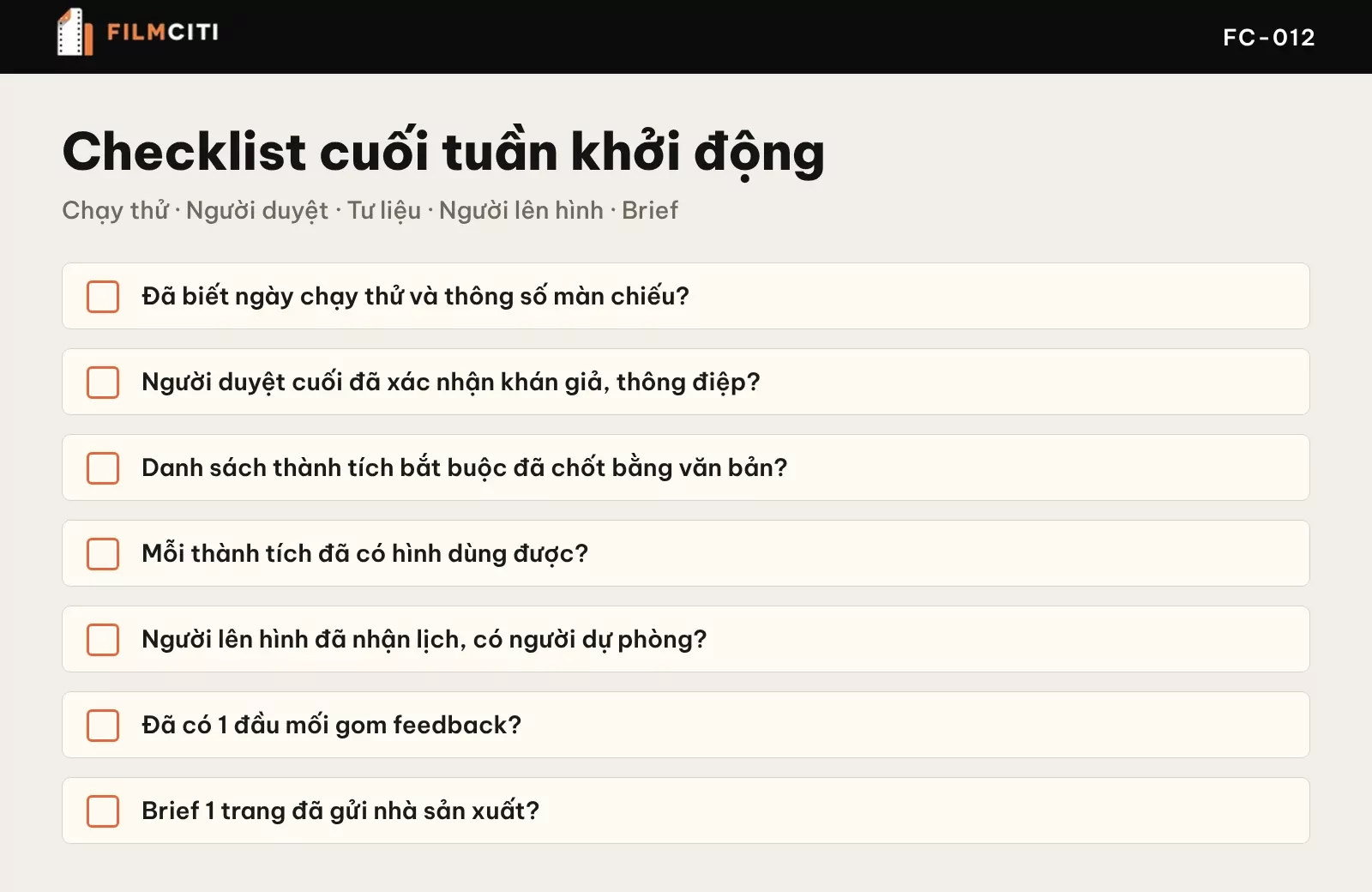
- Do you know the rehearsal date and the screen specifications?
- Has the final approver confirmed the audience and the message they want to convey?
- Has the list of required achievements been confirmed by message or email?
- Does each achievement have usable images, or does it need an extra shoot?
- Have the people appearing on screen accepted a time slot, and does each have a backup?
- Is there a single point of contact who consolidates feedback?
- Has the one-page brief been sent to the production company?
Ask again immediately if, by the end of the week, nobody has given you the rehearsal date, or the list of achievements is still "waiting for the management to add to it". However many days these two pieces of information are late, the production schedule behind them will slip by the same number of days.
Download the Kick-off week plan for a year-end film — Vietnamese template to follow the 5-day schedule, check footage against each achievement and compile a one-page brief for the production company.
Further reading
- Filmciti corporate film production, including year-end review films and year-end event films.
- The production packages Filmciti publishes on its pricing page, to help you estimate a budget range for the brief.
- Year-end review films for businesses: content, footage and production planning
- Making a year-end review film when time is short
Send Filmciti a brief with the gala date, the rehearsal date, the screen specifications and the list of achievements to mention. A Filmciti producer will draw up a countdown schedule from the rehearsal date for your film.
Related service: Corporate film production
FAQ
The film can still be ready, provided that in the first week you lock down the rehearsal date, the approver and the footage. The part most likely to run late is usually not the shooting day but the time spent waiting for approvals and for the schedules of the people on screen.
Yes, you can. State the budget range the company can spend, or say clearly that there is none yet; the production company can then propose options at a few levels for you to present to the management for approval, which often speeds up the budget decision itself.
Usually, a year-end film should combine both. Existing footage keeps the real moments of the year, while new shots are used for interviews and for achievements that have no good images. The balance between the two depends on what your footage check turns up.