




An urgent year-end film with 6 weeks to the gala: how do you build a schedule that works?
With 6 weeks to the gala, the footage folder is full, but the year-end figures and the leadership's speech are still not final. Making an urgent year-end film in this situation does not start with counting days; it starts with separating what can begin right away from what is holding the whole story back.

In this article
- Week 1: check the footage archive before promising a deadline
- Plan backwards from the playback test, not from the gala date
- When one input is late, narrow the scope on purpose instead of pushing everything into post-production
- Before confirming the schedule, every pending item needs someone to resolve it
6 weeks is the timeframe of the story in this article, not a production standard. A workable schedule depends on the quality of the footage, what needs additional filming, the storytelling approach and how quickly the company can respond to each version.
Week 1: check the footage archive before promising a deadline
A folder full of files does not mean there is enough usable material. The crew needs to know which event each photo belongs to, whether the videos have original files, who the people are and which information is cleared for publication.
Sort the inputs into 3 groups: usable, needs checking and missing. If the figures are not available yet but the story is clear, the crew can still prepare a script outline and edit the sequences that do not depend on the figures. If the leadership is still changing the theme, editing everything in advance can mean taking the edit apart and starting again.
| Input | Start now | Confirmation needed from |
|---|---|---|
| Event archives | Check quality, dates, original files and content | Material owner |
| Figures, names and titles | Mark the status of each fact and ask when the official version will be available | Department owning the information |
| Missing scene or statement | Decide whether to film or change the approach | Content approver and crew |
| Screen specifications | Request the aspect ratio, file format and sound system | Event organiser |
This table is the basis for answering how long the year-end film will take. The crew is responsible for checking the footage early and stating clearly any limits on its use; the company needs to name who can resolve each pending item.
With 6 weeks to the gala, Mr Quang, Ms Hà's director, made the call: “This year let's make a really grand year-end film. The company has a whole archive of footage.” The crew received a 300 GB folder named “Year-end 2026”.
When they opened the folder, the crew found mostly team-building photos at the beach, a few dozen vertical birthday-greeting videos and exactly 1 clip of the groundbreaking ceremony for the new factory. The clip was 40 seconds long, but halfway through, the person filming answered the phone: “Hello, I'm at the groundbreaking ceremony, I'll call you back.”
For the first 4 weeks, the crew put everything into sorting the 300 GB and scheduling make-up shoots, and the script was written around the growth figures that the finance department had promised to send “after the books are closed”. Finance was busy with year-end settlement, and everyone assumed “closing the books” would happen before the gala, so nobody asked for a date. Only in week 5 did it come out: the books close on 30/12, and the gala is on 27/12.
Watching the edit, Mr Quang nodded and added: “We're missing Mr Tư from the warehouse, he's been with us 20 years. Put him in the ending, it's just a small change.” At that moment, Mr Tư was on leave back in his home town for a wedding.
The “small change” meant: scheduling a new shoot, changing an ending already cut to the music and rewriting the narration that relied on figures nobody had yet. On the night before the gala, the event company added one more message: the stage LED screen was 32:9, so a 16:9 film would fill only the middle of it and look like a postage stamp.
The company handed over “the whole archive” without anyone sorting it, and scheduled the figures by the accounting calendar rather than the gala calendar. For its part, the crew should have checked the footage archive in week 1, asked for the date of the official figures, and requested the list of people who must appear and the screen specifications before writing the script.
The question that should have been asked at the start: “On which date must the film be tested on the actual event screen, and before that date, what will definitely not be available?”
The story above is a hypothetical situation, reconstructed from things that often happen in corporate filmmaking.
Plan backwards from the playback test, not from the gala date
A year-end film schedule needs a delivery deadline for testing at the event, not just the date the crew exports the file. A wrong aspect ratio, sound levels that do not suit the speaker system or subtitles that are too small must all be caught before the screening, while there is still time to fix them.
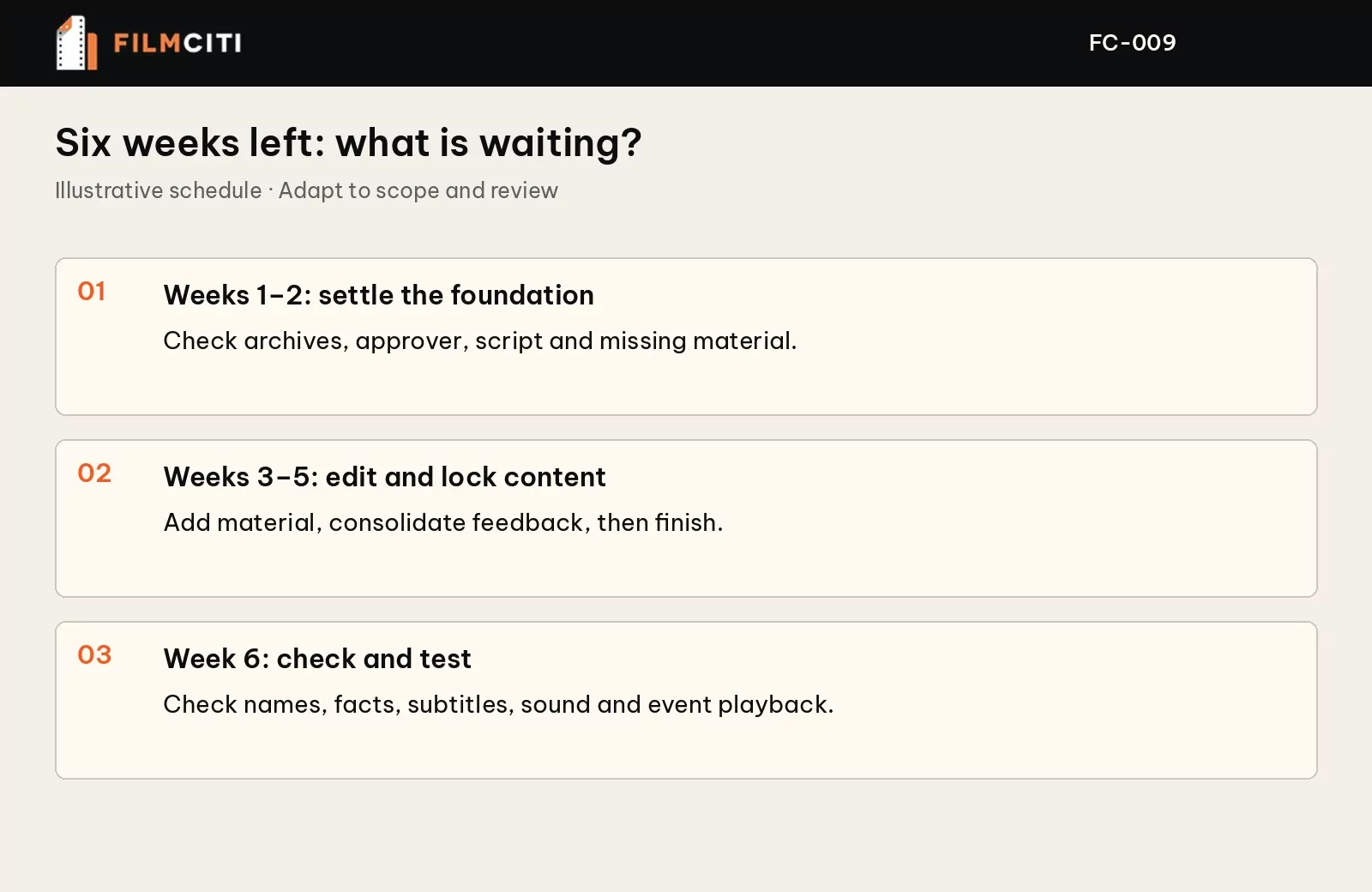
For the 6-week situation, the work can be divided as in the table below and then adjusted to the real conditions. The weekly milestones show the order of dependencies; both sides still need to agree response dates for each version and which tasks can run in parallel.
| Illustrative phase | Condition for proceeding |
|---|---|
| Week 1 | Choose the message, check the archive, confirm the approver and the screen specifications |
| Week 2 | Approve the script, the list of people on camera and the additional scenes to film |
| Weeks 3–4 | Add material, assemble the content edit, consolidate feedback |
| Week 5 | Lock content before finishing images, sound and text |
| Week 6 | Check facts, subtitles and technical settings; test on the event screen |
When one input is late, narrow the scope on purpose instead of pushing everything into post-production
Suppose that in week 4, one unit's figures are still not confirmed. If a whole sequence of the film is written around those figures, waiting until the end to replace them affects the narration, the graphics and the editing rhythm.
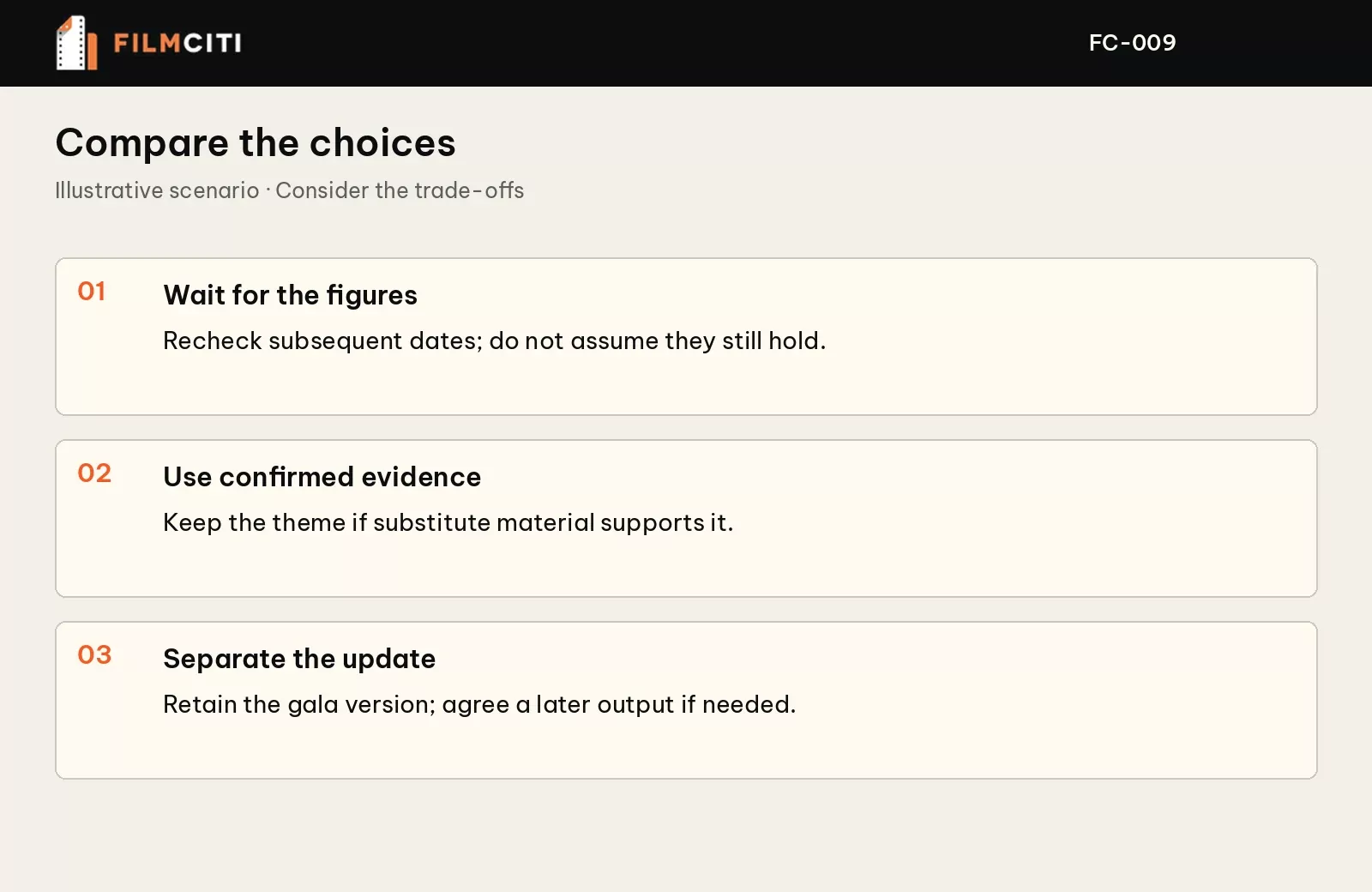
There are 3 directions to discuss: wait for the figures and move the later milestones back; keep the theme but switch to evidence that is already confirmed; or take that update out of the film shown at the gala. Each direction gives up part of the value, so the person with approval authority needs to choose together with the crew instead of simply asking them to “just edit it first”.
A good reduced plan keeps the main message and the strongest material. Dropping a non-essential filming location can be reasonable; dropping the time for checking names, job titles, usage rights for footage and the playback test lets errors go straight onto the screen.
Before confirming the schedule, every pending item needs someone to resolve it
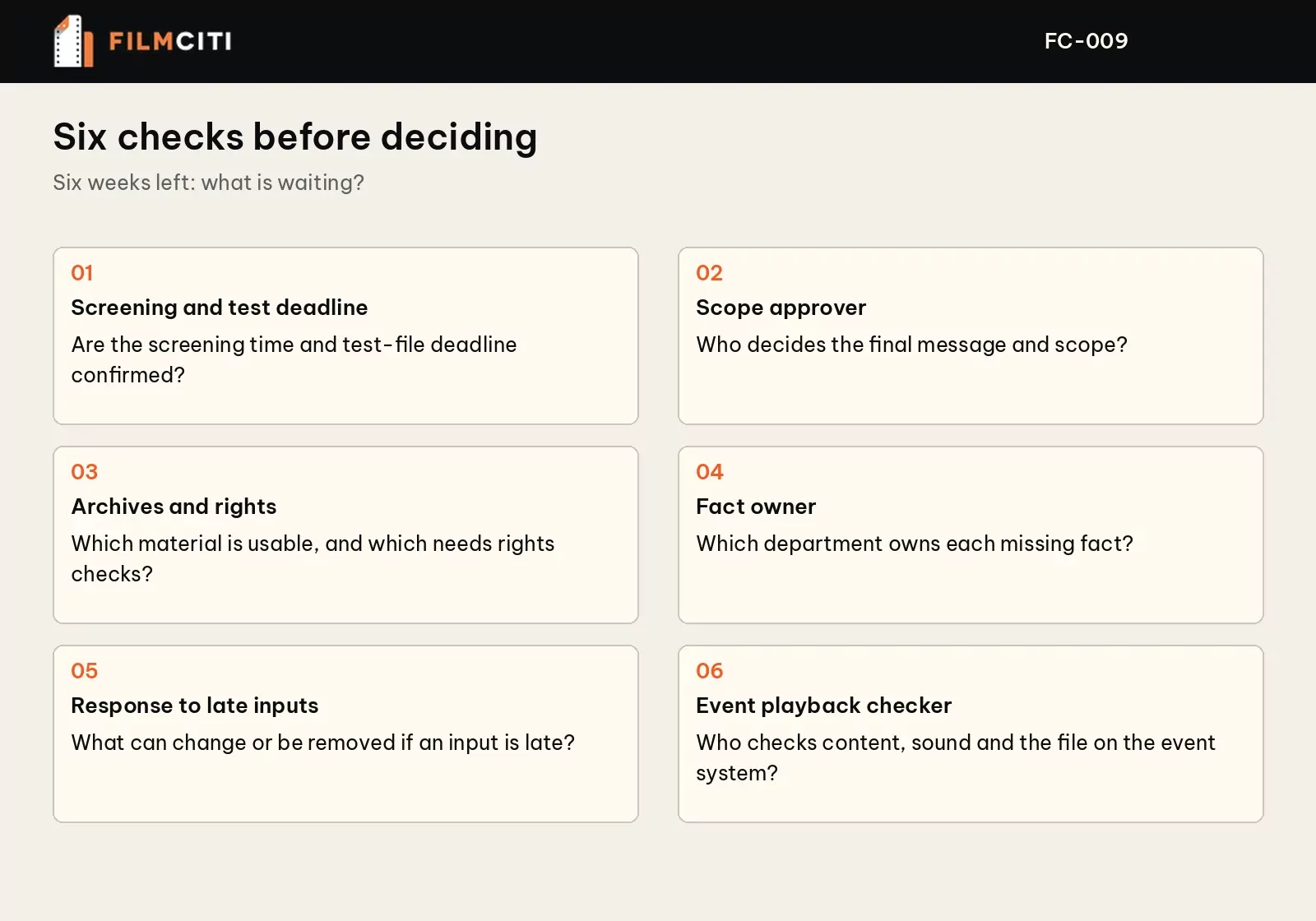
Before agreeing to the schedule, check the 6 questions below. The crew needs to flag early anything that could affect the screening version; the company's coordinator needs a fast way to get decisions, instead of just forwarding several streams of feedback.
- Have the screening time and the deadline for the test file been confirmed?
- Who decides the final message and scope?
- Which footage is usable, and which needs its usage rights checked?
- Which department is responsible for each missing figure, and on what date will the official version be available?
- Which people must appear, and will they be available on the shoot day?
- What is the screen's aspect ratio, and who checks the content, the sound and the file on the event equipment?
Download the 6-week pre-gala countdown — Vietnamese template to record who is responsible for each input. In Filmciti's collaboration process, feedback is consolidated through 1 contact; for a project close to its screening date, this principle lets the crew know exactly which version to revise. See also how to plan a company year-end film.
Need to settle a schedule close to the gala? Send Filmciti a brief with the screening date, the screen specifications, your footage archive and the inputs still pending, so both sides can agree on how to deliver.
Related service: Corporate film production
FAQ
Is using only existing footage faster than filming new scenes?
It can be, if the footage is of sufficient quality, has usage rights and serves the story. Files with unclear sources or missing key scenes still need to be checked, replaced or supplemented with new filming before the schedule is confirmed.
To shorten the schedule, what should be cut first?
Look for parts that affect the main message little but create a lot of new work, such as a filming location or a complex graphics sequence. The crew needs to explain clearly what is lost when that part is dropped; the time for checking facts and technical settings stays.
Should the screening version be delivered on the day of the gala?
No. Agree a delivery deadline earlier than the screening time so there is time to test and deal with problems. The exact interval depends on the event's system and the scope of work, and should be written into a schedule that both sides confirm.