

6 ways to open a company introduction video, based on what viewers need
Many company introduction videos open in the same order: the logo appears, the music swells, a drone shot flies over the building, and then a company leader says hello. There is nothing wrong with this order, but it answers the question "who are we", while viewers usually click on the film with a different question, such as "can this company do what I need". No opening guarantees that viewers will stay to the end, but a company introduction video should open with what viewers need to know, using one of 6 approaches: the customer's problem, a verified result, a signature process, a customer's account, a person on shift, or before and after. This article helps you match each approach to a group of viewers and check its conditions before the shoot.
In this article
- The opening needs to answer the question viewers bring with them when they click on the film
- 6 ways to open, each serving a group of viewers
- Every opening comes with a condition that needs checking at the script stage
- The logo and greeting still have a place, but after viewers have a reason to stay
- Even the strongest opening may have to be replaced for lack of one consent form
- Checklist before agreeing on the opening
- Further reading
Start with the overview: First corporate film: 5 decisions before choosing a production company
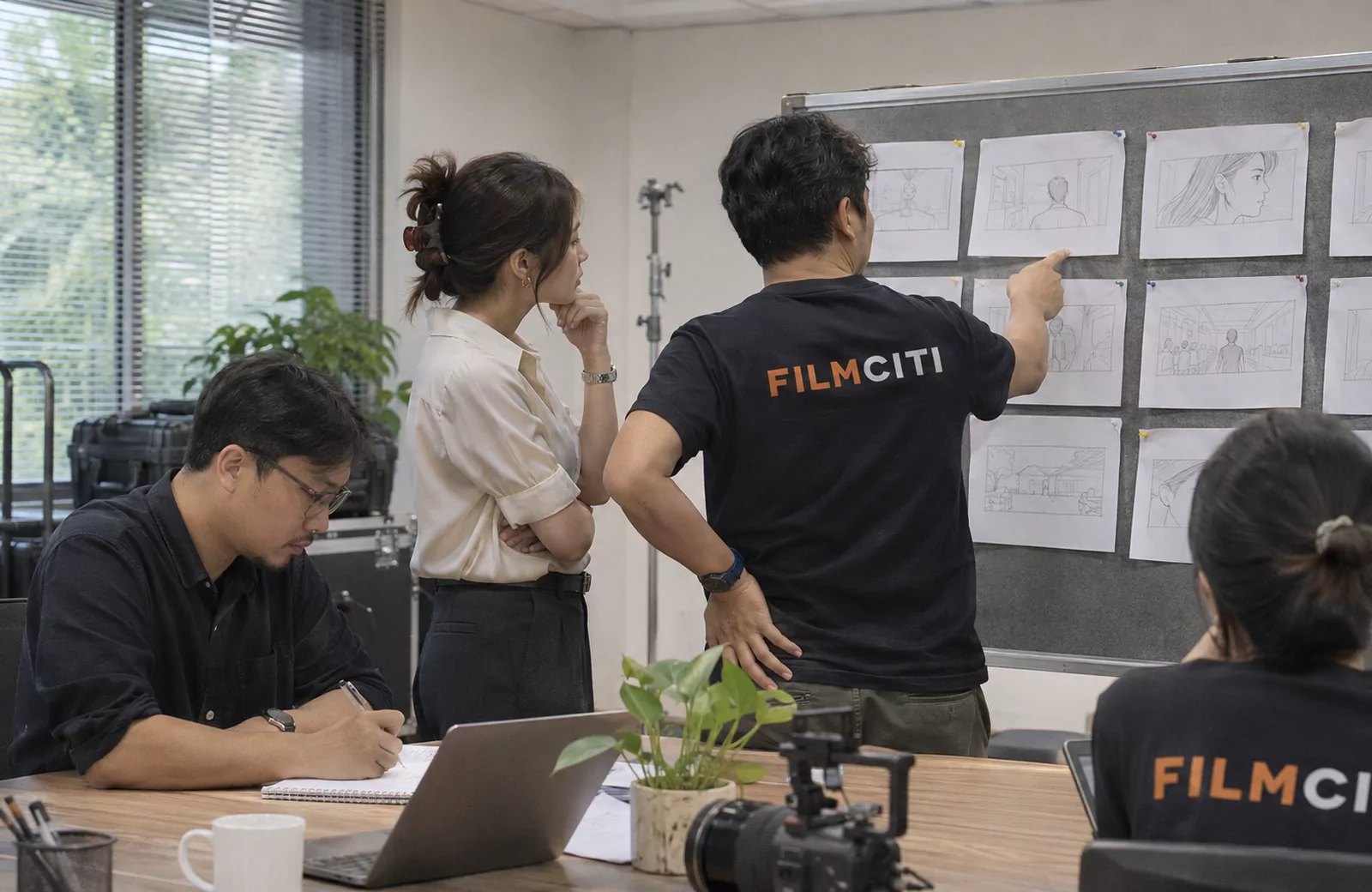
Illustration.
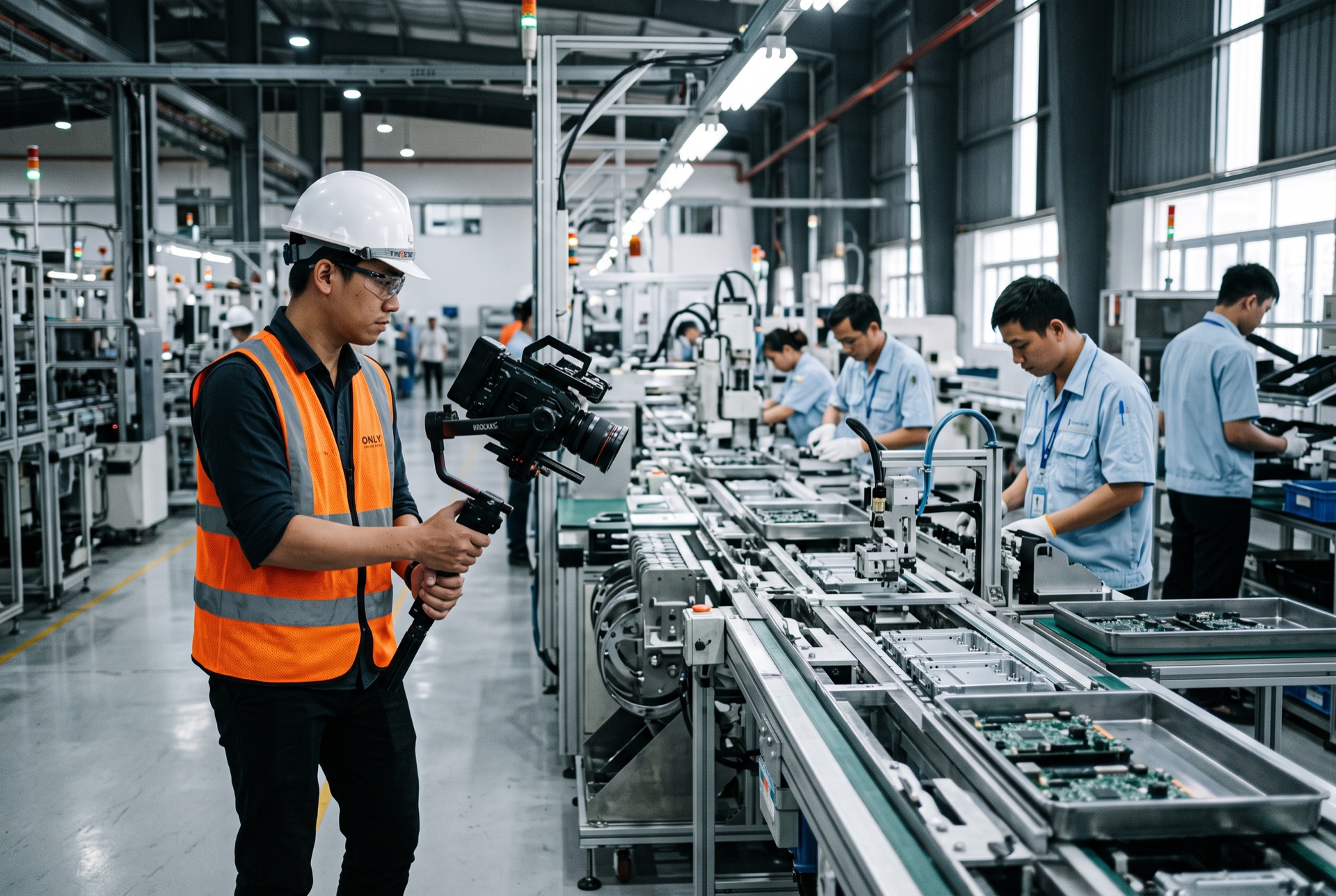
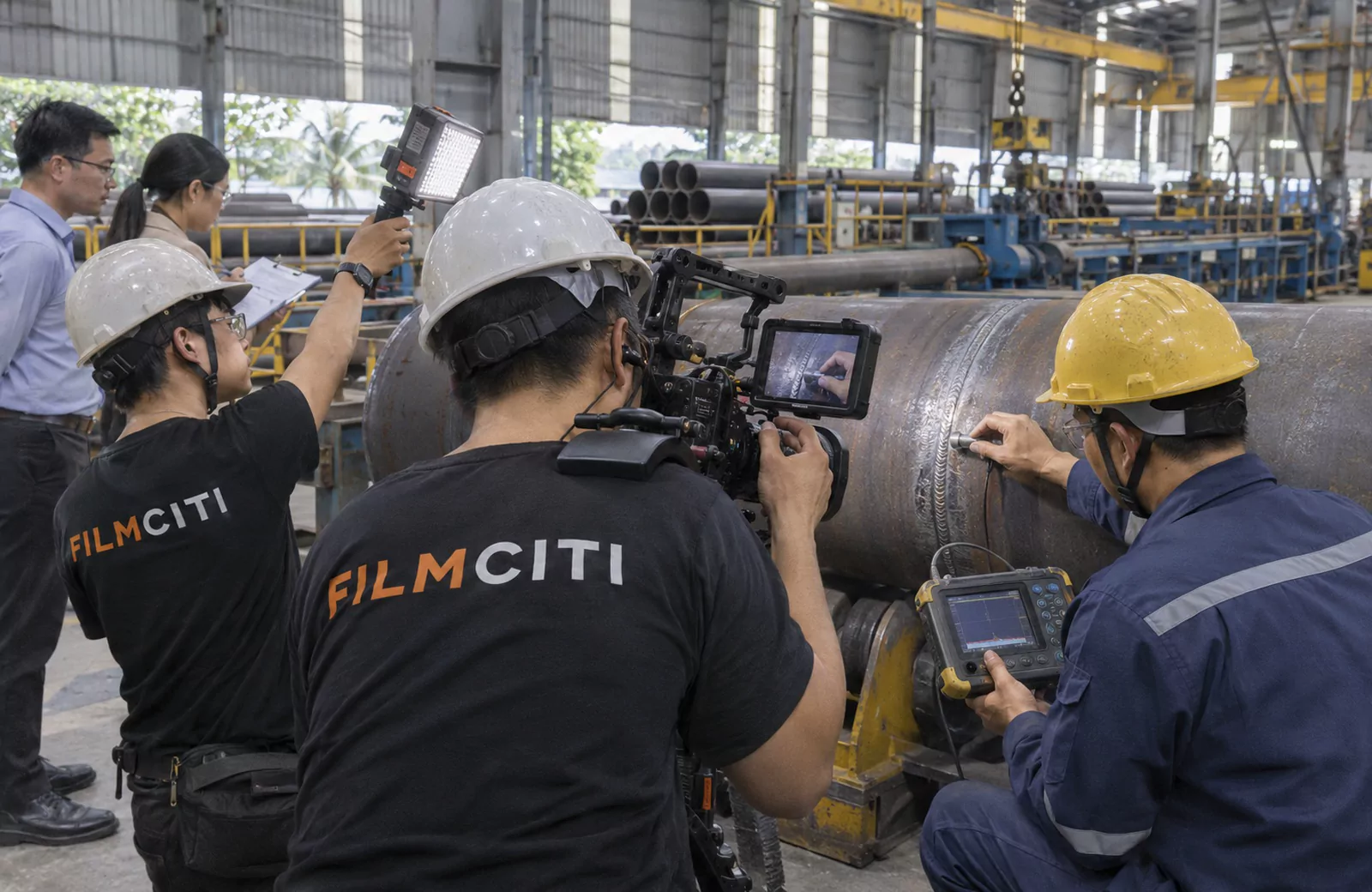
The crew films a close-up of a signature process on the production line to use as the film's opening shot.
The opening needs to answer the question viewers bring with them when they click on the film
A company introduction video is rarely watched by chance. Viewers come across it on the website while looking for a supplier, receive the link in an email from the sales team, stand in front of a screen at a trade-fair booth, or watch it with colleagues in a meeting to choose a partner. Each setting comes with its own question, and viewers already know the company's name before the film starts.
So the logo and greeting in the first few seconds usually add no new information. A potential customer wants to know whether the company understands their problem. An overseas partner wants to see scale and standards. A job candidate wants to picture the working environment. The opening should give an immediate signal in answer to that question.
Before choosing an opening, write down 2 lines: who the film's main viewers are, and what they are asking themselves when they click on it. If the film has to serve several groups of viewers, choose the group with the greatest business value for the main version, then make separate openings for the short cut-downs.
6 ways to open, each serving a group of viewers
Each of the 6 openings for a company introduction video below can sit within roughly the first 10–20 seconds of a 2–3 minute film. What matters is choosing the right opening for the right viewers, not using several at once.
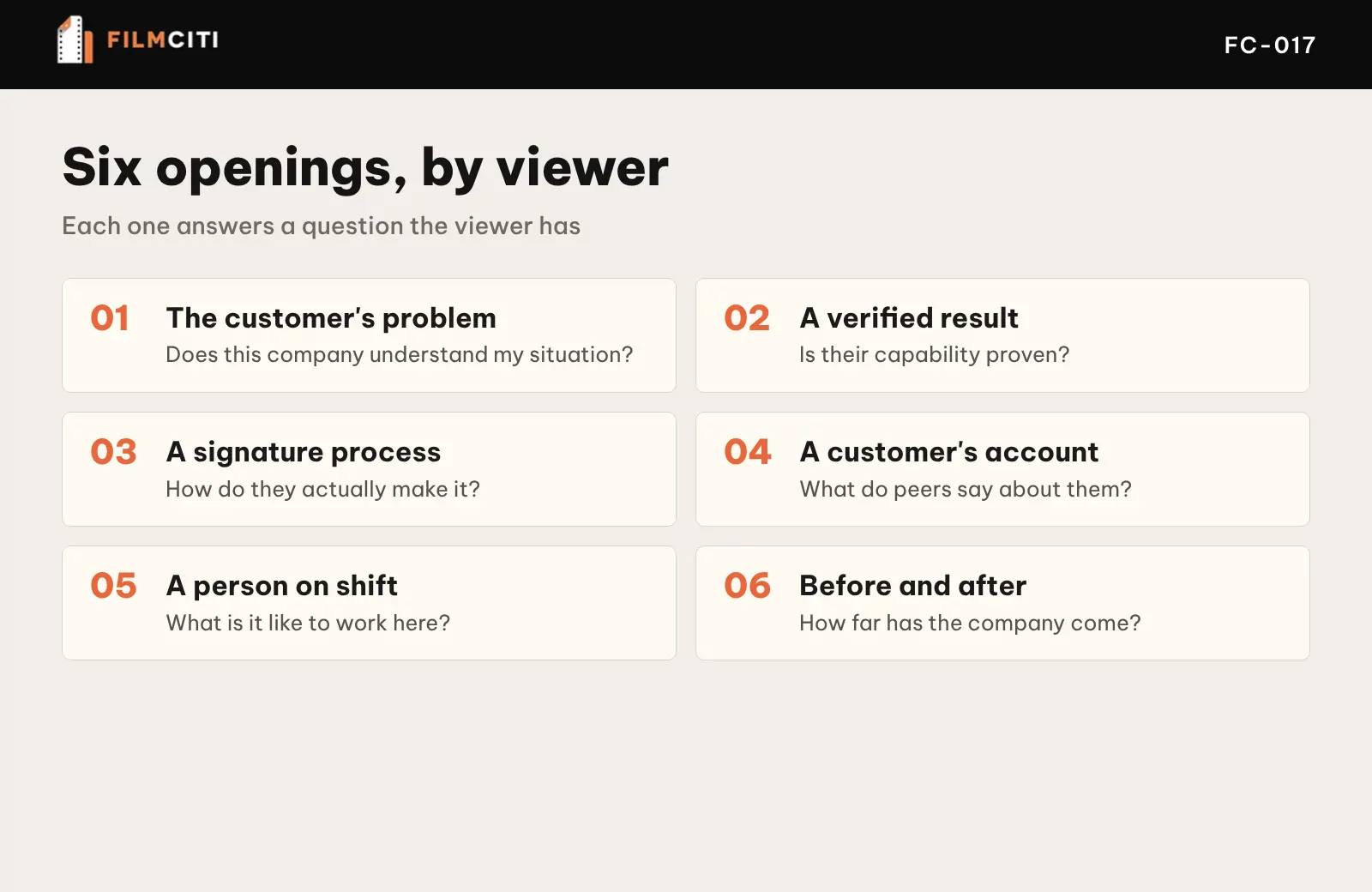
The table below compares the 6 openings by the viewers they suit, an example opening shot or line, and the condition each one requires.
| Opening | Suits these viewers | Example shot or opening line | Conditions for use |
|---|---|---|---|
| 1. The customer's problem | Potential customers who find the film on the website | "An export shipment held at the port just because the secondary label had the wrong specifications." | The problem must be real and true for the target customer group |
| 2. A verified result | Partners and investors who need to see capability | Text stating a certification or a confirmed delivery figure, with footage of a shipment | The figure has a source, is cleared for publication and is still true when the film runs |
| 3. A signature process | Factory visitors, trade-fair booths playing without sound | Close-up of a weld being checked ultrasonically, no voice-over needed | The process can be filmed without revealing trade secrets |
| 4. A customer's account | Customers in the same industry considering a first trial | An investor describes their first time working with the company | Written consent to use their image and words |
| 5. A person on shift | Candidates, new employees, the local community | A female technician starts the morning shift, checking the machine before it runs | The person is natural on camera and agrees to appear |
| 6. Before and after | Guests at an anniversary, long-standing partners | A photo of an empty plot in 2012 turning into a wide shot of today's factory | Old footage good enough to show on a large screen |
The first two openings suit films used for sales, because they go straight to what customers care about. The third has an advantage at trade fairs and reception areas, where films often play without sound. The remaining three rely on people and time, so they suit recruitment films, anniversary films or films sent to familiar partners.
The twist: a steel company has shot its film using the third opening, starting with a weld inspection. A week before the trade fair, the CEO wants the film to open with his greeting, because the company is celebrating its 20th anniversary this year. There are 3 ways to handle this:
- Keep the welding opening and place the greeting right after it, at around the 20-second mark. The film still starts with what visitors care about, but the reason needs to be explained clearly to the CEO.
- Make 2 versions: the trade-fair version opens with the welding process, the anniversary version opens with the greeting. Each version suits its setting, but the business spends extra time editing and approving one more version.
- Open every version with the greeting. This is the fastest option and pleases the approver, but at a trade-fair booth playing without sound, the first seconds will show only a person talking.
Every opening comes with a condition that needs checking at the script stage
An opening only works when its condition is met, and most conditions have to be checked before the shoot. The figure in the second opening needs to be confirmed by the sales or legal team, because the film may be shown for years while figures change every quarter. The customer's account in the fourth opening needs written consent, stating where and for how long the film will be used. If the speaker works for a large group or a state agency, also ask whether their organisation has its own approval process, because a personal signature may not be enough. These confirmations usually take a few days, so they belong in the schedule as soon as the first draft of the script is approved, not in the final week before the screening.
The opening also determines the shot list. If the script opens with a signature process, the shotlist (the list of shots to film) must include that shot, along with the time when the line is running that exact process. If the opening is only chosen in the edit suite, the editor has to use whatever footage exists, and the opening often falls back on the familiar drone shot. For the fifth opening, the shotlist needs to note when the shift starts and where the camera can stand without getting in the operators' way. For the sixth, the crew needs the old material before the shoot so that today's shot can match the angle of the archive photo, which is what makes the two images flow into each other. When the opening is agreed early, these details sit in the call sheet (the schedule for the shoot day) instead of being solved on set.
Besides that, each opening has its own limits. Opening with the customer's problem helps viewers feel it is relevant to them, but can feel negative if it drags on; the problem should take only a few seconds before the film moves to the solution. Opening with a person builds goodwill, but needs more time for viewers to understand what the company does.
The logo and greeting still have a place, but after viewers have a reason to stay
Removing the logo from the first second does not mean removing the brand from the film. A small logo can sit in the corner of the frame from the start, while the full logo and slogan go at the end, where viewers need to know who to contact. A leader's greeting can move to the middle of the film, when viewers already want to know who is behind what they have just seen.
There are still cases where opening with the logo or a greeting makes sense, such as a film shown at an anniversary ceremony introduced by a host, or a welcome film for a delegation that has booked a visit. In those cases the viewers are already in the room and ready to watch, so the formality suits the setting.
If an old film already has enough good footage, fixing the opening sometimes only means reordering shots. For example, a precision engineering company's film that opens with 5 seconds of logo, 8 seconds of drone footage and the director's greeting can become: a close-up of a milling machine cutting a part, text about a customer's demanding tolerance requirement, and only then the drone shot. Before booking a pick-up shoot, ask the editor to go back through the existing footage. The reason is that shoot days usually account for most of the production cost: according to Filmciti's pricing page, all-inclusive production packages start from VND 70 million (excluding VAT) for 1 shoot day with a director, a producer and a 4K camera. Re-editing just the opening from existing footage mainly takes the editor's time and one round of approval, so it is usually the option to try first.
Even the strongest opening may have to be replaced for lack of one consent form
In mid-September 2025, a structural steel company in Hai Phong needs a new introduction film for a construction exhibition on 15 October 2025. Mr Quân, the sales manager, gives the crew his brief: "The opening has to have a big client talking about us, so partners believe us straight away."
The crew chooses to open with an account from Ms Hạnh, project director at an industrial-park investor. She is a long-standing client and a close friend of the company's director; she agrees over the phone and gives the crew 20 minutes right on the construction site. What she says on camera is completely natural: "The first time we worked together, I only meant to try them on a small package." Everyone in the approval meeting loves this opening.
On 10 October 2025, Ms Hạnh forwards the preview to a few colleagues. That afternoon, with the film already loaded onto the booth's media player, the investor's communications department sends an email: under group policy, staff may not appear in suppliers' promotional materials without written approval, and the approval process takes 3 weeks.
Mr Quân messages the crew: "Just blur her face, or drop the company name. It's a small fix."
But that does not solve the problem. Ms Hạnh's voice is still easy to recognise for people in the industry, the hard hat with the investor's logo appears in several shots, and what she says mentions the industrial park by name. The crew has to re-edit the opening using existing footage of the structural welding process, rewrite 2 voice-over passages leading into her account, and re-export the Vietnamese version and the English-subtitled version. Everything is finished on the evening of 14 October, and the film's strongest opening survives only in the archive.
With a client he has worked with for years, it was normal for Mr Quân to trust a verbal agreement over the phone. The bigger gap lay with the crew, because filmmakers know how tightly large groups control their staff's images. With everyone on such friendly terms, no image-use consent form went out before the shoot, and nobody asked whether the person on camera needed approval from their organisation.
One question raised at the script stage could have saved that opening: "Can the person in the opening agree to appear on their own, or does their organisation need to approve it?"
The story above is a hypothetical situation, reconstructed from things that often happen in corporate filmmaking.
With the Filmciti crew, we send the image-use consent form to everyone appearing on camera as soon as the script is approved, and ask whether their organisation needs to give its own approval. On the same shoot day, we also film extra footage of signature processes, so the edit suite has an alternative opening ready if a client's account cannot be used.

Illustration.
The editor rebuilds the opening from process footage already in the archive.
Checklist before agreeing on the opening
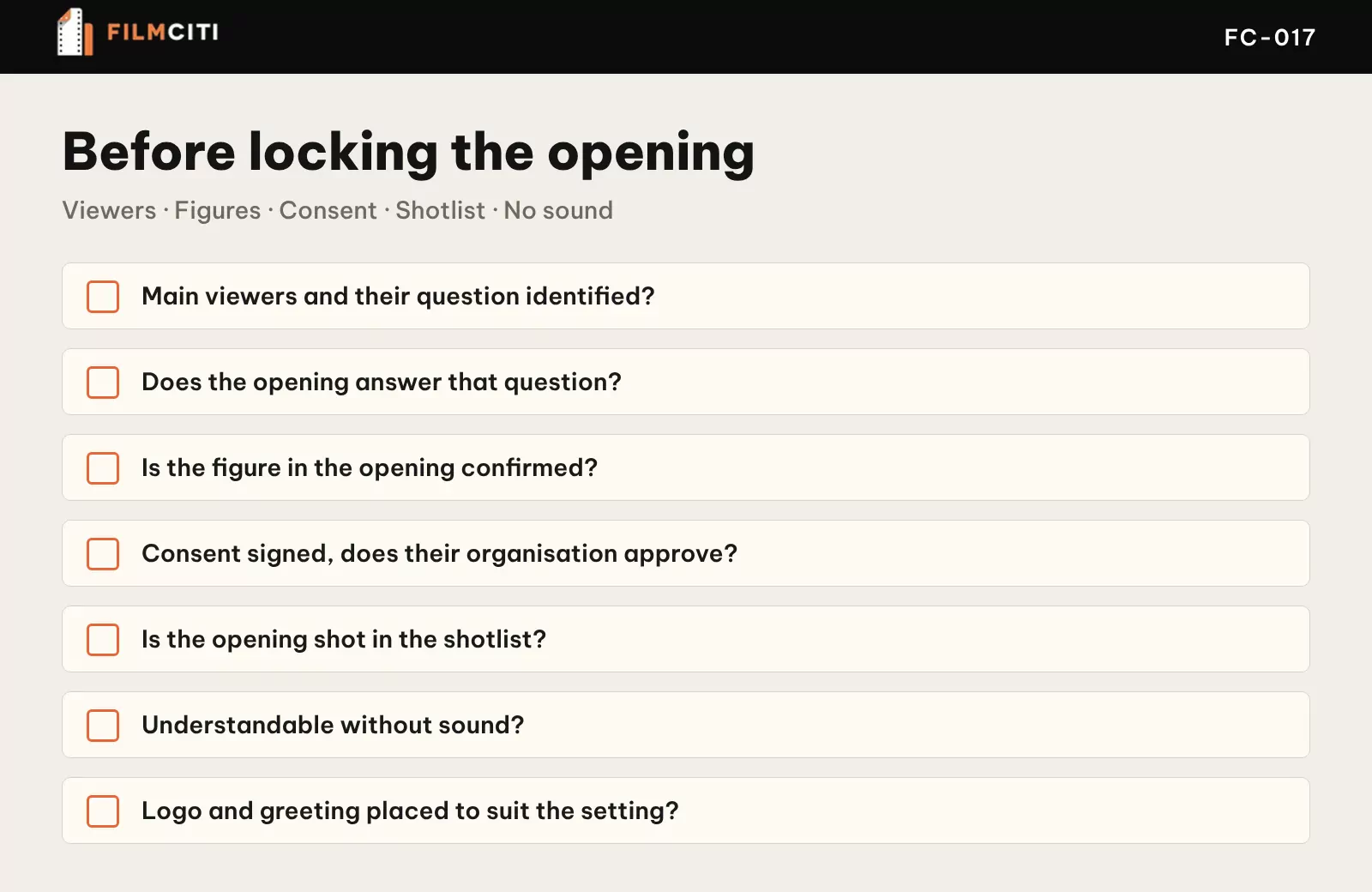
- Have you identified the film's main viewers and the question they bring with them?
- Does the chosen opening answer that question directly?
- Has the figure or result in the opening been confirmed and cleared for publication?
- Has the person in the opening signed a consent form, and does their organisation need to approve it?
- Is the opening shot in the shotlist, with a suitable time to film it?
- Can the opening be understood when the film plays without sound?
- Have the logo and greeting been placed where they suit the screening setting?
Ask again if the script still opens with a logo and greeting even though the film is mainly for sales, or if the opening relies on a person or a figure whose right of use nobody has confirmed.
Download the Opening selection sheet for company videos — Vietnamese template to note the viewer at each screening context, check the conditions of the 6 openings and pick one for the main cut.
Further reading
- First corporate film: 5 decisions before choosing a production company
- Choosing the people who appear in a corporate film
- Filmciti's corporate film production service: film types, process and ways of working.
If you are preparing a company introduction video, send Filmciti a brief with the film's main viewers, where the film will be shown and the material the business already has. The Filmciti crew will propose a suitable opening and the shots needed to make it work.
Related service: Corporate film production
FAQ
There is no fixed number. The opening should be just long enough for viewers to see that the film is relevant to them, usually just a few shots within the first 10–20 seconds of a 2–3 minute film. If the opening needs a long voice-over to explain itself, the opening may not be clear enough.
It can, if scale is exactly what viewers need to see, for example partners assessing production capacity. For customers looking for a solution to a specific problem, the drone shot should come after a shot showing that the company understands that problem.
Usually not. If the existing footage has shots that fit one of the 6 openings, the editor can rebuild just the opening and keep the rest; only if shots are missing do you need a short pick-up shoot.