

What should a company introduction film say? A suggested 5-part structure
The content draft for your company introduction film has already reached four pages: the company's founding history, 12 product lines, 9 certificates, a message from the chairman and an introduction to 6 departments. Every department wants to be in the film, and every request has a good reason behind it. However, a film cannot keep growing with the number of points you want to make, because viewers only remember a few things. A 3-minute company introduction film should say five things in the order viewers care about them: their problem, who the company is, proof to believe it, the people they will work with, and the next step. This article walks through each part, how to estimate the amount of voiceover before you write, and how to handle points that do not fit into the film. It is a reference framework, not a mandatory formula.
In this article
- A 3-minute film holds only about 350 words of voiceover, so do the maths before you write
- Each part of the 5-part structure answers a question the viewer is asking
- History, certificates and product catalogues are better shown with images and text than spoken aloud
- A draft before and after it is reorganised into the 5-part structure
- When the screening location changes, the opening changes too, but the structure stays
- When every department adds a section, a 3-minute film can stretch to almost 10 minutes
- Checklist before approving the script
- Further reading
Start with the overview: First corporate film: 5 decisions before choosing a production company
A 3-minute film holds only about 350 words of voiceover, so do the maths before you write
Vietnamese voiceover read at a calm, clear pace usually runs at about 2.2–2.5 words per second. This is a range drawn from working experience, not a statistic, because the real pace also depends on the voice, the regional accent and the rhythm of the music. Read without a break for 3 minutes, a film can therefore hold roughly 400–450 words. However, a film also needs pauses for the images and music, especially before the logo appears and after the emotional climax, so the usable figure in practice is only about 350 words, or a little over half a page of A4. The most reliable check is to have someone read the draft aloud at the film's pace, time it on a phone, and compare the result with the agreed running time before sending it for approval.
The four-page draft above has about 2,000 words, the equivalent of 13–15 minutes of continuous reading. No editing technique can squeeze that much content into 3 minutes, and if the voiceover is read faster, viewers will not be able to take it in.
That is why you should count the words in your draft before sending it for approval. If it goes over 350 words, cut points rather than trying to shorten sentences. If the film has no voiceover and is told through interviews, the same calculation applies, only to the selected interview clips.
Each part of the 5-part structure answers a question the viewer is asking
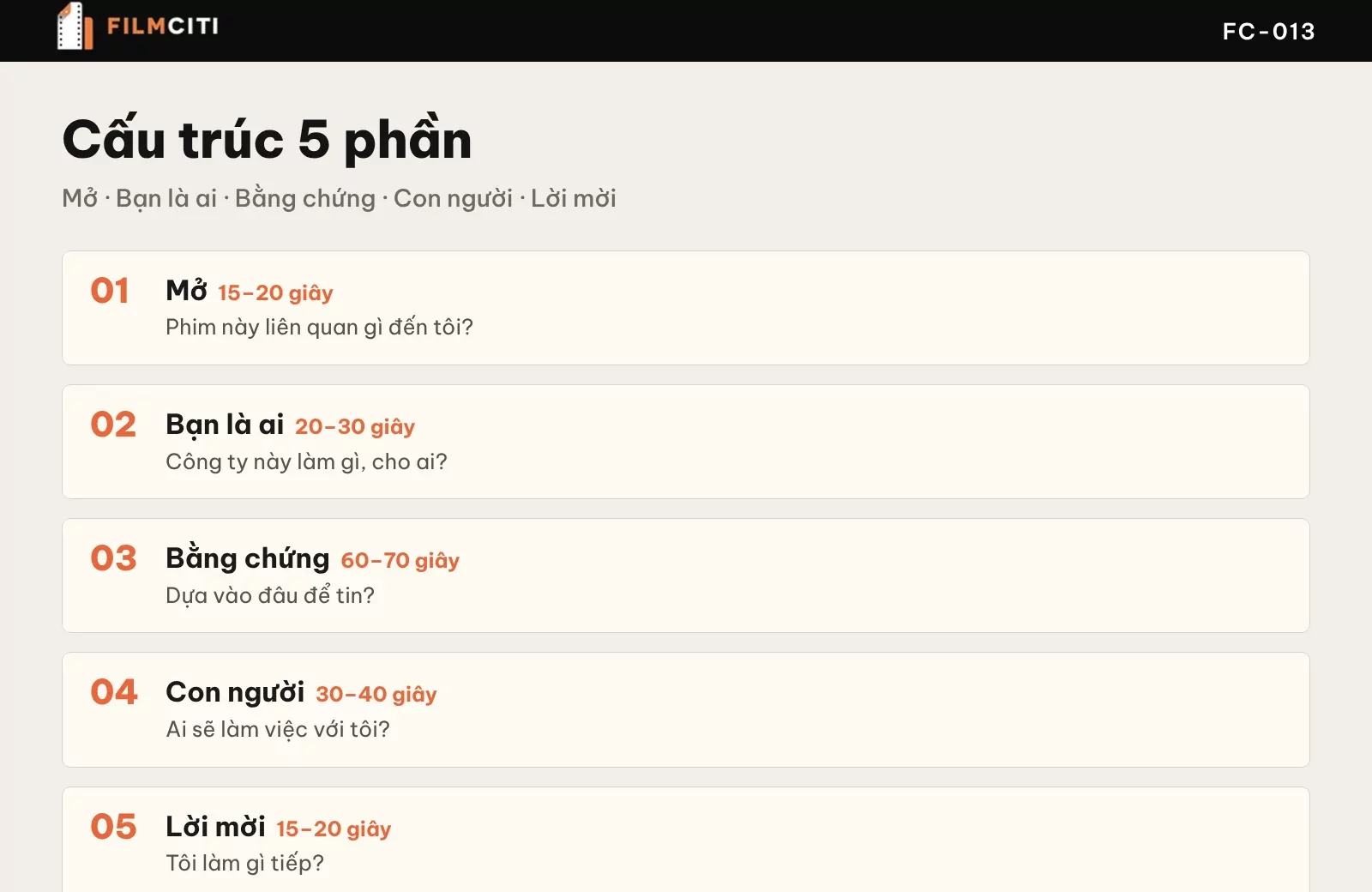
Viewers of an introduction film, whether partners, customers or job candidates, ask themselves a few questions in turn. The 5-part structure below follows the order of those questions: it starts from the viewer's concerns, moves to the company, then comes back to the viewer.
| Part | The viewer's question | Suggested length (3-minute film) | What it should contain |
|---|---|---|---|
| 1. Opening | "What does this film have to do with me?" | 15–20 seconds | The context or the problem the customer is facing |
| 2. Who the company is | "What does this company do, and for whom?" | 20–30 seconds | A one-line positioning statement, with images of the product or service in use |
| 3. Proof | "Why should I believe it?" | 60–70 seconds | 2–3 differentiators backed by visual proof |
| 4. People | "Who will I be working with?" | 30–40 seconds | Real people at work, with short interviews |
| 5. Invitation | "What should I do next?" | 15–20 seconds | An action suited to where the film is shown |
If a film opens with "Founded in…", it is answering a question the viewer has not yet asked. The founding year is not wrong information; it simply belongs in a different place.
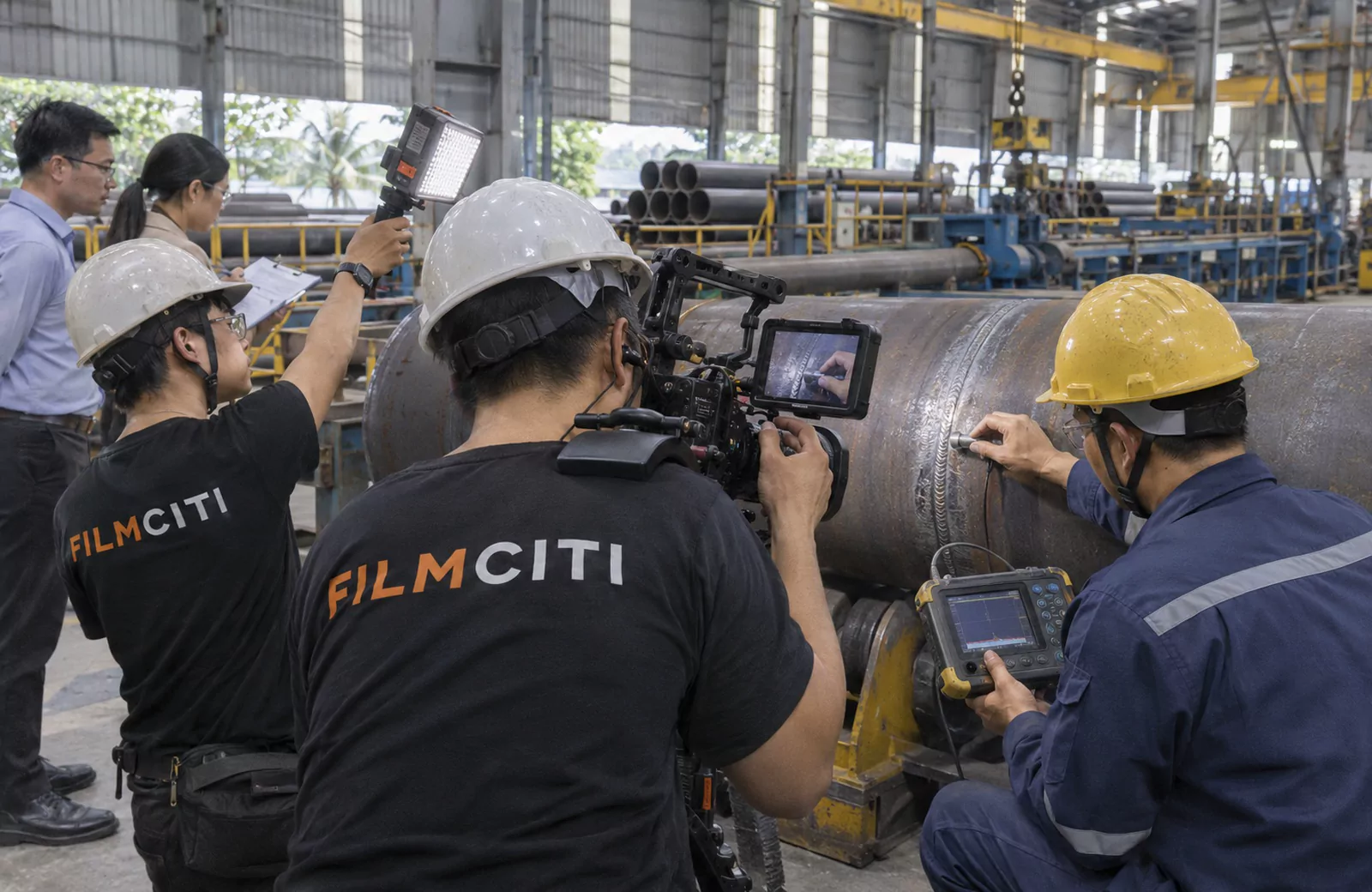
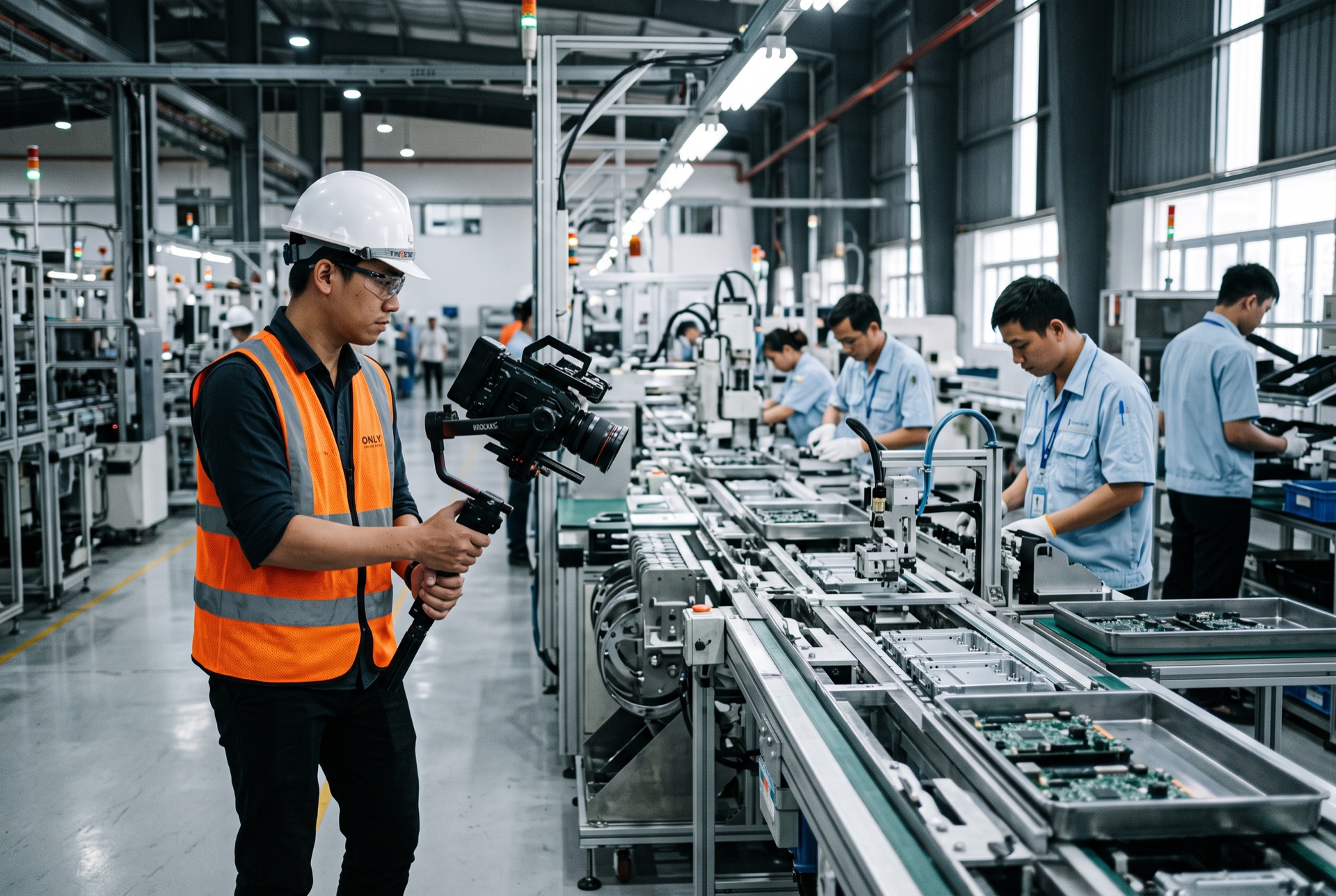
Part 3 is the one that determines the shooting days, because every piece of proof has to be a shot that can actually be filmed. "A rigorous inspection process" is not proof; a shot of a technician pressure-testing each product sample is. When choosing 2–3 pieces of proof, favour work that happens regularly at the plant or on site, done by real people and filmable in one session, rather than achievements that exist only on paper. Each piece of proof you choose brings with it a location, equipment and the people who need to be there on the shooting day. Write one sentence for each part, ask the final approver to agree on those five sentences, and only then start writing the detailed voiceover.
History, certificates and product catalogues are better shown with images and text than spoken aloud
Reading out the names of 9 certificates in the voiceover takes about 20 seconds, yet viewers will hardly remember any of them. By contrast, placing the certificate logos together in one frame near the end of the film for a few seconds is enough for viewers to see that the company meets all the required standards. Twenty years of history can be condensed into a single shot that moves from a photo of the first workshop to an image of today's plant from the same camera angle. Twelve product lines can become a quick sequence of shots, each labelled with the product line's name in text. The reason lies in how viewers take things in: the ear holds only a few points per listen, while the eye recognises logos, figures and product images almost instantly.
The thing to watch is on-screen text. When a lot of information is moved into text, the film has to give viewers enough time to read it, and each text frame should stay on screen for at least 3 seconds. Content that fits neither the voiceover nor the on-screen text can move to a brochure, the "About us" page on the website, or a separate long version of the film.
A practical method is to split every point you want in the film into two columns: "said in the voiceover" and "shown with images and text". Each point may sit in only one column, and the total word count in the "said in the voiceover" column must stay within the 350-word limit.
A draft before and after it is reorganised into the 5-part structure
The brief: an aluminium-and-glass door manufacturer in Bình Dương needs a 3-minute introduction film to send to project developers and to show in its showroom. The first draft was written by the administration department and follows the order of the company profile.
| Part | Draft | After reorganising |
|---|---|---|
| 1. Opening | "Founded in 2006, Company X is…" | Heavy rain lashes against the window frame of an apartment, while the floor inside stays dry |
| 2. Who the company is | Reading out the names of 12 product lines | One sentence: "We make aluminium-and-glass doors for homes and office buildings", with 4 product shots captioned with the line name |
| 3. Proof | Reading out 9 certificates and the size of the plant | 3 shots: the aluminium cutting machine, the water-tightness testing room, the installation team on site; certificates move to the final frame |
| 4. People | A 90-second message from the chairman | The chairman says one sentence of about 15 seconds; an installation technician says one sentence about checking every door frame |
| 5. Invitation | "Contact us…" with 3 phone numbers | Website and QR code in the showroom version; the name of the project manager in the version for developers |
The reorganised version does not drop the certificates, the plant or the chairman's message; it simply moves this content from the voiceover into images or text, or shortens it.
A complication: two days before the final script approval, the chairman wants to add a "20 years of growth" section with 8 milestones. There are three ways to handle this:
- Condense the history into a single shot of 8–10 seconds in part 2, and put all 8 milestones on the "About us" page and in the brochure. This keeps the running time unchanged and adds no cost, but the film will not tell each milestone individually.
- Make an extra 5–6 minute version for the partner conference while keeping the 3-minute version as it is. The chairman gets the full history; in return, the company pays extra for editing and review time.
- Give the history 30 seconds by taking time from the proof section. The chairman gets all 8 milestones shown in text and archive photos; in return, the film loses one piece of proof and the voiceover has to be recalculated.
When the screening location changes, the opening changes too, but the structure stays
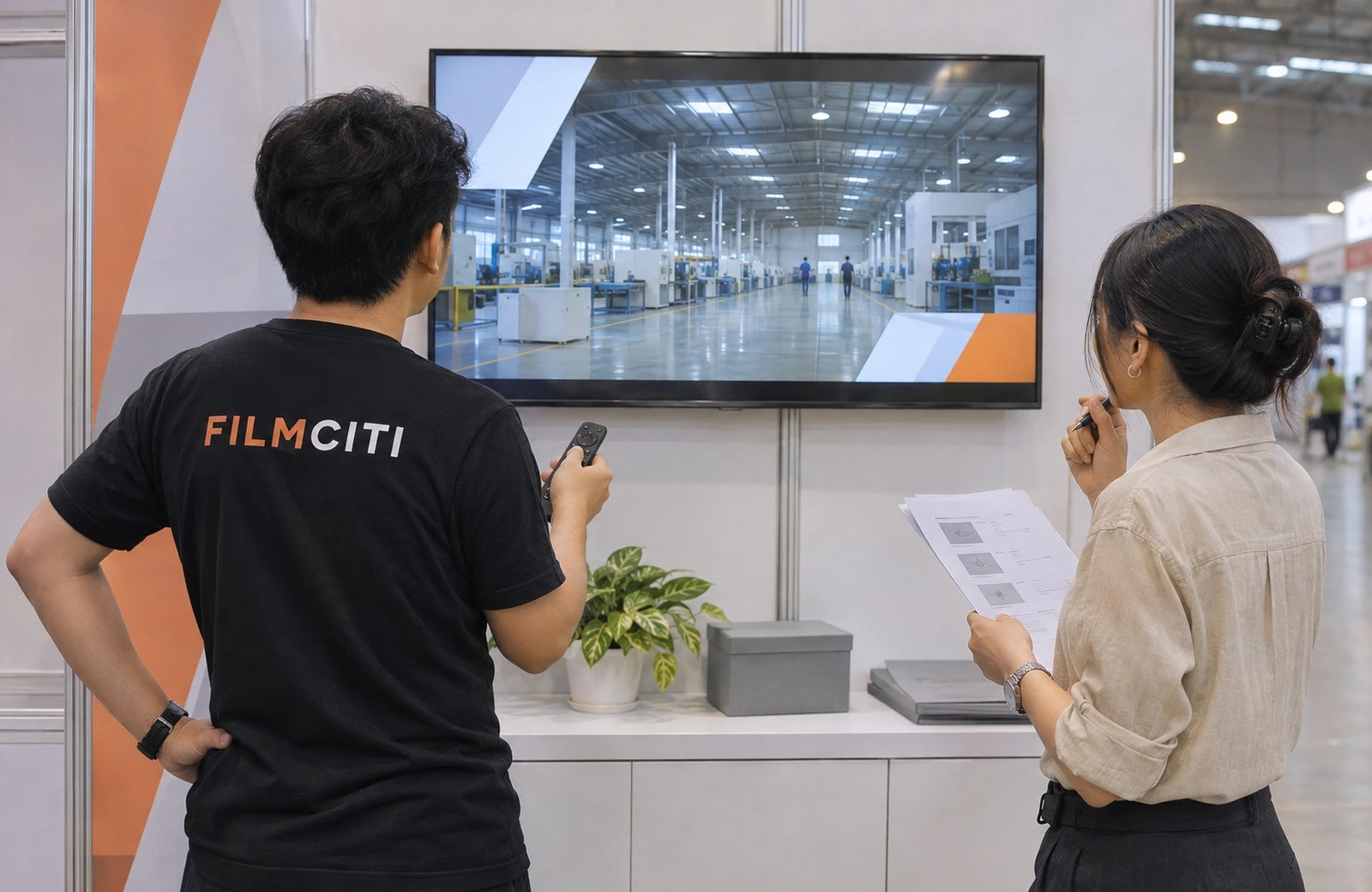
At a trade-fair booth, films are usually played without sound because the surroundings are too noisy. On-screen text then has to replace the voiceover, the opening shot has to explain itself without audio, and the film should run on a continuous loop. On a website, viewers choose to click play, so they can be a little more patient with the opening. When the film is shown at a partner meeting, the room has speakers and the audience watches the whole film, so the proof section can run longer.
The social media version should be cut separately, at about 30–60 seconds, keeping only the opening, the single strongest piece of proof and the invitation. It is a different product, and it needs to be planned when the script is written rather than simply trimmed at the very last step. According to Filmciti's pricing page, corporate films sit in the 3–10 minute range, and the company can choose from the start between one main 16:9 version or a main version plus a short cut and a vertical 9:16 version.
Before you write, list every place the film will be shown and mark the ones without sound. The most important screening location decides how the film opens.
When every department adds a section, a 3-minute film can stretch to almost 10 minutes
An industrial kitchen equipment company needs a 3-minute introduction film for a hospitality trade fair opening in four weeks. Ms Mai, the marketing team lead, sends the script to six department heads: "Could you take a look and let me know if anything's missing?"
It is the year-end order-closing season, the department heads reply at 11 p.m., and each of them adds a section for their own department. The crew points out that the film will run three times the agreed length, but the company approves it anyway and agrees to pay for the extra editing, so the crew edits exactly according to the script; at a test screening in a meeting room with speakers, everyone sees their department in the film. The final file is named "PhimGT_final_v9_them P.KD.mp4" and runs 9 minutes 40 seconds.
On the first day of the fair, the film plays on a 55-inch screen at the booth with the sound off, because the neighbouring booths are all playing music. The first 90 seconds are the chairman's speech: one person talking to the camera, with nothing to hear and no subtitles. Passers-by glance for a few seconds and walk on.
That evening, Ms Mai messages the crew: "Can you cut it down to 3 minutes and add text so we can run it tomorrow morning? It's only a small fix."
Cutting 9 minutes 40 seconds down to 3 minutes means dropping about two thirds of the film, which means choosing whose department section goes, when every section was approved by that department head personally. The film was edited around the voiceover, so with the sound off the crew has to write text for every point and replace the opening shot as well. After one night, the crew produces a temporary version for day two of the fair, but it is not a version everyone agrees on.
The department heads all gave honest feedback, and each of them was looking out for their own department. The crew also sees where it fell short: at the briefing, it never asked where the film would be shown or whether the sound could be on, and it never proposed a single person to approve the content before editing in every comment.
One question asked at the very first meeting could have kept the film at 3 minutes: "Where will this film be shown, how long will viewers stand and watch, and will they be able to hear it?"
The story above is a hypothetical scenario, reconstructed from situations that commonly happen in corporate filmmaking.
With the Filmciti crew, we ask where the film will be shown and whether the sound can be turned on there at the briefing stage, and we ask the company to name one person who signs off the final content. If the film is for a trade fair, we write on-screen text for every point and test the cut without sound on the same kind of screen the booth will use, so the opening shot tells the story without speakers.
Checklist before approving the script
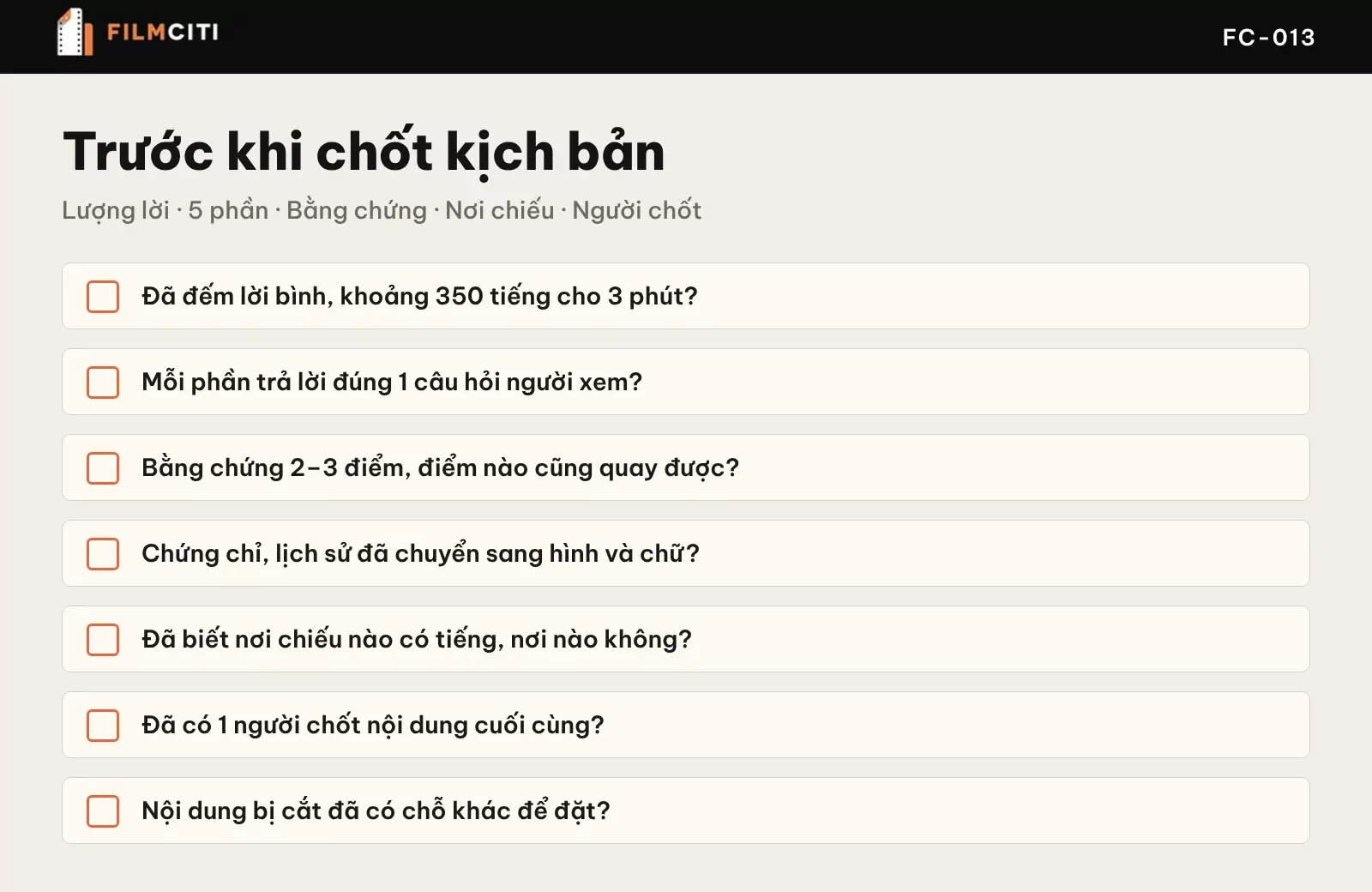
- Have you counted the voiceover words and checked that they fit the running time, about 350 words for a 3-minute film?
- Does each part answer exactly one of the viewer's questions?
- Does the proof section have 2–3 points, each with a shot that can be filmed?
- Have the certificates, history and product catalogue been moved into images and text?
- Do you know every screening location, and which have sound and which do not?
- Is there one person who approves the final content?
- Does the content that was cut have somewhere else to go?
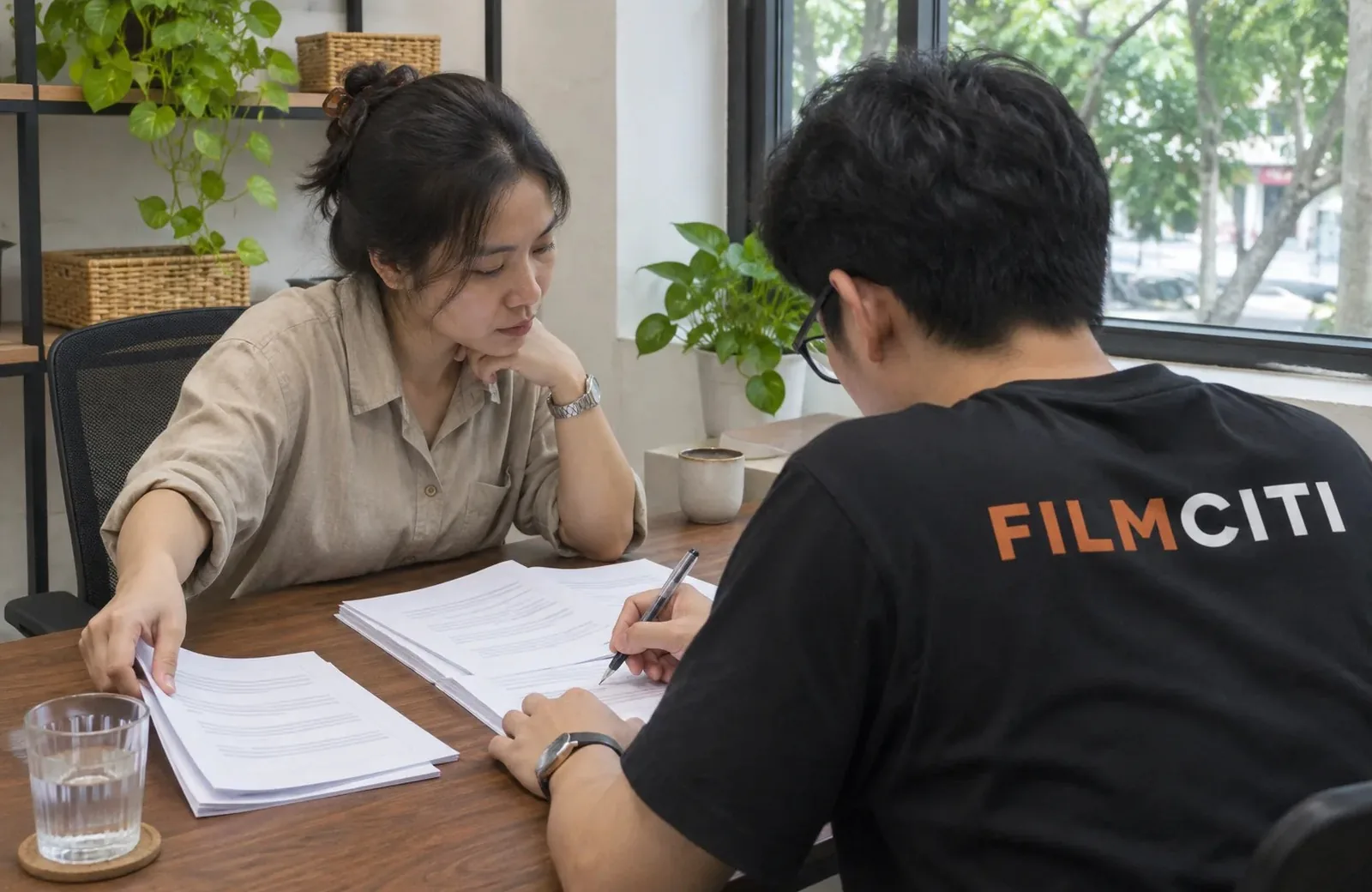
You should ask again when the script is sent to many people for feedback without stating who has the final say, or when the draft for a 3-minute film is longer than one page.
Download the 5-part script frame for a 3-minute film — Vietnamese template to write narration part by part, count words automatically against the ~350-word mark and run the checklist before approving the script.
Further reading
- Filmciti corporate film production: introduction films, year-end review films and event films.
- The production packages on Filmciti's pricing page, with options for a main version, a short cut and a vertical 9:16 version.
Send Filmciti a brief with where the film will be shown, the running time you want, the content draft you have and the name of the person who signs off the content. The Filmciti crew will propose how to divide it into five parts and point out which points should move into images.
Related service: Corporate film production
FAQ
The right length depends first on where it will be shown. A 2–3 minute film suits a website, partner meetings and trade fairs, while the social media version should be cut separately and kept shorter. Longer films only work when viewers choose to sit and watch, such as at a partner conference or an internal training session.
No. A film can be told through interviews, on-screen text, or a combination of both; telling it through text works especially well at trade fairs or in lobbies, where the sound often cannot be turned on. Whichever you choose, the amount of speech and text still has to be calculated against the running time, and each text frame needs enough time for viewers to read it.
Choose the one or two most powerful sentences for the main film, usually the ones about customers or the company's direction, and show the leadership a rough cut so they can feel the film's pace. The full speech can become a separate internal video or be placed on the "About us" page.