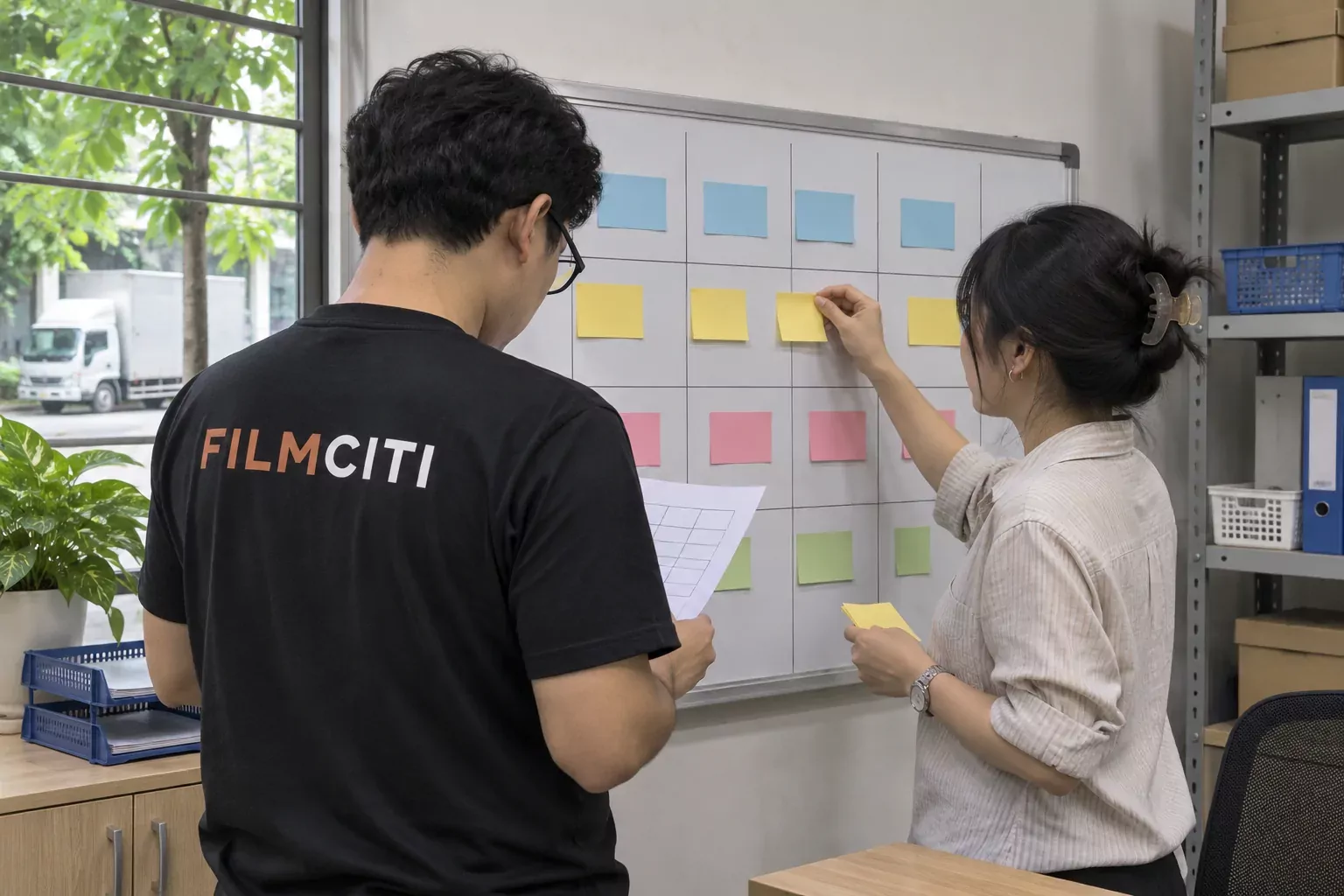




How do you choose who appears in a company film? Start with the story
The list of people who will appear in a company film is usually drawn up in about 10 minutes: the CEO, the department heads and a few of the year's top employees. That list is right in terms of recognition, but it may not be able to tell the story the film needs to tell. The person with the best results does not necessarily have the most concrete story, and someone who speaks well in meetings is not necessarily natural in front of the camera. To choose who appears in a company film well, settle the story first, then give each person one of three roles: storyteller, witness or person at work. This article helps you assign the roles, meet each person before the shooting day and have a plan ready for when someone has to be replaced.
In this article
- Settle the story first, then draw up the list of people on screen
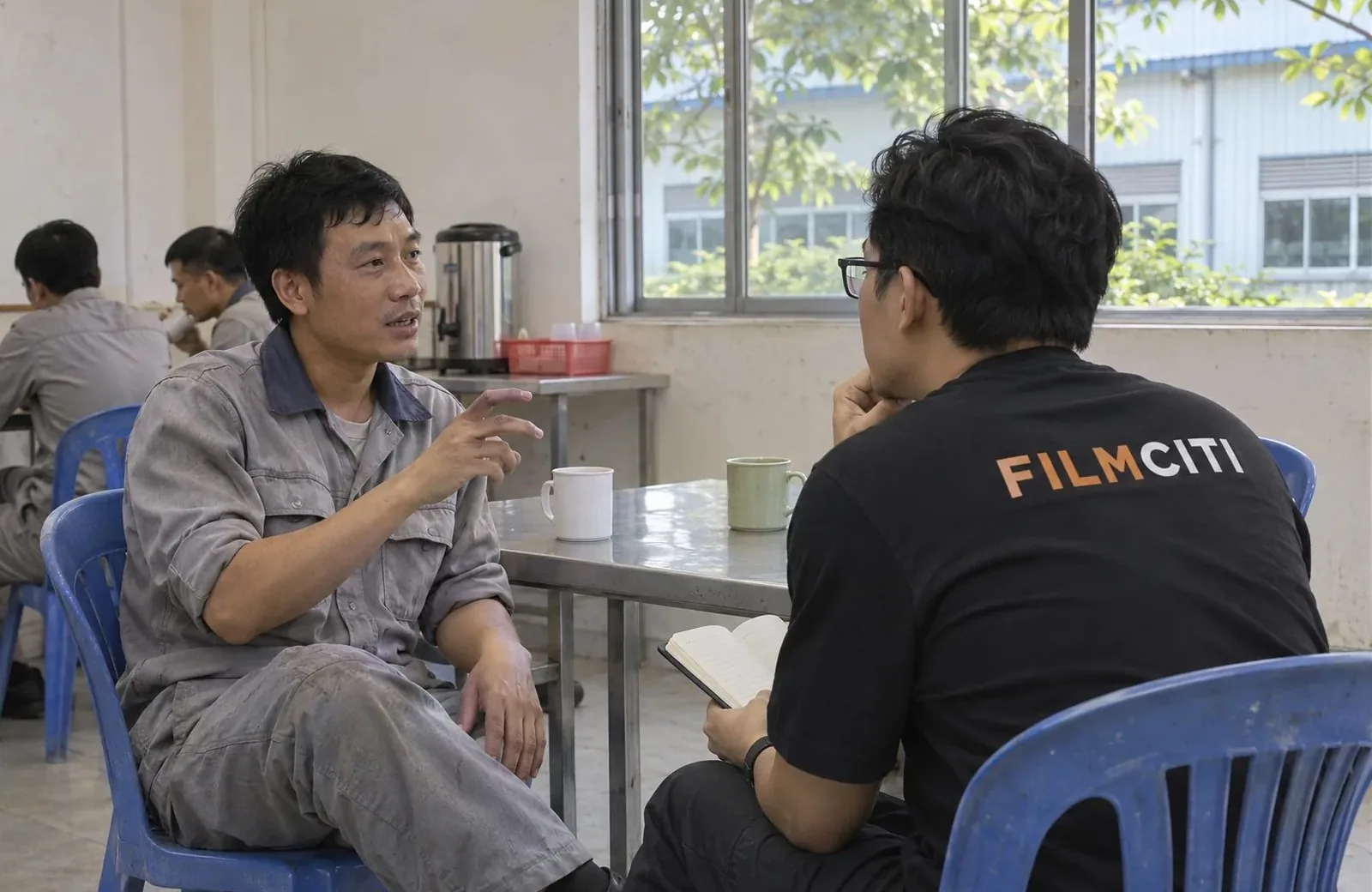
- There are three roles on screen: the storyteller, the witness and the person at work
- A meeting before the shooting day shows who can tell a story, instead of guessing from a list
- Consent forms, backups and a plan for when someone leaves the company need to be settled before the shooting day
- Leaders and outstanding employees still have a place in the film, as long as they are in the right role
- In practice: assigning roles for a 4-minute company culture film
- The best story is sometimes outside the approved list of people on screen
- Checklist before approving the list of people on screen
- Further reading
Settle the story first, then draw up the list of people on screen
Everyone who appears in the film needs to carry one point of the story. Until you know what the film wants to say, you cannot know who you need, and the list can only be drawn up from the organisation chart.
In the same company, three different types of film will need three different groups of people. A culture film about customer care needs someone who has handled a difficult situation with a customer. A recruitment film needs people who joined one or two years ago and can talk about what they have learned and who mentored them. A year-end review film needs the people behind the results, sometimes people from departments that are rarely mentioned, such as the warehouse or engineering.
Write the story as 3–5 points, each in a single sentence. Next to each point, add the question: "Who in the company has a real story that proves this point?" The list of people on screen is drawn up from the answers in that column. If nobody can be found for a point, that is a sign the point needs to be told in a different way, or lacks real-life evidence to be included in the film.
There are three roles on screen: the storyteller, the witness and the person at work
The storyteller carries the thread of the film through the interview. This role needs someone with a concrete experience, who remembers the details clearly and can tell it in their own words. The witness appears briefly, usually for just one or two sentences, to confirm something from another perspective, such as a customer, a partner or a colleague from another department. The person at work does not need to say anything, because the image of them doing their real job is already the proof. Most employees in the film play this role, and it is just as important as the other two. When assigning roles, start with the storytellers, because the film's thread rests on their words; then find a witness for each point that needs confirming, and finally list the work scenes that need to be filmed. Following this order keeps the list short, and everyone knows exactly why they are in the film.
The role on screen is not tied to job title. A leader can be the storyteller when the film is about direction and commitment, or a witness with one closing sentence at the end. Conversely, a technician can perfectly well be the main storyteller if the film's story takes place on site.
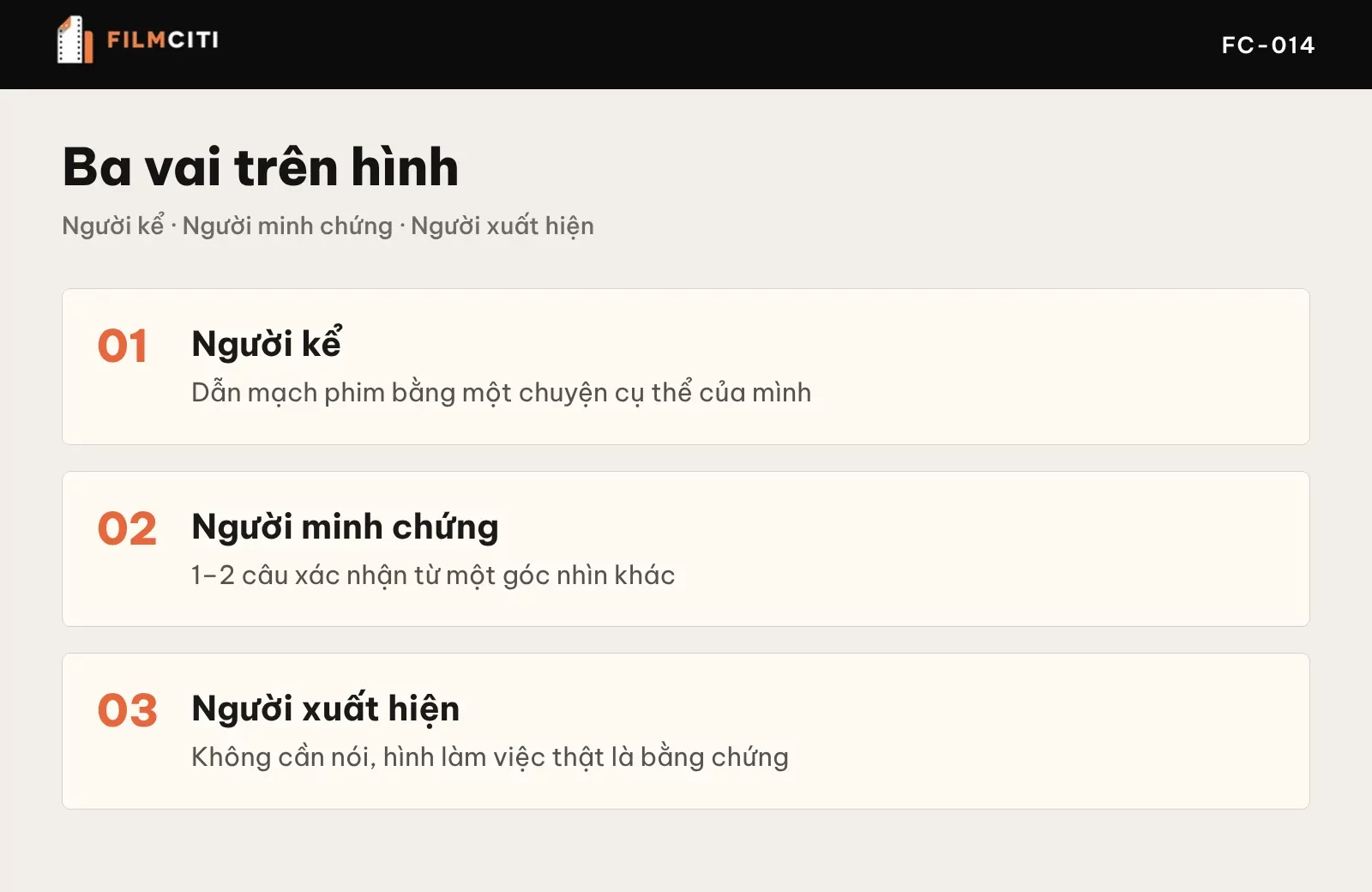
The number of storytellers needs to fit the running time. A 3–4 minute film usually needs only 2–3 storytellers; with more, each person is left with just a few sentences and nobody has time to tell a complete story. This is a trade-off between recognition and depth: more storytellers means more people get to appear, but the story loses depth. Assign each person on the list exactly one role before sending it to the production company.
A meeting before the shooting day shows who can tell a story, instead of guessing from a list
Speaking well in a meeting and telling a story well in front of a camera are two different skills. The only way to know whether someone can tell a story well is to meet them before the shooting day. In this meeting, the director or scriptwriter talks with each person for 15–20 minutes, in person or by video call, and asks questions as in a normal conversation rather than reading from a printed list.
During the meeting, the crew listens for three things: whether the person has a concrete story (what day, where, who was involved); whether they are telling it in their own words or reciting something prepared; and whether they are comfortable being asked follow-up and deeper questions. A sentence such as "I always put customers first" cannot be turned into images. By contrast, "That day at 9 p.m., a customer called to say the machine had stopped, and I ran down to the plant…" can be filmed.
The meeting is not meant to weed people out. Someone who says little at first may tell a story very well once they are used to the crew, while someone used to giving speeches may keep a stage voice and need to be asked in a different way. What the crew gains from the meeting is knowing how to ask each person.

Ask the production company to hold this meeting and include it in the pre-production schedule. When you contact the people appearing on screen, send them the topic and the reason they were invited, rather than a list of questions for them to prepare answers to. Pre-written answers almost always come across as recited in front of the camera.
Consent forms, backups and a plan for when someone leaves the company need to be settled before the shooting day
Under Article 32 of Vietnam's 2015 Civil Code, using a person's image requires that person's consent. For a company film, the company should obtain written consent that states where the film will be used (internally, on the website, on social media or in advertising) and for how long. An employee who agrees to appear in a film shown internally does not necessarily agree to appear in an advert running on Facebook. Article 32 also states that using another person's image for commercial purposes requires paying the person in the image, unless the parties agree otherwise. So if the film may be used to promote a product or service, the consent form should state whether participating employees will be paid, to avoid disputes later.
Company films are usually used for several years, while the people in them may change jobs at any time. If the main character of a recruitment film leaves after six months, the company is in a difficult position: either re-edit the film or stop using a film that is still good. You should therefore agree in advance, in the consent form itself, how this situation will be handled.
The shooting schedule is the third risk. If the whole film relies on one main storyteller, the shooting day depends entirely on that person's schedule; if they fall ill or are suddenly sent on a business trip, the entire shoot has to move. Each storyteller should have a backup who has been met beforehand. For a film meant to be used for a long time, consider telling the story through a small group instead of relying on one person; in return, each person gets less screen time. According to Filmciti's pricing page, all-inclusive production packages start from VND 70 million (excluding VAT) for one shooting session, so interviews with all the storytellers usually have to fit within that session. Each storyteller's availability should therefore be confirmed at the same time as the shooting date, not left until the final week.
Leaders and outstanding employees still have a place in the film, as long as they are in the right role
Many company films carry another goal alongside the story: recognition. The board wants to see top employees in the film, and departments want to be mentioned by name. This goal is entirely reasonable; it just does not have to be met through interviews.
There are two ways to separate recognition from the story. The first is to set aside a dedicated honours section in the film, showing photos, names and achievements in text for about 20–30 seconds, without each person having to say anything. The second is to make a separate honours video for the gala night, so the main film keeps its narrative thread. The first creates no extra product but makes the film longer; the second costs more to edit, but each product does exactly one job.
For leaders, the best place is usually the opening or the end of the film, when they talk about the reasons, the commitment and where the company wants to go. If a leader only reads out results that the images have already shown, the film loses the content that only a leader can provide: the reasons and the commitment. For outstanding employees, if they have a story to tell, invite them to be storytellers; if not, they still appear in the film and are named in the honours section. Nobody is left out; only the way they appear changes. One honest sentence from a leader about why the company chose the harder way often carries more weight than a whole list of results.
In practice: assigning roles for a 4-minute company culture film
The brief: a lift maintenance company in Ho Chi Minh City needs a 4-minute company culture film with the message "there when customers need us". The film will be shown at the company's founding anniversary and posted on its careers page. HR is in charge of the project and has three weeks before the shooting day.
| Story point | Person on screen | Role | Why they were chosen | Risk and backup plan |
|---|---|---|---|---|
| The company's commitment | CEO | Storyteller (opening and ending) | The person who set how the company handles incidents | Busy schedule: film first, in a one-hour slot at the office |
| A difficult night | Technician with 8 years' experience | Main storyteller | Once handled a lift trapping people at 2 a.m. | Shy of interviews: a backup technician who has been met beforehand |
| Behind the call | Call centre operator | Witness | The person who took the first call that night | Works nights: schedule filming at the start of the shift |
| The customer's view | A building management team | Witness | Confirmation from outside the company | Needs the building's permission; backup: show a thank-you letter in text |
| Everyone working together | Engineering, warehouse and training teams | People at work | Images of real work | Film by shift, without interrupting work |
In the table above, the CEO is not the main storyteller despite holding the most senior position, because the film's main point takes place on site. He still appears at the opening and the end, exactly where the person speaking about commitment belongs.
A complication: three days before the shoot, the technician asks not to take part in the interview, because he does not want his face to appear publicly online. There are three ways to handle this, and each one needs his agreement:
- Keep him in the role of a person at work, filming only his hands or his back without naming him, and have the call centre operator tell the story of that night. This keeps the true story but loses the voice of the person who lived it.
- Keep him as the storyteller, but use this version only at the anniversary event and not online. He will feel more at ease; in return, the careers page version has to be edited with a different storyteller.
- Switch to the backup who has already been met. The story will be different and the middle of the script has to be rewritten, taking about one more day, but the film can be used on every channel.
The best story is sometimes outside the approved list of people on screen
A pharmaceutical distributor in Hanoi is making a film for its 15th anniversary, to be shown at the celebration on 20 December 2025. Ms Hạnh, the HR manager, is busy with the Tết bonus review, so she chooses quickly from the awards list: Ms Thảo, the top salesperson three years running, is picked as the main character.
Ms Thảo memorises a speech prepared by HR and nails it in one take, without stumbling over a single word.
During the lunch break at the warehouse, Uncle Bình, a driver who has been with the company for 12 years, sits drinking water and recounts a night of flooding years ago when he drove medicine up to a provincial hospital. The truck stalled in the middle of a flooded road, and he and his co-driver waded nearly 2 km on foot, each carrying a box of medicine. The camera operator switched on the B-camera on a whim, but the shot was backlit, there was no lavalier mic, and the warehouse fans drowned out most of what he said.
The first edit is sent off. As soon as he finishes watching, the CEO calls: "Why isn't Uncle Bình in it? Everyone in the company knows that story. Add him in, it's only a small fix."
The lunch-break footage is not good enough to show on a big screen, so the crew has to set up a proper interview. But at year-end Uncle Bình drives long-distance routes and is only back in Hanoi on Saturdays. When the main character changes, the middle of the film has to be re-edited too, with only 9 days left before the celebration.
HR chose someone with results to honour, and Ms Thảo memorised her lines for fear of making a mistake in front of the board: everyone had their reasons. The production crew had its own lapse: it never proposed a meeting before the shooting day, even though one conversation in the warehouse would have brought Uncle Bình's story out early. In the final version, Uncle Bình becomes the main storyteller, while Ms Thảo briefly tells the story of landing her first customer in a new province.
What HR and the crew needed to ask each other at the very first meeting was: "When people in the company talk about what this film wants to say, which story do they keep telling, and who is in that story?"
The story above is a hypothetical scenario, reconstructed from situations that commonly happen in corporate filmmaking.
With the Filmciti crew, we have a short conversation with the likely on-screen people before the shooting day, including those who are not on the awards list, such as drivers or warehouse staff. Any story that people keep retelling goes into the script, and the person in that story gets a dedicated interview, with proper lighting, a lavalier mic and a time slot that fits their working schedule.
Checklist before approving the list of people on screen
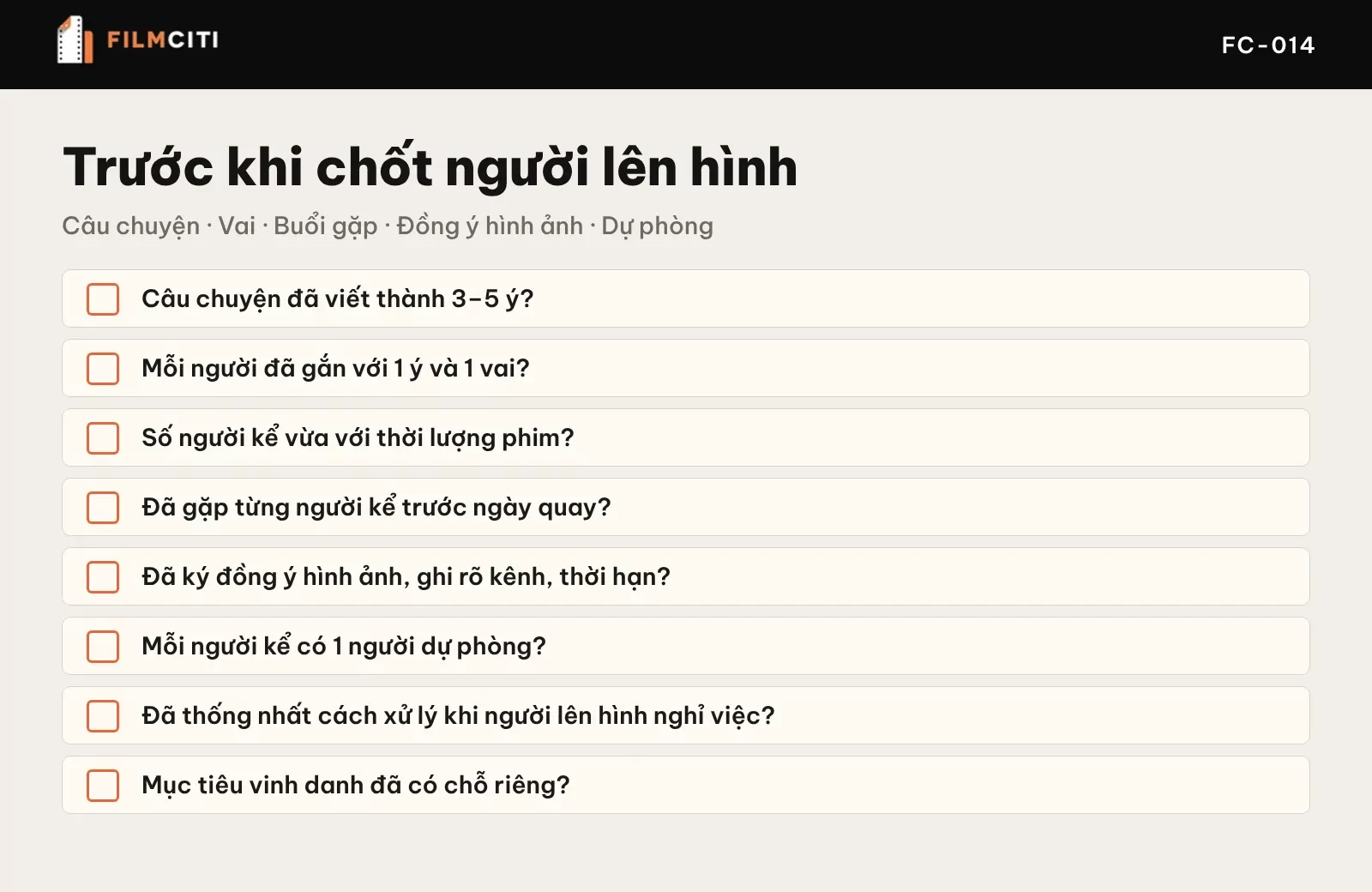
- Has the film's story been written as 3–5 points?
- Has each person on the list been assigned one point and one role?
- Does the number of storytellers fit the running time?
- Have you held a meeting with each storyteller before the shooting day?
- Have the people on screen signed an image consent form that states the channels and the duration?
- Does each storyteller have a backup?
- Have both sides agreed how to handle it if someone on screen leaves the company?
- Does recognition have its own dedicated place?
Reconsider when the list of people on screen is almost identical to the awards list, or when the main storyteller has never spoken with the crew before the shooting day.
Download the On-camera casting sheet — Vietnamese template to match each person with one story point and one role, and track the pre-shoot meeting, image release and backup person.
Further reading
- Interviewing employees for a company film so they speak naturally on camera
- When leaders are reluctant to appear in a company film
- Filmciti corporate film production: culture films, recruitment films and year-end review films.
- The production packages on Filmciti's pricing page, including the option of actors or company employees on screen.
Send Filmciti a brief with the purpose of the film, the story you want to tell (even if it is only a few points), the list of people you plan to put on screen and where the film will be shown. The Filmciti crew will propose a role assignment and a schedule of meetings before the shooting day.
Related service: Corporate film production
FAQ
The choice between actors and real employees depends on the type of film. Films about people and company culture should use real employees, even if they are not yet fluent speakers; films that need to re-enact a situation, such as adverts or training films, are better suited to actors. You can also combine both, using actors for re-enactments and real employees for the interviews.
First, ask why. If they are shy about speaking, move them to the role of a person at work; if they do not want their face or name shown, the crew can film only their hands or back and leave out their name. If they do not want to appear at all, respect that decision and use the backup.
Send only the topic and the reason for the invitation. When people receive a list of questions in advance, they usually prepare their answers, and prepared answers usually sound recited on film. If someone is nervous, the director can have a short chat with them at the pre-shoot meeting, so they get used to the questions without memorising answers.