


Writing a corporate video brief when the initial request is a single sentence
“Make me a really impressive film to introduce the company.” That sentence is enough to start a conversation, but not enough to plan a shoot. Writing a corporate video brief in this situation means turning a general wish into choices that can be discussed concretely: who the film is for, what it needs to persuade them of and what material can prove it.

In this article
- A brief starts with one question: after watching, what should the viewer believe?
- Every message needs material strong enough to serve as evidence
- A reference film only helps when you write down what to learn from it
- When leadership wants to tell everything, compare 2–3 options against the same frame of reference
- A usable brief helps the next meeting reach decisions
The marketing lead does not need to write the script for the crew. A good brief leaves room for creativity while pinning down what must not be misunderstood: the objective, the facts, the filming conditions and the final decision-maker.
A brief starts with one question: after watching, what should the viewer believe?
A film for distribution partners and a film for a recruitment day can share the same factory footage. But the question in each viewer's mind is very different: partners care about the ability to fulfil orders, while candidates want to picture the work and the workplace.
So do not stop at the line “audience: customers, partners, employees”. Choose 1 priority group and the situation in which they watch, then write 1 sentence about what they should understand or believe more afterwards. The other groups can be served by a separate version if it is really needed.
A brief is an agreed definition of the assignment, not the creative answer. “Partners need to see how we control quality” opens a far clearer storyline than “show our prestige and professionalism”.
If the film is part of a campaign, write down how success will be measured in the brief itself: is the goal awareness, lead generation or sales support, and which metric will you track? A film that needs viewers to stay until the 2-minute mark is edited very differently from one that only needs to hold them for the first 6 seconds. For paid video, the completion rate usually tells you more than total views.
Every message needs material strong enough to serve as evidence
“High quality”, “a dedicated team” and “modern technology” are all things a company wants to say. The problem appears when the script is finished and the crew still does not know what to film to make those lines credible.
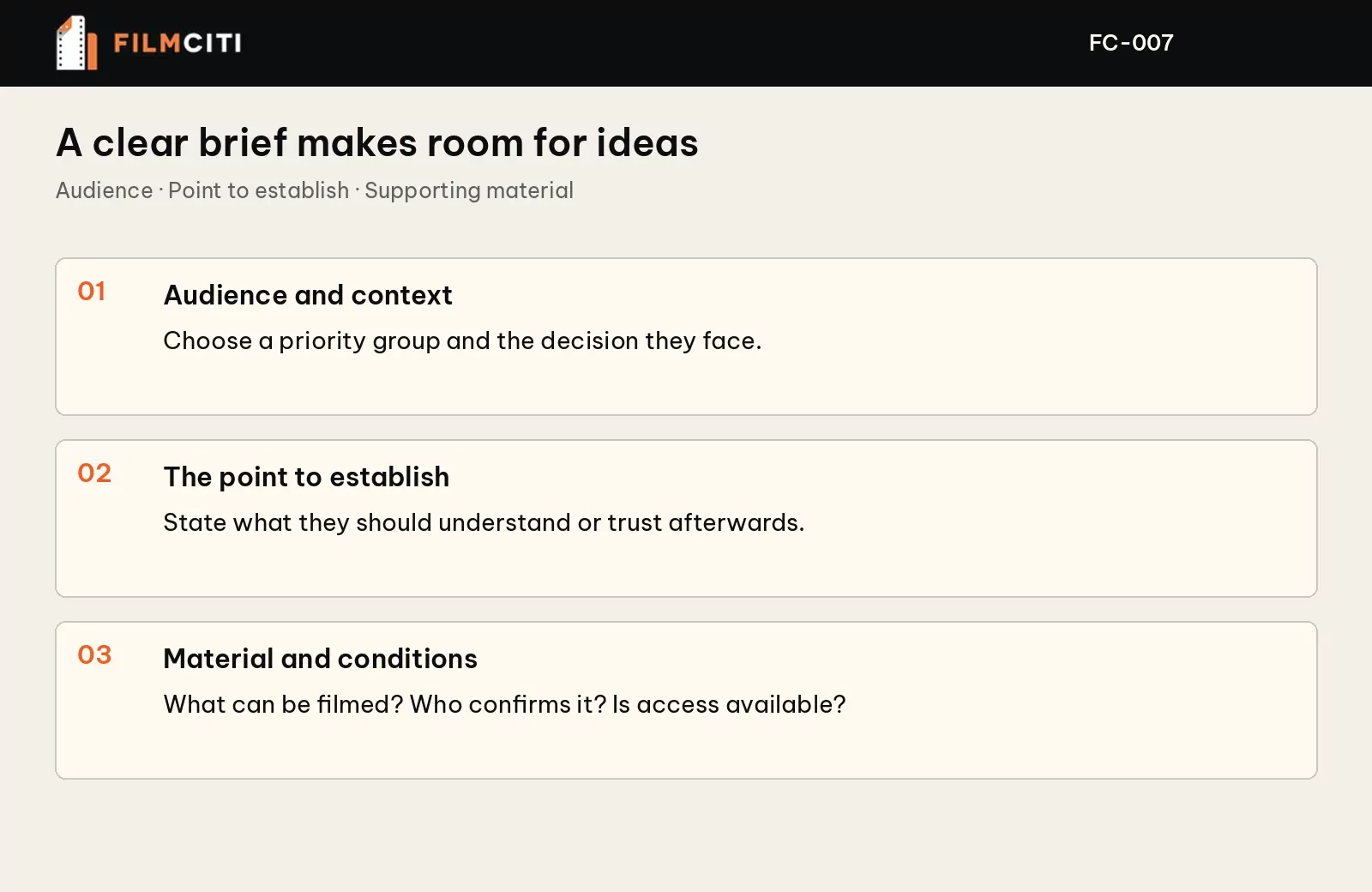
Build a table that connects each message to material and filming conditions. If you want to talk about quality control, the company provides the process, assigns someone to explain it and confirms which stages may be filmed; the crew proposes how to film it so that people outside the industry can still follow.
| What viewers should believe | Material to assess | Question before filming |
|---|---|---|
| Orders are tracked clearly | Workflow and an interface approved for disclosure | What must be concealed, and who approves it? |
| Products are checked systematically | A specific inspection stage | Will it operate on the shoot date, and what protection is required? |
| Departments work together | A task involving several teams | Who participates, and can real work be recorded? |
This is the part most often left out of a video production brief: not just listing the messages, but showing which facts each message rests on. Information that is not yet cleared for publication should be removed from the current plan or held for confirmation, rather than leaving the crew to find images to fill the gap.
A reference film only helps when you write down what to learn from it
A brief that is too open lets each side imagine a different film. A brief that is too closed easily turns into a list of mandatory shots, even when those shots do not serve any main point.
On Monday, Mr Hùng, director of a steel pipe manufacturer, messaged Ms Lan in marketing: “A Japanese partner delegation is visiting the factory on Thursday. Make me a 2-minute film to show when we welcome them, like the one I saw on Facebook yesterday. It looked really classy.” When Ms Lan asked for the link, he could not remember it; he only remembered that the film had “a herd of cows on a meadow, golden sunlight, soft music”. Then he boarded a flight for a business trip.
Ms Lan found a fresh-milk TVC that matched the description and sent him a screenshot. Between 2 meetings, he replied with a single word: “Ok.”
With only 3 days left, the crew started straight away: a meadow mood board, golden-hour afternoon light, dairy cows grazing at their leisure; the producer held a drone slot, and Ms Lan called a dairy farm to ask about renting it as a location. Nobody had time to sit down and ask Mr Hùng another question.
On Tuesday evening, Mr Hùng landed, opened the concept file and called immediately: “We sell steel pipes. Where did the cows come from?”
It turned out that what he liked was the slow pace and the sense of closeness, not the cows or the meadow. What he wanted the delegation to see was a team of welders working carefully down to every joint. 1.5 days of concept development had to be dropped, and the crew had exactly 1 day left to film at the factory.
Nobody did anything wrong: the reference was indeed the film he had watched, and the crew made exactly what they had been sent. The tight deadline made both sides choose to start work instead of asking more, so they agreed on the feeling but not on the content.
The crew carries part of the responsibility too. The tighter the deadline, the more the crew needs 15 minutes of careful questions before starting: what do you like in this film, the storytelling pace, the colours or the way people appear? On the company side, one extra line of description in the message is enough.
The question that should have been asked at the start: “In the reference film, what exactly do you want to keep?”
The story above is a hypothetical situation, reconstructed from things that often happen in corporate filmmaking.
So for each reference film, write down specifically what you want to learn: an opening built on an action, the way a person tells the story or the rhythm of the transitions. The crew explains which parts suit the material available. Sending only a link with “make it like this” can lead both sides to agree on the feeling without agreeing on the production workload.
A reference film should also match the budget. A TVC shot across many locations, with a large cast and heavy visual effects, is hard to recreate on the budget of a 2-minute company profile. With a moderate budget, choose references for their emotion, colour or storytelling pace rather than their production scale.
A brief should also separate 3 layers: what is mandatory, what is still open and what is waiting for a decision. The screening date or broadcast deadline, the languages to deliver and areas where filming is prohibited are constraints; narration, editing rhythm and story structure are usually where the crew makes proposals.
For example, the company needs a Vietnamese version for an event and an English version to send to partners. This requirement affects narration, subtitles, on-screen text and proofreading from the start; it is not simply exporting one more file at the end.
If the company already has brand guidelines, attach them and list separately the points the crew must follow: logo position and size, fonts, main colours, slogans or product names that must not be used, and settings that must not appear on screen. These rules affect graphics, wardrobe and location choices, so the crew needs them before developing the concept, not when the edit is already under review.
Budget should also be discussed in terms of scope. When the figure is not final, state what matters most and ask the crew to point out the items that create differences between options: the number of locations, the number of people on camera, the level of staging or the number of versions. A quotation for an unclear assignment should be read together with its assumptions; it is not a commitment to every request added later.
There are 2 common ways to share a budget. The first is to give a ceiling, so the production house can balance equipment, crew and shooting days within that limit. The second is to leave the brief open and ask the crew to send a director's treatment with a quotation for each option. The first reaches a decision faster; the second suits companies that do not yet know what level of investment is reasonable.
Filmciti director Hoàng Đại Dương sees this from the crew's side: “Many clients worry that an open brief will let the director drift far beyond the budget. In reality, a smart brief sets limits on money but stays open on emotion.”
When leadership wants to tell everything, compare 2–3 options against the same frame of reference
For example, a manufacturer is preparing to welcome a new partner and also wants to use the film for recruitment. The initial request includes company history, scale, products, technology, culture and a welcome from the leadership, and every point is marked “important”. Production wants every stage filmed, sales wants every product line, and HR wants to add culture.
If the running time is split evenly across everything, the film may cover every heading but lack persuasive power. The question to settle first: which concern should the partner meeting resolve, production capacity, quality or the ability to work together?
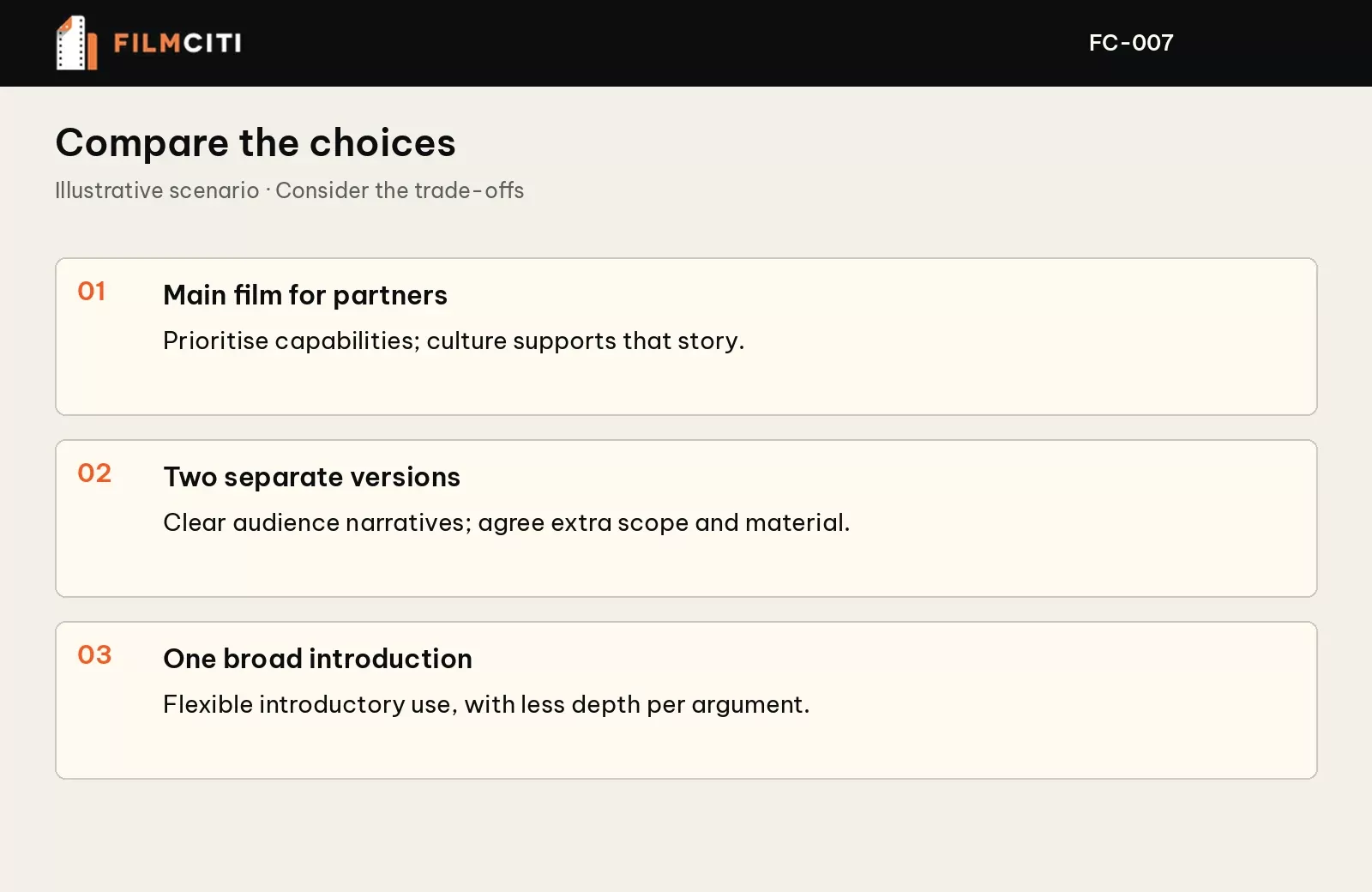
| Option | Priority | Trade-off |
|---|---|---|
| One main film for partners | Capabilities and evidence relevant to cooperation | Recruitment culture appears only where it supports that story |
| Main film plus a recruitment version | A clear narrative for each audience | Additional outputs and dedicated material must be agreed |
| One broad introduction | Flexible use at introductory meetings | Less space to develop each argument |
Suppose that, by the time scripting begins, an important production area still cannot be filmed. Keeping the promise about capability without the evidence pushes the pressure onto post-production. Using approved archive footage or narrowing the message are 2 directions to weigh before confirming the shoot date.
The client confirms the real conditions and the order of priorities. The crew assesses whether substitute material can still tell the story, identifies what needs additional filming and adjusts the plan. The decision is recorded in the brief so the next review round does not have to start over.
A usable brief helps the next meeting reach decisions
A brief sent to a production house does not need to be long. A working document with named files, their sources, their usage status and the questions you want the crew to advise on is easier to discuss than a loose folder where nobody knows which file is the latest.
After the meeting, update the brief into a version with a revision date and the person who confirmed it. Comments sent by message are still input, but any decision that affects the storyline must be brought back into the shared working document. The crew restates how it understands the brief before developing the script; the company checks that the agreed points match what the final approver intended.
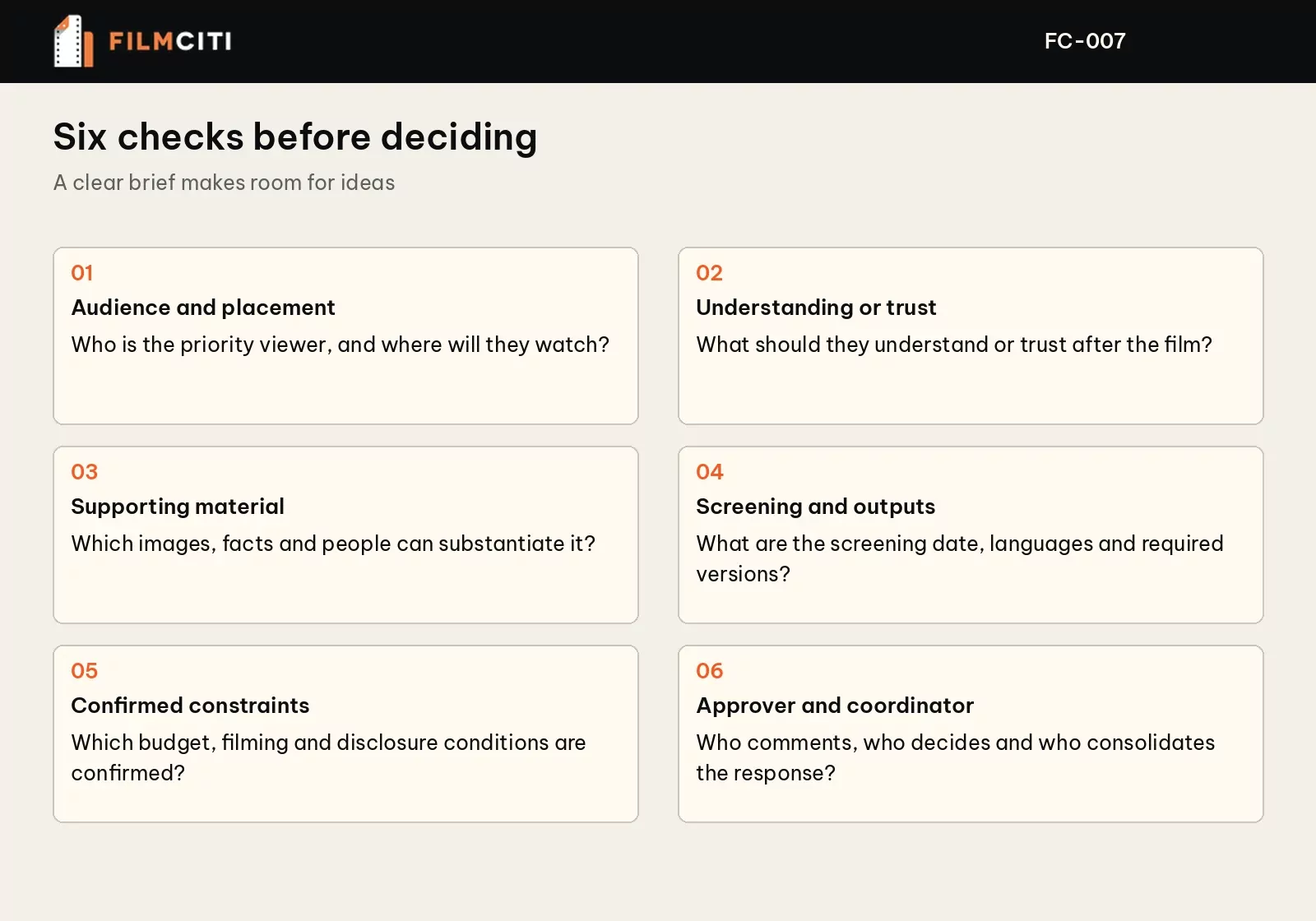
Before sending, check the 6 points below. For any point that has no answer yet, write down who will confirm it and the decision deadline, instead of filling in something that sounds certain just to complete the form.
- Who is the priority viewer, and where will they watch the film?
- After watching, what should they understand or believe?
- Which images, facts and people can prove it?
- For any reference film, have you written down what to learn from it?
- What are the screening date, the languages and the versions to deliver?
- Who comments, who gives final approval and which contact handles feedback?
Download the Brief clarification and confirmation sheet — Vietnamese template to record confirmed information, assumptions and questions awaiting a decision separately. For a marketing video, also note what viewers should do after watching so the crew can propose a suitable ending and versions. First-time clients can also read what to prepare before making a corporate film.
Send Filmciti a brief with the material you have, your reference films (noting what you want to learn from each) and the points that are not yet agreed, so the first conversation can focus on the decisions that need to be made.
Related service: Corporate film production
FAQ
Can we send a brief without a creative idea yet?
Yes, as long as you can describe the objective, the audience and the conditions you have. The crew needs a clear assignment to propose ideas; the client does not need to prepare the creative part. You also do not need a script, a shot list or reference images yet. If you already have them, note which parts must be kept and which the crew may propose changes to.
What should we write if the budget is not final?
State clearly that the budget is awaiting a decision and which parts are the priority. Both sides can discuss options with different scopes; the final quotation is based on the work that has been defined.
Who should approve the brief before the script is developed?
The person authorised to confirm the objective and the message approves the main direction. The relevant departments confirm the facts and filming conditions, and one contact consolidates the decisions for the crew to execute. If the final cut must also be approved by the legal team or a parent company, add that round to the brief from the start, because it directly affects the delivery schedule and the number of versions to prepare.