




Comparing corporate film quotes: clarify the differences before you choose
You have just received 3 quotes for the same company film: a freelance team sends a 1-page all-in quote, a production company a 40-line table, and an agency a proposal deck with the costs on the last page. The total at the bottom of each one does not tell you which option suits you better. To compare corporate film quotes properly, compare totals only once the quotes cover the same scope, then choose on 5 grounds: understanding of the brief, proven capability, the people doing the work, the approval process, and cost with its conditions. As a reference point, Filmciti's pricing page splits all-in production packages into 4 tiers from 70 to 300 million VND (excluding VAT).

In this article
- Three quotes look different because three providers are selling three levels of service
- To compare, bring the quotes into the same frame of items
- The total is only one of five grounds for choosing
- Weighted scoring gives the choice clear grounds
- Illustrative comparison: 3 quotes for a 3-minute company film for a logistics company
- Sending the same quote request template from the start removes most of the comparison work
- Three quotes identical line by line are not necessarily right for the film the business needs
- Checklist before choosing a production company
- Further reading
Illustration.
Laying the quotes side by side and marking the items that are still "unclear" before comparing costs.
Three quotes look different because three providers are selling three levels of service
On the market, corporate films are usually made by 3 groups of providers. Freelance teams or small-scale crews have low operating costs and are flexible, but the business usually has to prepare the content and coordinate more of the work itself. A production company has its own crew and process, with a producer managing schedule, budget and approval milestones. A creative agency focuses on strategy and ideas, and then usually works with a production company to shoot and edit. This difference decides who carries the coordination: with a freelance team, the marketing person usually has to contact locations, schedule the people on camera and collect feedback from departments; with a production company or agency, that work is part of the quote and handled by the producer.
So the 3 quotes differ not only in their figures, but in the share of the work each side takes on. An agency's quote may already include research, ideas and management of the whole project. A freelance team's quote may only cover the shoot days and editing, with the script supplied by the business. Putting these two figures side by side without counting the work the business has to do itself is not a fair comparison.
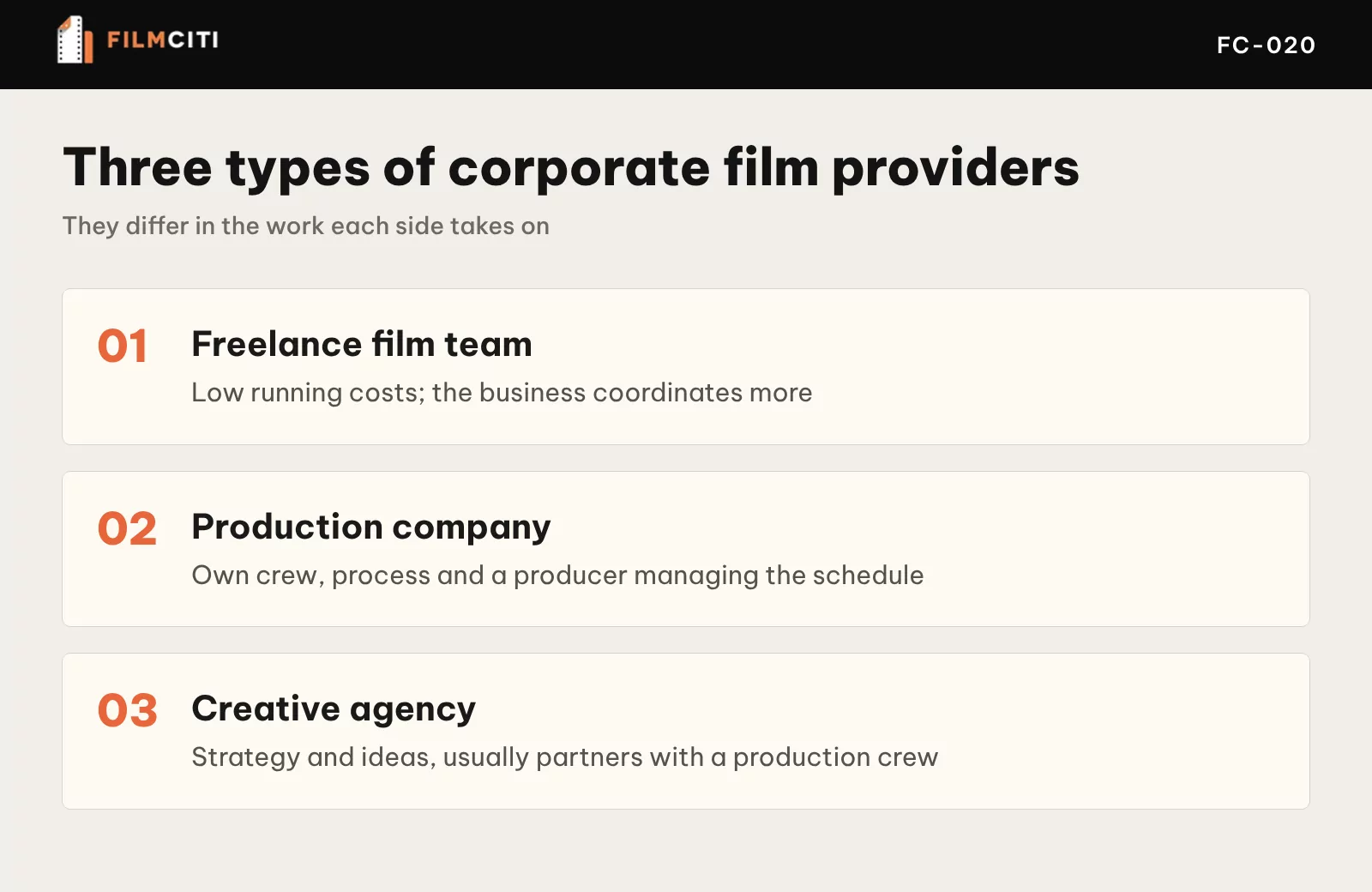
No group is always better than another. An internal film with clear content may suit a small-scale crew very well, while a brand launch film that needs a fresh idea calls for an agency or a production company with a creative team. Before comparing, note next to each quote: which group this provider belongs to, and which parts of the project they are taking on.
To compare, bring the quotes into the same frame of items
To compare quotes fairly, build a shared table with fixed items, then fill in each quote's information. A workable frame for a corporate film has 8 rows: understanding of the brief, creative work (idea and script), shoot days and crew size, equipment and locations, post-production, delivery versions, music and image usage rights, and the number of revision rounds and how the project is managed.
On the first pass, you do not need to enter costs. For each cell, just mark one of three states: included in the quote, not included, or unclear. This shows you straight away which quote is missing which item, before the figures start to sway you.
The "unclear" cells are exactly the list of questions to send back to each provider. A freelance team's all-in quote may have the most unclear cells, but that does not mean they will do less; they may simply not have written it down. Once you have the answers, if a provider is still missing an item the business needs, ask them to add it so that all the options share the same scope. When you send the questions, write them so they can be answered with yes, no or a number, such as "Does the quote include English subtitles?" or "How many shoot days, and how many hours each?". These written answers also become the scope description you will attach to the contract later.
The total is only one of five grounds for choosing
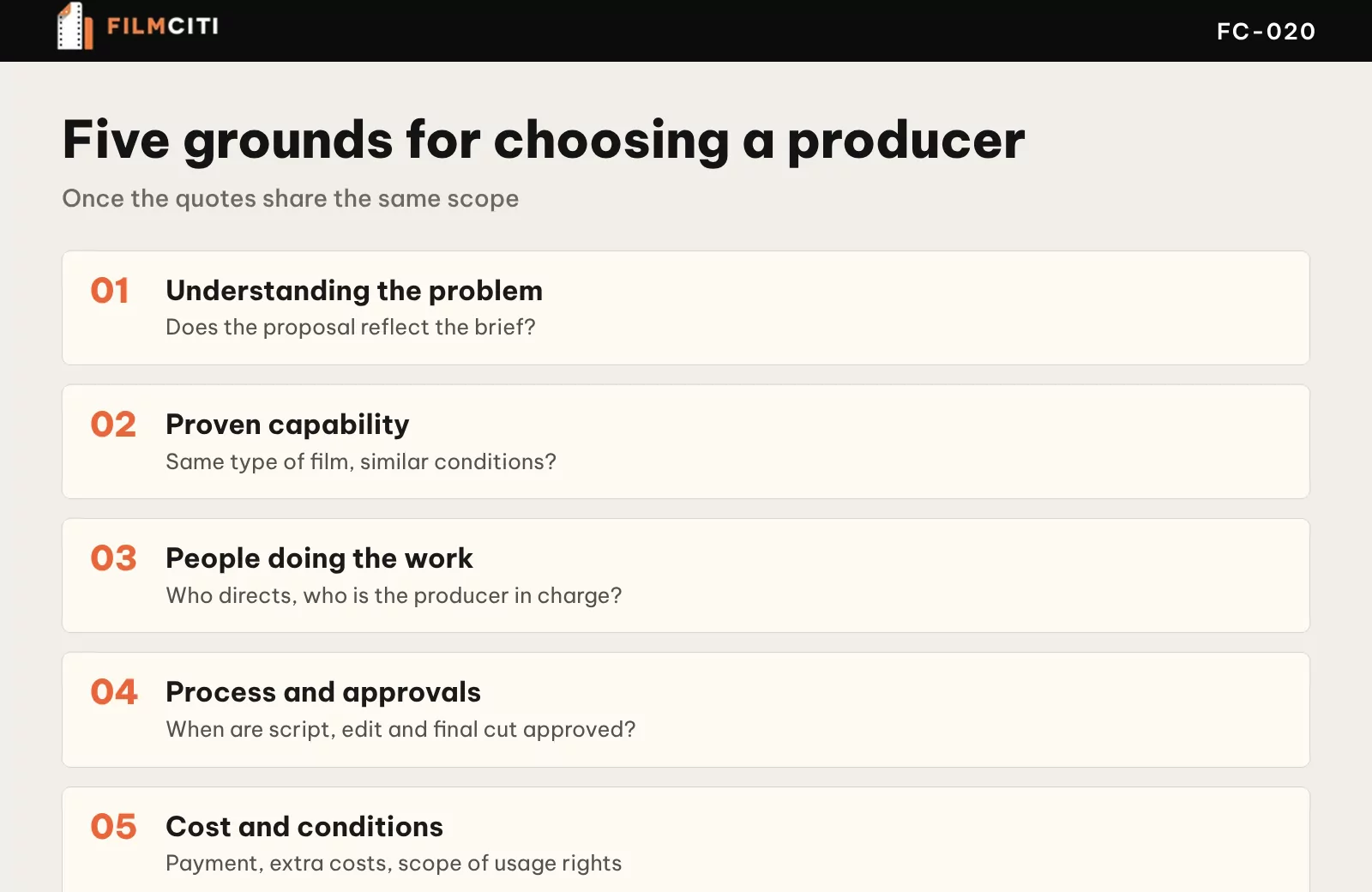
Once the quotes share the same scope, the remaining difference reflects each provider's approach and capability. At this point, evaluate them on 5 grounds rather than the total alone.
The first ground is understanding of the brief: does the proposal reflect the objective, audience and screening setting in the brief, or is it a generic option used for every client. The second is proven capability: has the provider made films of the same type, in similar conditions, for example a film shot in a working factory or a film with interviews of several executives. A quick test for the first ground is to read the idea section and ask: if you replaced the business's name with another company in the same industry, would the proposal still hold? If it would, that provider has not truly understood the brief. For the second ground, ask about the actual shooting conditions of the films they show, because a beautiful studio film does not show how the crew copes when a production line is still running.
The third ground is who will actually do the work: who will direct, who will be the producer in charge, and have you met or talked to them. The fourth is process and approval milestones: does the schedule state clearly when the business approves the script, the edit and the final cut. The fifth is cost and accompanying conditions, including the payment schedule, how extra costs are charged and the scope of usage rights.
To assess the second and third grounds, ask each provider to send 2 films they have made in conditions closest to your project, together with the name of the person who directed them. A polished showreel shows style, but not how they handle a problem like yours.
Weighted scoring gives the choice clear grounds
Once you have all the information, you can score each ground from 1 to 5 for each provider, then multiply by a weight. The weights depend on the film's objective. A film shown to overseas partners at an international trade fair should give high weight to capability and the people doing the work. An internal training film with settled content can give more weight to cost.
A scoring table does not replace the decision. Its value is that it forces everyone to agree on criteria before discussing figures. When the approver asks why you did not choose the lowest-cost provider, you can point to the ground that made the difference, rather than answering on impressions.
One point to note: the weights should be agreed with the final approver before scoring. If the weights are agreed after scoring, the table can easily be adjusted to fit a choice that has already been made.
Illustrative comparison: 3 quotes for a 3-minute company film for a logistics company
The brief: a logistics company needs a 3-minute company film to show at its year-end customer conference and send to overseas partners. The film is shot at the office and 2 warehouses, with an interview with the CEO. The business has agreed the weights with the final approver and received 3 quotes after each provider added items to match the same scope.
The table below compares the 3 quotes on the 5 grounds: each ground is scored from 1 to 5, then multiplied by the weight shown in brackets.
| Ground (weight) | Freelance film team | Production company | Creative agency |
|---|---|---|---|
| Understanding of the brief (25%) | 3 – follows the brief, no proposal of its own | 4 – proposes telling the story through the journey of one shipment | 5 – has customer research and a fresh idea |
| Proven capability (25%) | 3 – many event films, few warehouse films | 5 – has 2 films shot in working warehouses | 4 – many brand campaigns, few company films |
| People doing the work (20%) | 4 – talks directly with the director | 4 – has met the producer and director | 3 – does not yet know who will shoot |
| Process and approval milestones (15%) | 2 – no approval schedule yet | 4 – 5-week schedule with 3 approval milestones | 4 – has a schedule, with an extra idea-approval round |
| Cost and conditions (15%) | 4 – lowest cost, payment terms still sketchy | 4 – mid-range, clear conditions | 2 – highest cost |
| Weighted score | 3.20 | 4.25 | 3.75 |
In this table, the production company scores highest because it fits the warehouse shooting conditions and has a clear approval process. The agency is strongest on ideas, but has not yet confirmed who will shoot, while the film must be finished before the conference. The freelance team has the lowest cost but no approval schedule, a major risk when many people are giving feedback.
The twist: after the business chooses the production company, the director it met during the discussions reports a scheduling clash, and the company proposes a different director instead. The "people doing the work" ground has just changed, so the scoring needs another look. There are 3 ways to handle this:
- Meet the replacement director, watch films they have made in similar conditions, then rescore the third ground. This keeps the choice if the replacement is capable enough, but takes a few extra days.
- Ask to keep the original director and move the shoot to fit their schedule. The business keeps the person it assessed, but post-production time before the conference gets squeezed.
- Switch to the provider with the second-highest score. This choice is already backed by the table, but the business has to restart the brief discussions and may lose the price it negotiated.
Sending the same quote request template from the start removes most of the comparison work
Most of the difficulty in comparing comes from each provider receiving a different request, through different phone calls. If you send everyone the same quote request template from the start, the proposals that come back will be closer in scope, and you will have fewer "unclear" cells to follow up.
A quote request template for a corporate film should include the following:
- The film's objective, main audience and where it will be shown.
- The length of the main version and the list of versions to be delivered, including subtitles.
- The number of locations, the address of each and the shooting conditions (a working factory, restricted areas).
- People on camera: executives, employees, customers or actors.
- The material the business already has and the content the business will supply itself.
- The delivery date and required approval milestones.
- A request to present the quote by item, with "included" and "not included" sections.
- A request to attach 2 films of the same type and the name of the person who will lead the project.
This template should be sent as the business's own brief; one provider's quote should not be used as the frame for the others.
Three quotes identical line by line are not necessarily right for the film the business needs
Thảo, a marketing executive at a medical equipment distributor in Ho Chi Minh City, is asked to choose a company film provider within the week, in time for the customer conference on 12 December 2025. Her manager tells her: "Last time the 3 quotes were all different and we couldn't compare them. Do it properly this time."
The first quote Thảo receives is very detailed, already split into 25 lines. To make comparison easy, she deletes the provider's name and prices, then sends the table to the other 2 providers as a template. 2 days later, all 3 quotes come back identical line by line. The file "So_sanh_bao_gia_v3.xlsx" is so tidy that her manager praises it in the meeting.
In the afternoon, the file goes up to the director. 10 minutes later, the director replies: "Where's the new warehouse in Long An? This year we have to show it off." Thảo opens the file and sees the line "Shoot: 1 day in Ho Chi Minh City" sitting neatly in all 3 columns. The first quote was drawn up when that provider only knew about the office in District 7, and the other 2 filled in that same frame.
Thảo messages all 3: "Could you just add 1 line for a shoot day in Long An? Just 1 line."
But adding the Long An warehouse is not just adding a line. The crew needs a separate shoot day for the warehouse, travel costs, permission to film in the temperature-controlled area, and a new section in the script. All 3 providers need to requote, and the comparison slips by 1 week with only 6 weeks left until the conference.
Bringing 3 quotes into one frame is the right thing to do, and Thảo did it in exactly that spirit. The bigger gap lies with the people who make films for a living. The producer at one of the 3 companies later admitted that, given a ready-made frame, the crew filled it in quickly instead of calling back to ask where the film needed to be shot, even though the number of locations is the first question in any quote.
The question that needed asking the moment the shared frame arrived: "Does this shared frame contain everything the business needs, or only what the first provider knew?"
The story above is a hypothetical situation, reconstructed from things that often happen in corporate filmmaking.
With the Filmciti crew, we do not fill in a ready-made quote frame before asking again for the list of shoot locations. The producer checks that frame against the business's brief, asks about any new locations or restricted areas, and visits the site before quoting when needed, so that every shoot day in the table is tied to a specific place.

Illustration.
The producer surveys the warehouse before quoting for the shoot day at the second location.
Checklist before choosing a production company
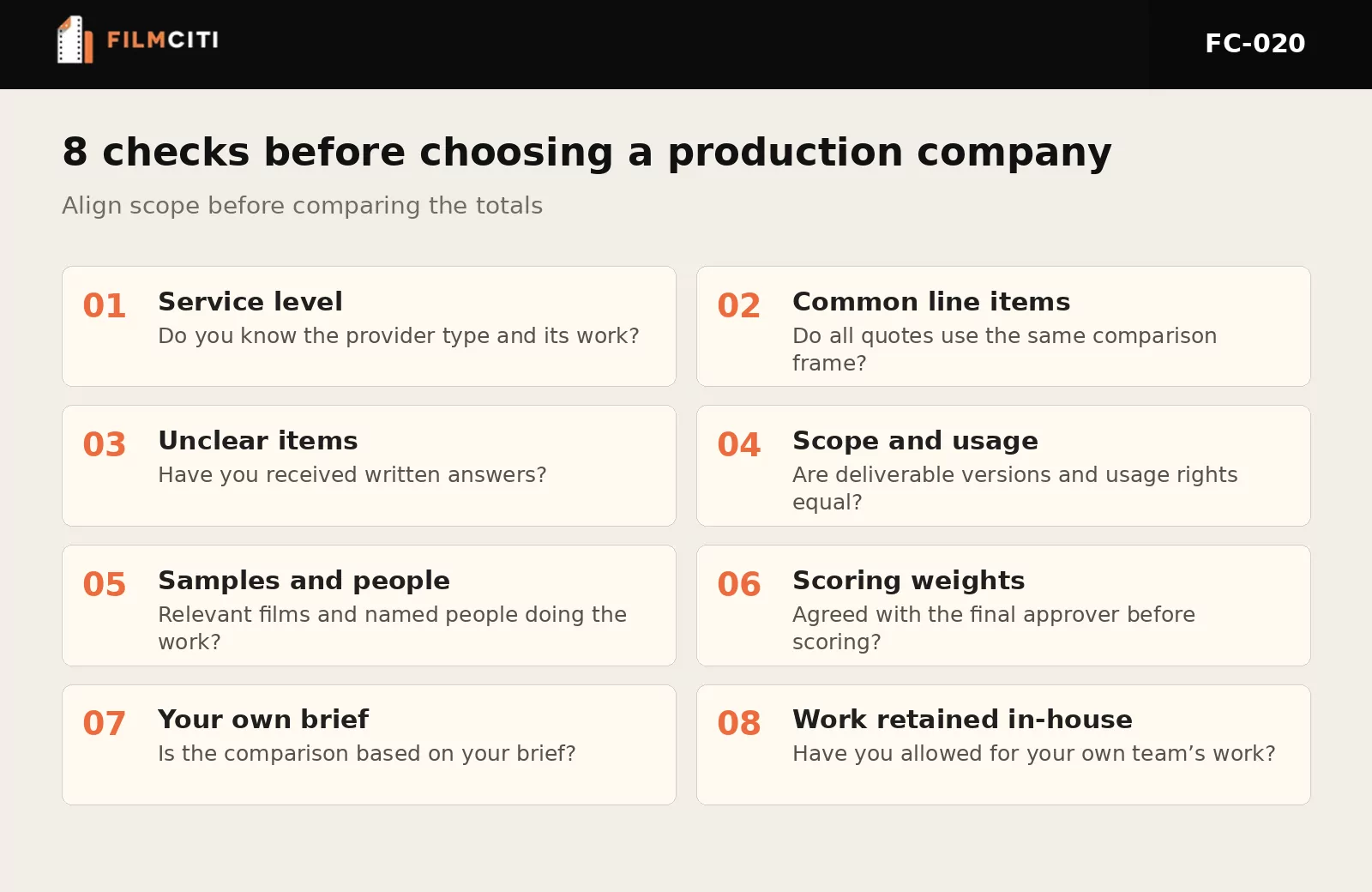
- Do you know which group each provider belongs to and which work they are taking on?
- Have the quotes been brought into the same frame of items?
- Has every "unclear" cell been followed up and answered in writing?
- Do the quotes share the same scope, including delivery versions and usage rights?
- Has each provider sent films of the same type and the name of the person doing the work?
- Were the weights of the grounds agreed with the final approver before scoring?
- Was the comparison frame built from the business's own brief?
- Has the work the business must do itself been factored into the choice?
Ask again if a provider will not say who will direct, if the sample films have no conditions in common with your project, or if the gap between quotes is large and cannot be explained by the scope of work.
Download the Quote request template and scoring sheet — Vietnamese template to send the same request to every vendor, map quotes to one line-item frame and score 5 criteria by weight.
Further reading
- Filmciti's corporate film production service: film types, process and ways of working.
- The production packages Filmciti publishes on its pricing page, as a point of reference when comparing quotes.
If you need one more option for your comparison table, send Filmciti a brief following the items in the quote request template above. Filmciti's producer will send a quote broken down by item, with "included" and "not included" sections, together with films of the same type and the name of the person leading the project.
Related service: Corporate film production
FAQ
Usually 3 quotes are enough to have points of comparison without spending too much time on discussions. More important than the number is that the quotes are based on the same brief, and that at least 2 different groups of providers are included so you can see the levels of service clearly.
The middle is not automatically safer. Choose on the scores for the 5 grounds once the quotes share the same scope; if the mid-priced provider scores highest, that is a choice with grounds, not a choice based on price position.
Yes. When providers know the business is comparing, they usually present their quotes more clearly by item, and you have a good reason to ask them to use a shared request template. What you should avoid is showing one provider's quote to another.