



Company film quotes: 5 things to confirm before you sign
You have chosen a production company, the total in the company film quote is within budget, and the contract is waiting to be signed. At this stage, most of the extra costs that appear later come not from unit prices but from things the two sides understand differently and nobody has written down. So a company film quote is ready to sign only when it clearly states 5 things: the deliverables and ownership, the scope of each revision round, the usage rights for music and people on camera, a payment schedule tied to sign-off milestones, and how extra costs are charged. As a budget reference point, Filmciti's pricing page lists all-in production packages starting from 70 million VND (excluding VAT) for 1 shoot day.

In this article
- The quote should state the deliverables, the raw footage and who owns the film
- Revision rounds and usage rights need a definition, not just a number
- The payment schedule should be tied to specific acceptance milestones
- How extra costs are calculated should be agreed before any change happens
- A postponed shoot day can cost more than a day of waiting
- Checklist before signing a company film quote
- Further reading
Start with the overview: Corporate film costs: why do quotes differ for the same running time?
Illustration.
The producer and the business owner go through the quote line by line before the contract signing.
The quote should state the deliverables, the raw footage and who owns the film
"A 3-minute company film" tells you the length of the main version, not which files the business will receive. The list of versions, subtitle languages, formats and file specifications should be set out in the quote, because each version needs extra time for editing, text adjustments and exporting.
The part most often understood differently is the raw footage, meaning all the unedited shots. Many businesses assume they will receive every shot so they can cut short videos themselves later. Meanwhile, some production companies deliver only the finished film, while the raw footage is archived for a set period and handed over only on request, possibly with the cost of a hard drive and copying time. A multi-camera shoot can produce hundreds of gigabytes of data, so this needs to be agreed from the start rather than "sent by link" at the last minute. If the business plans to use the footage to cut short videos for social media, say so from the start, because the crew will need to shoot extra scenes that suit a vertical frame, label the shots so they are easy to find again, and include the hard drive handover in the quote.
The third question is who owns the film once payment is complete. Can the business cut, edit or translate the film itself, or hire another company to continue working from the raw footage? Can the production company include the film in its portfolio? These depend on the agreement, so ask for them to be stated clearly in the contract or an appendix.
Revision rounds and usage rights need a definition, not just a number
The line "3 rounds of revisions" only means something when both sides understand what changes a round includes. Usually, a round covers changes within the existing edit, such as shortening, reordering shots or correcting on-screen text. Rewriting the narration after the voice-over has been recorded, adding a new point that needs extra filming, or changing the person on camera are usually charged separately. This boundary exists because every change outside the edit triggers a chain of other work: rewriting the narration means booking the voice artist and studio again, while adding new shots means re-editing the music, transitions and colour of the neighbouring sections too. You should also agree how many days the business has to send feedback in each round, because slow feedback pushes back the delivery date.
Usage rights need to be defined in the same way. Background music, voice-over and on-screen people usually come with a scope of channels and a period of use. Before signing, send the production company a list of the places the film will be used over the next 1–2 years, and ask them to confirm that the accompanying rights cover that list.
The payment schedule should be tied to specific acceptance milestones
A common payment schedule has 2–3 instalments: an advance on signing, one after the shoot, and the final one on delivery. This split is reasonable for both sides, because the production company needs funds to hold the crew's schedule and rent equipment, while the business pays as the work progresses.
What needs clarifying is which condition each instalment is tied to. "Payment on delivery" could mean on receiving the final edit, when the business signs the acceptance record, or when all versions have been received. If the condition is unclear, the two sides can easily get stuck right at the final stage, when the film is about to be shown.
Ask for each instalment to be linked to a specific deliverable or record, and agree how long the business has to respond for acceptance.
How extra costs are calculated should be agreed before any change happens
Extra costs are not always the result of one side doing something wrong. Rain on an outdoor shoot day, an on-screen person called away unexpectedly, or the business wanting an extra location are all real changes in production. The problem only arises when a change has happened and the two sides have not agreed how to charge for it.
There are 3 groups of changes worth writing down in advance. The first is postponing or cancelling a shoot day: how much notice avoids a fee, and which items are charged if notice comes late. The second is changes in scope: an extra location, an extra version, an extra person on camera. The third is the cost of shooting outside the city, including travel, accommodation and crew allowances. The first group needs the clearest wording, because once the shoot day is confirmed, the production company has already held the crew's schedule, paid equipment deposits and possibly applied for location permits, so a late postponement brings several costs that cannot be recovered. For the third group, ask whether the quote already includes travel costs, because many companies quote shoots outside Hanoi and Ho Chi Minh City separately.
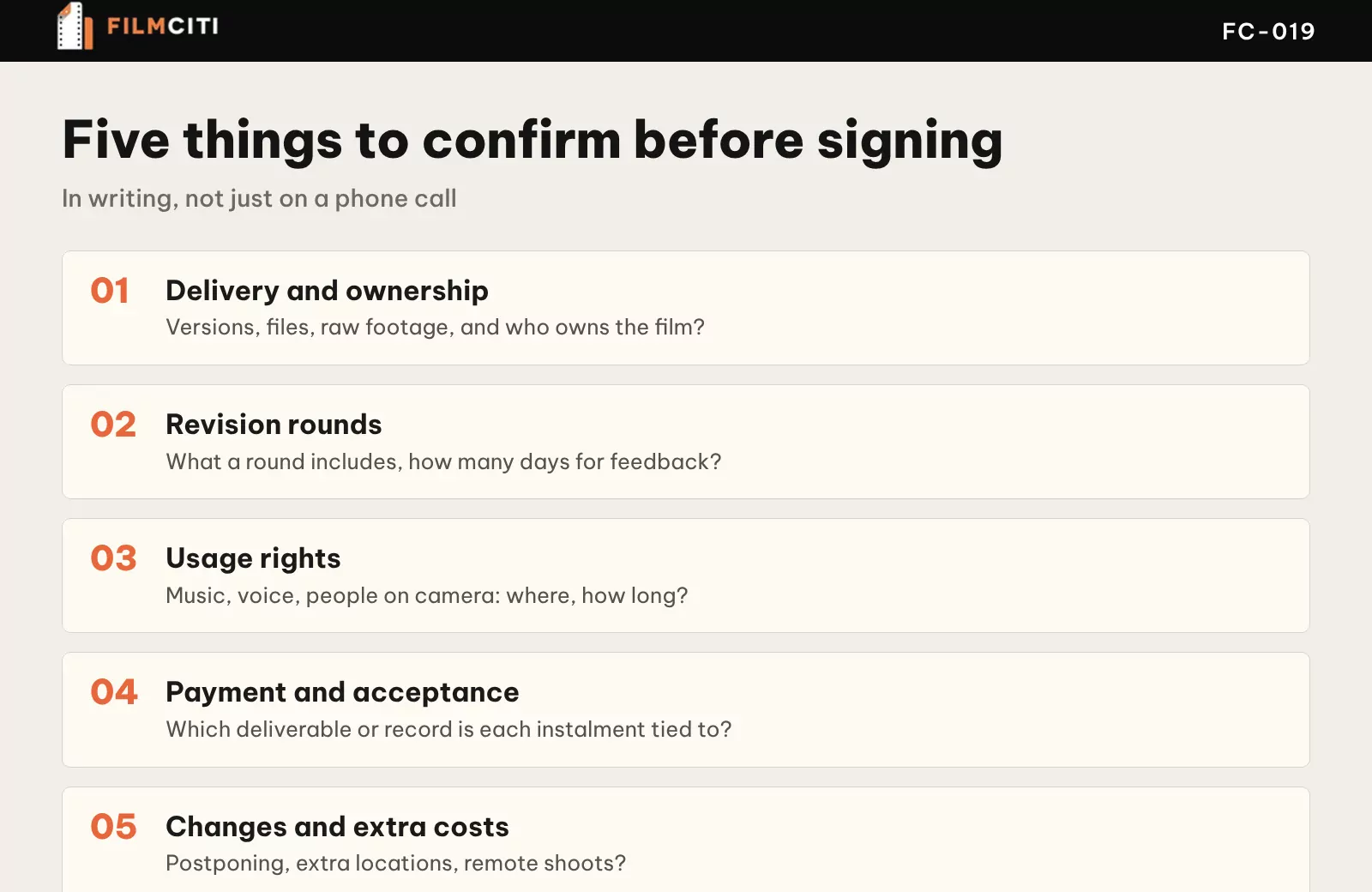
The table below turns the 5 items into a question to ask and a sign that the quote still needs clarifying.
| Item | Question to ask | Sign that it needs clarifying |
|---|---|---|
| Delivery and ownership | Which versions and raw footage will the business receive, and who owns the film? | The quote only states the length of the main version |
| Revision rounds | What changes does a round include, and how many days for feedback in each round? | Only the number of rounds, no scope |
| Usage rights | Where and for how long can the music, voice-over and on-screen people be used? | Says "as agreed" or does not mention it |
| Payment and acceptance | Which deliverable or record is each instalment tied to? | The final instalment says "on delivery" without a definition |
| Changes and extra costs | How are postponements, extra locations and remote shoots charged? | Says "extra costs charged as incurred" |
Not everything has to go into the quote. Some points fit better in the contract or an appendix, as long as they are written down and both sides have read them. What you want to avoid is an agreement that exists only in a chat message or a phone call.
The twist: at the final instalment, the business has approved the Vietnamese version but has not signed the acceptance record, because the English-subtitled version is still waiting for the overseas partner to check the terminology. The quote says "final instalment on delivery" without stating which versions delivery includes. There are 3 ways to handle this:
- Split the English version into a separate acceptance item. The business pays most of the final instalment for the Vietnamese version and the rest when the English version is complete; in return, the two sides need one more record.
- Accept everything as it stands, with a commitment to fix the terminology within a short period. This is the fastest option, but the business has to rely on that commitment after paying in full.
- Postpone the whole final instalment until the English version is ready. The business keeps control, but the wait depends on an outside partner, and the relationship can easily become tense.
A postponed shoot day can cost more than a day of waiting
An electronic components factory in Binh Duong needs a company film to show a Japanese partner delegation visiting on 20 August 2026. The shoot is fixed for Thursday 6 August 2026, two weeks before. Mr Phong, the factory director, tells the crew: "Let's shoot on Thursday, I'll let you know if anything changes." The quote is 1 page long, with no line about postponement, and because everyone is in a hurry, nobody asks further.
Pre-production goes smoothly. The script is approved in 2 days, the 8-person crew holds the date, the equipment deposit is paid, and the drone flight permit has been issued for that Thursday.
On Tuesday afternoon, another Japanese customer moves its factory audit to that very Thursday, because their delegation has changed its travel plans. On audit day, the line has to run according to the inspection procedure and no outsiders are allowed into the workshop. One Japanese delegation has taken the shoot day of a film made to welcome another Japanese delegation.
Mr Phong calls the crew: "Push it to next Thursday for me, it's just one week."
The crew explains that postponing is not just changing the date. Half the crew has taken other jobs next week, so replacements have to be found. The equipment deposit is not refunded when a cancellation comes within 48 hours. The drone flight permit was issued for the registered time window, and a new application takes time to process, so it may not be ready for next Thursday. If the shoot moves to next Thursday, editing time shrinks to exactly 1 week before the 20th, compared with 2 weeks in the original plan. In the end, the two sides spend a lot of time discussing who bears the deposit and the cost of reapplying for the permit, right when that time was needed for the new script and schedule. The film is still ready for the 20th, but the drone shots are dropped because the new permit does not come through in time.
The factory had no choice but to prioritise its customer's audit, and nobody blames Mr Phong for that. The crew is the first party that needs to look back at itself. They have filmed in many factories and know production schedules can always change, yet the quote has no line about the notice period for postponing or the items charged for a late change, and every risk is left to a single "I'll let you know".
The most valuable question in this project belonged in the very first conversation about the quote: "If the shoot day has to be postponed, how much notice does the business need to give, and which items will be charged?"
The story above is a hypothetical situation, reconstructed from things that often happen in corporate filmmaking.
With the Filmciti crew, we write the notice period for postponing and the items charged for a late change into the quote itself, and we ask the factory for its customer audit calendar for the month before proposing a shoot day. For scenes that need a drone, we register a flight window that also covers a backup day, so the aerial shots still have an option if the factory's schedule changes.
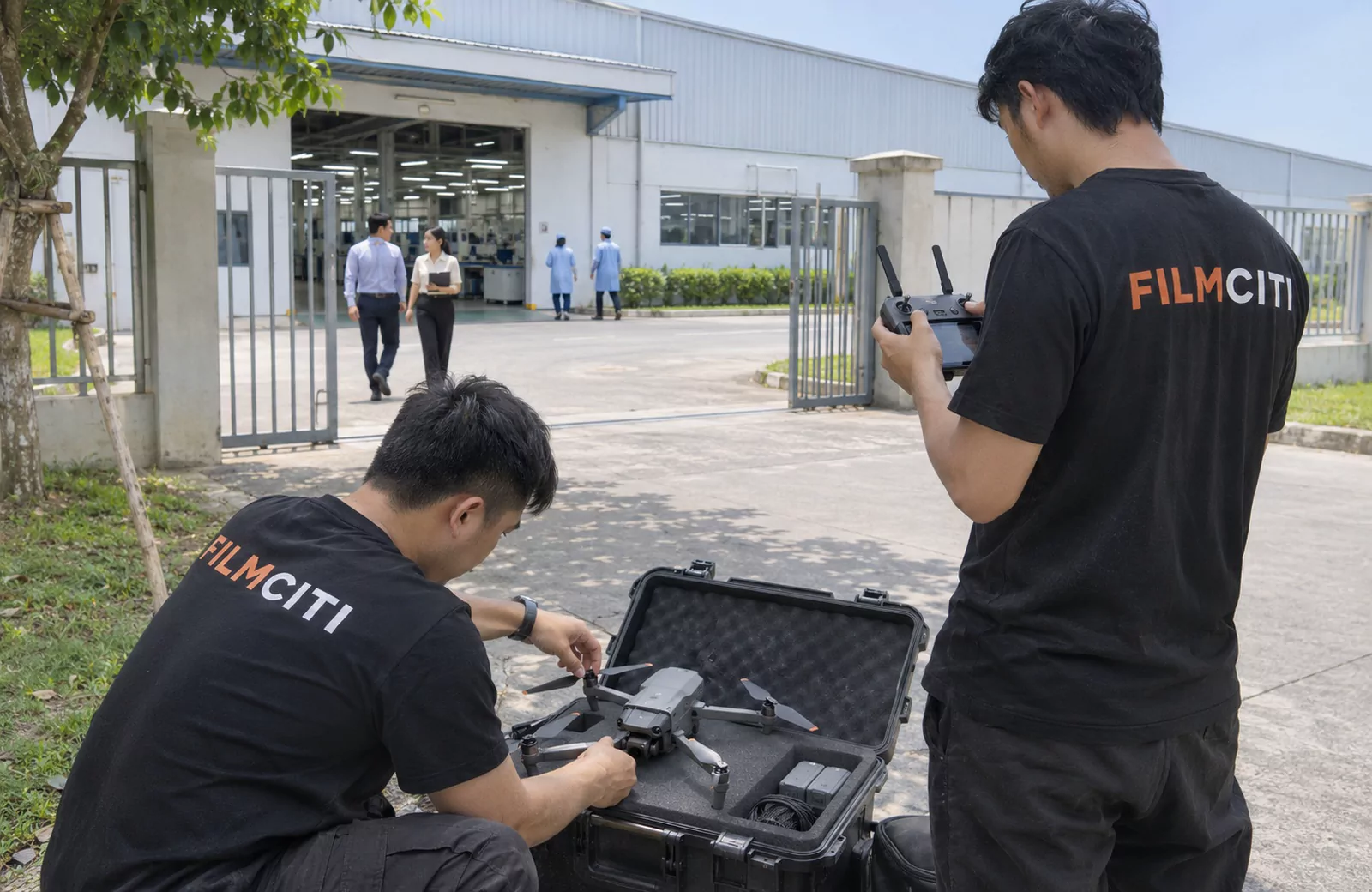
Illustration.
The crew prepares the drone in front of the factory gate on a shoot day covered by a flight permit.
Checklist before signing a company film quote
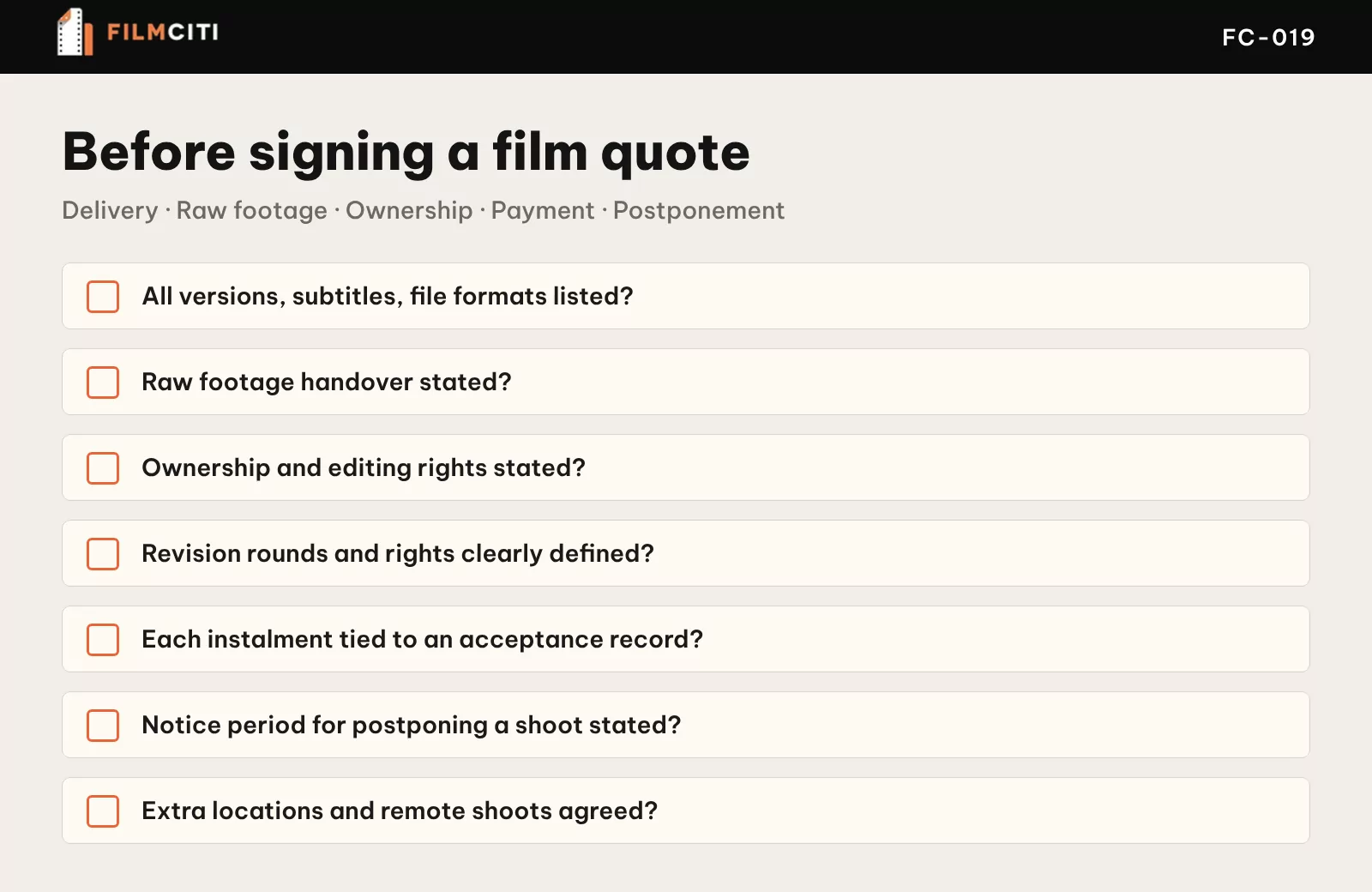
- Does the quote list all the versions, subtitles and file formats to be delivered?
- Is the handover of raw footage clearly stated?
- Does the contract state who owns the film and how far the business may edit it?
- Do revision rounds and the scope of usage rights have a specific definition?
- Is each payment instalment tied to a specific deliverable or acceptance record?
- Does the quote state the notice period for postponing or cancelling a shoot day without a fee?
- Has the way of charging for extra locations or shoots outside the city been agreed?
Ask again if the quote contains phrases such as "all-in", "as agreed" or "extra costs charged as incurred" without a definition, or if things agreed over the phone have not appeared in any written document.
Download the Pre-signing quote review sheet — Vietnamese template to record answers on the 5 points to confirm, tie each payment to an acceptance step and agree on rescheduling terms.
Further reading
- Filmciti's corporate film production service: film types, process and ways of working.
- First-time corporate filmmaking: what to know before you start.
If you want a proposal to compare before signing, send Filmciti a brief covering the film length, the versions to be delivered, the channels where the film will be used and the date it must be ready. Filmciti's producer will send a proposal that includes the full delivery scope, the number of revision rounds and the accompanying conditions.
Related service: Corporate film production
FAQ
The price depends on the number of shoot days, locations, on-screen people, the amount of graphics and the versions to be delivered, so the same 3 minutes can come at very different costs. Send a complete brief to get a quote for the exact scope, then check it against the 5 items in this article before signing.
They do not have to be in the quote, but they need to be written in a document both sides sign or confirm, such as the contract, an appendix or an email confirming the scope. What matters is not leaving the agreement only in a phone call.
There is no general rule, so it depends on the agreement between the two sides. If the business plans to use the footage for more videos later, say so from the start so the quote covers handing over the raw footage and the rights that come with it.