

TVC production quotes: the costs behind a 30-second commercial
You have just presented a TVC production quote to the board, and the first question you get is: "The film is only 30 seconds, so why does it cost more than a 3-minute company film?" This question is very common, because many people are used to estimating the value of a video by its length. In reality, the cost of a TVC is not proportional to its seconds on screen; it depends on how many people are involved, how many working days are needed, how tightly every frame is controlled and how widely the film will be used once finished. This article walks through each cost group in a TVC quote, so that you can explain why each line is there and which lines can be adjusted when the budget is limited.
In this article
- TVC costs are calculated by the work needed to create 30 seconds, not by the number of seconds
- A TVC quote usually has 5 cost groups
- Three items usually cause the biggest differences between TVC quotes
- Illustrative table: the cost groups of a 30-second TVC for a cooking-oil brand
- Cutting a small cost line can sometimes create a bigger bill on the shoot day
- Checklist before presenting a TVC quote to the approver
- Further reading
Start with the overview: TVC production: when should a business invest, and what does it need to prepare?
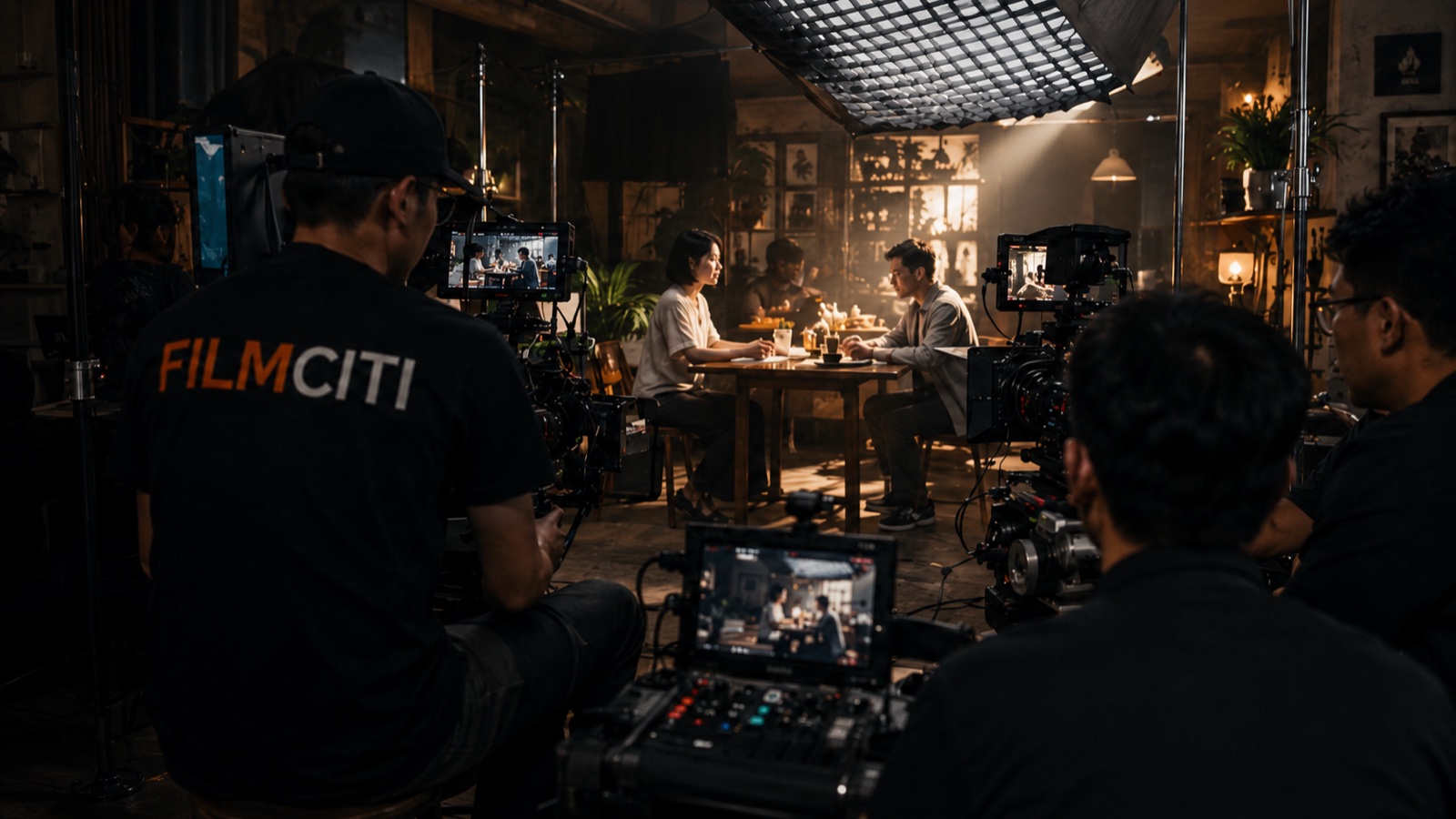
Illustration.
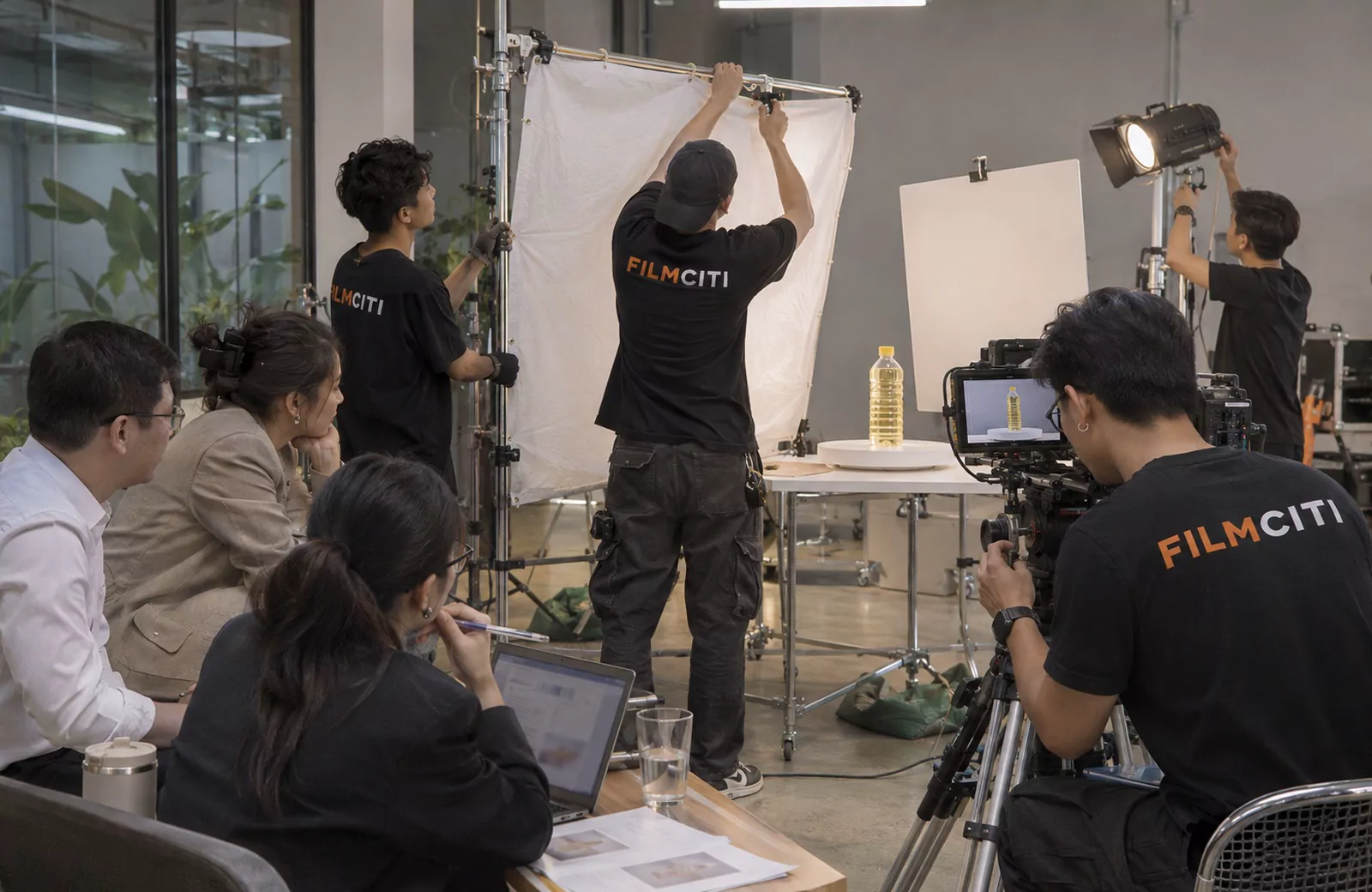
The lighting crew and camera operator prepare the closing product shot on the turntable in the studio.
TVC costs are calculated by the work needed to create 30 seconds, not by the number of seconds
In a 3-minute company film, many scenes are shot as things actually happen in the factory or office. In a TVC, almost every frame is staged in advance: where the actors stand, which direction the light comes from, which angle the product turns to, and how many frames each movement lasts. The reason lies in how the film is broadcast: a TVC runs repeatedly during a campaign, so every mistake is seen by viewers many times over.
A 2-second shot can take half a day to film. For example, a shot of water pouring into a glass with droplets splashing in time with the music needs a high-speed camera, someone preparing the product and sometimes dozens of takes before one works. The closing product shot (the packshot) is also usually filmed separately, with the lighting adjusted down to every reflection on the packaging. Every extra take means drying the table, setting a fresh glass, resetting the lights and waiting for the high-speed camera to finish writing its data, so time passes much faster than it feels to someone watching the monitor. This is why a TVC quote usually lists the number of shots and shoot days in some detail: those two figures decide how many working hours the crew needs, and they are the easiest points to check when you present the quote to the approver.
So when explaining the quote to the approver, ask the production company to present costs by work group, instead of a single line saying "30-second TVC, all-in". A quote split into groups shows where the budget sits, and helps both sides discuss specifics when adjustments are needed.
A TVC quote usually has 5 cost groups
The first cost group in a TVC quote is creative and pre-production, including developing the concept and script (if the business does not have one yet), the director's treatment, storyboard, casting, location scouting and the pre-production meeting. This part creates the blueprint for the whole film and determines most of the costs in the groups that follow.
The second group is shoot-day crew. Besides the director and camera operator, a TVC usually needs roles rarely seen on company films, such as an art director, costume, make-up, someone who prepares food or products for the camera (a stylist) and an assistant director who manages the progress of each shot. The third group is equipment, studio and sets: cameras, lenses, lights, motion equipment, studio hire or building a dedicated set.
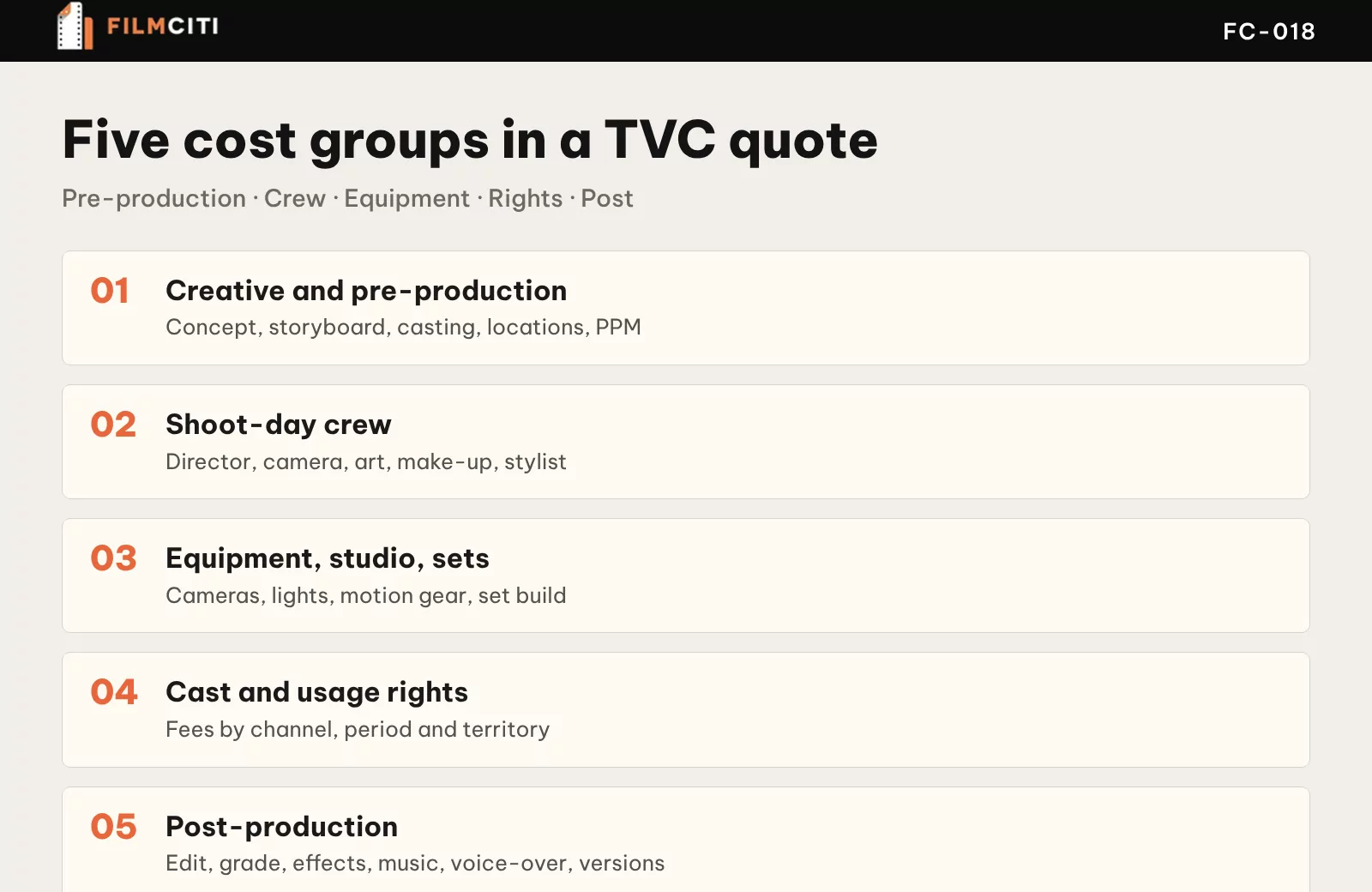
The fourth group is cast and usage rights. Actors' fees are usually tied to the scope of use: which channels the film runs on, for how long, and in which countries. Running on national TV for 1 year and running only as social media ads for 3 months are two different levels of rights. The fifth group is post-production, including editing, colour grading, graphics, effects, music (original or licensed), voice-over recording, sound mixing and exporting versions to each channel's specs. These two groups are often underestimated because they are invisible on the shoot day, yet they are tied directly to how the business will use the film: the more channels and versions, the higher the rights costs and the export workload. That is why the media plan should exist before the production company prepares the quote.
When reading a quote, check whether all 5 groups are there. If a group is missing, ask whether the business is expected to handle it or whether it has been folded into another line.
Three items usually cause the biggest differences between TVC quotes
The first item that makes TVC quotes differ is the amount of post-production. A TVC shot entirely live-action and a TVC with 3D product simulations, such as coffee beans flying across the screen or a stream of milk forming letters, involve very different amounts of post-production work. Two quotes that both say "post-production" may be describing two very different workloads.
The second item is the set. Shooting in an existing apartment or shop costs less than building a kitchen in a studio, but an existing location brings limits on camera angles, lighting and the hours you are allowed to shoot. A dedicated set costs money to design and build, but in return the crew controls every detail and can shoot for longer. The location also determines travel, accommodation and equipment transport costs for the whole crew. According to Filmciti's pricing page, TVCs and iTVCs run from 15 to 90 seconds, while shooting outside Hanoi and Ho Chi Minh City and KOL fees are quoted separately, outside the production package. When comparing two quotes, ask where the set is and whether travel costs have been included.
The third item is usage rights, including the image rights of actors and key opinion leaders (KOLs) and music rights. The wider the broadcast scope or the longer the period, the higher the cost of rights. Compare the scope of rights in the quote with the actual media plan, so that you neither pay for rights you will not use nor have to buy more once the campaign is already running.
Illustrative table: the cost groups of a 30-second TVC for a cooking-oil brand
The brief: a cooking-oil brand needs a 30-second TVC to run on TV and social media for 1 year. The script has a family of 3 cooking dinner, close-ups of frying and a shot of the oil bottle at the end. The film is shot in 1 day in a studio with a built kitchen. The table below compares the 5 cost groups of this film by where each cost comes from and how to save while keeping the idea.
| Cost group | Where the cost comes from | How to save while keeping the idea |
|---|---|---|
| Creative and pre-production | Detailed storyboard for every shot, casting a family of 3, kitchen design | Keep as is; cutting here usually creates extra costs on the shoot day |
| Shoot-day crew | Food stylist, art director, make-up for 3 actors | Reduce the number of shots to avoid overtime; film shots for the 15-second version on the same day; do not cut specialist roles |
| Equipment and set | Studio kitchen build, high-speed camera for the hot-oil shots | Rent an existing show kitchen, film the hot-oil shots on a small tabletop set |
| Cast and rights | Fees for 3 actors with 1 year of TV and social media rights | Narrow the rights to match the media plan, or reduce to 2 actors |
| Post-production | Food colour grading, original music, voice-over, 30-second, 15-second and 9:16 versions | Use licensed library music, reduce the shots that need detailed grading |
The twist: after receiving the quote, the board asks for a 30% cut in the production budget while keeping the on-air date. There are 3 ways to handle this:
- Keep the idea, reduce the scale: switch from a built kitchen to an existing show kitchen, and reduce the family of 3 to 2. The film keeps its story, but camera angles and lighting are limited by the real location.
- Keep the image quality, narrow the scope of use: buy only social media rights for the first 6 months, and decide on TV after the campaign shows results. The immediate cost falls, but if more rights are bought later, the total may be higher than buying once.
- Switch to a simpler idea: focus on the food and the oil bottle, with no actors. The budget falls the most, but the film loses the family element, which is the emotional core of the message.
Cutting a small cost line can sometimes create a bigger bill on the shoot day
A food company in Can Tho is making a 30-second TVC for its frozen fried chicken range, going on air with a promotion on 1 April 2026. The studio has exactly 1 free day left in March. When approving the quote, the finance director strikes out the line "Food stylist: 1 person". "Our kitchen has the best chef in the region, why hire someone just to arrange the food?" The crew notes a line saying "Client prepares the food" in the scope confirmation email.
The shoot day starts on time. The chef fries the first batch of chicken golden and crisp, and the whole crew gets hungry just from the smell. The chicken is placed on the table, the studio lights come on, and the camera starts rolling.
After 20 minutes under the lights, the coating has gone flat, oil has seeped onto the plate and the garnish has started to wilt. On the monitor, the chicken looks as if it was left over from yesterday. The director calls a halt.
The marketing manager calls the finance director for his view and gets the answer: "Just have the chef fry another batch, it's a small fix."
Each new batch takes 15 minutes to fry, and then the crew resets the lighting and composition from scratch, but the second and then the third batch also go flat before the shot is done. Food that tastes good and food that looks good on camera are two different jobs: a stylist knows how to keep the coating puffed up and the chicken glossy, and when to swap in a fresh plate. The shoot day runs 4 hours over; overtime for more than 20 people plus the studio extension far exceed the amount that was cut, and the closing close-up of the chicken has to be reshot on a small tabletop set at the crew's workshop, 3 days before going on air.
Looking at a quote that only listed job titles, the finance director cut a line he thought was unnecessary, and any budget holder could have done the same. The heavier share of the blame sits with the crew. Every filmmaker knows that fried food goes flat under studio lights, yet the crew only recorded the cut in an email, without explaining what a stylist does or spelling out the risk when the business proposed dropping the role.
One question asked at the moment the line was struck out could have kept the shoot day on schedule: "If we drop this cost line, who will do that work on the shoot day, and what is the risk?"
The story above is a hypothetical situation, reconstructed from things that often happen in corporate filmmaking.
With the Filmciti crew, we describe in the quote what each role will do on the shoot day, not just its title. When a business wants to drop a line such as the food stylist, we explain right away who would take over and what could happen in front of the camera, then agree on an option with the client before sending the scope confirmation email.
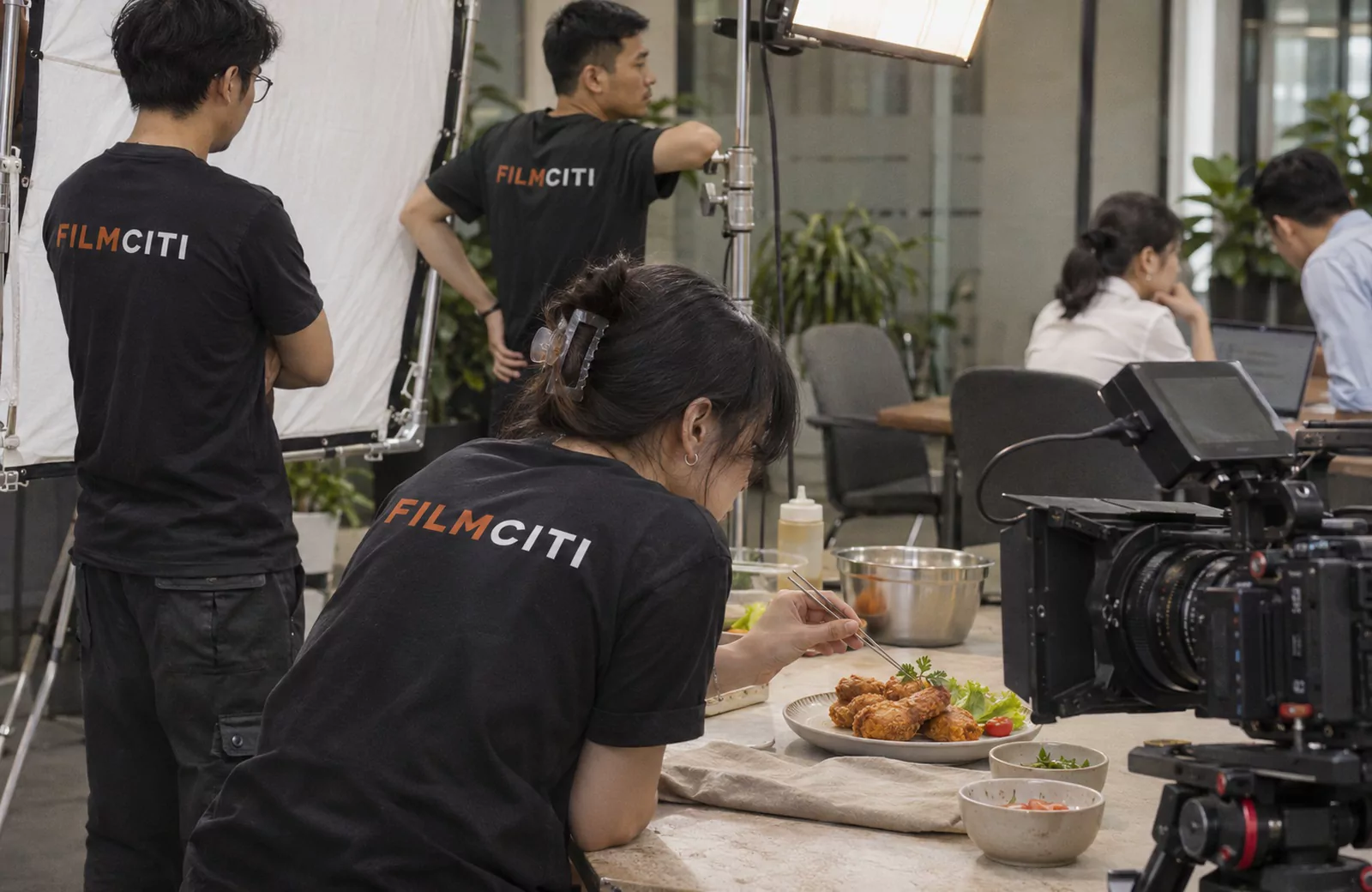
Illustration.
The stylist adjusts the food on the turntable while the lighting crew waits to shoot the close-up.
Checklist before presenting a TVC quote to the approver
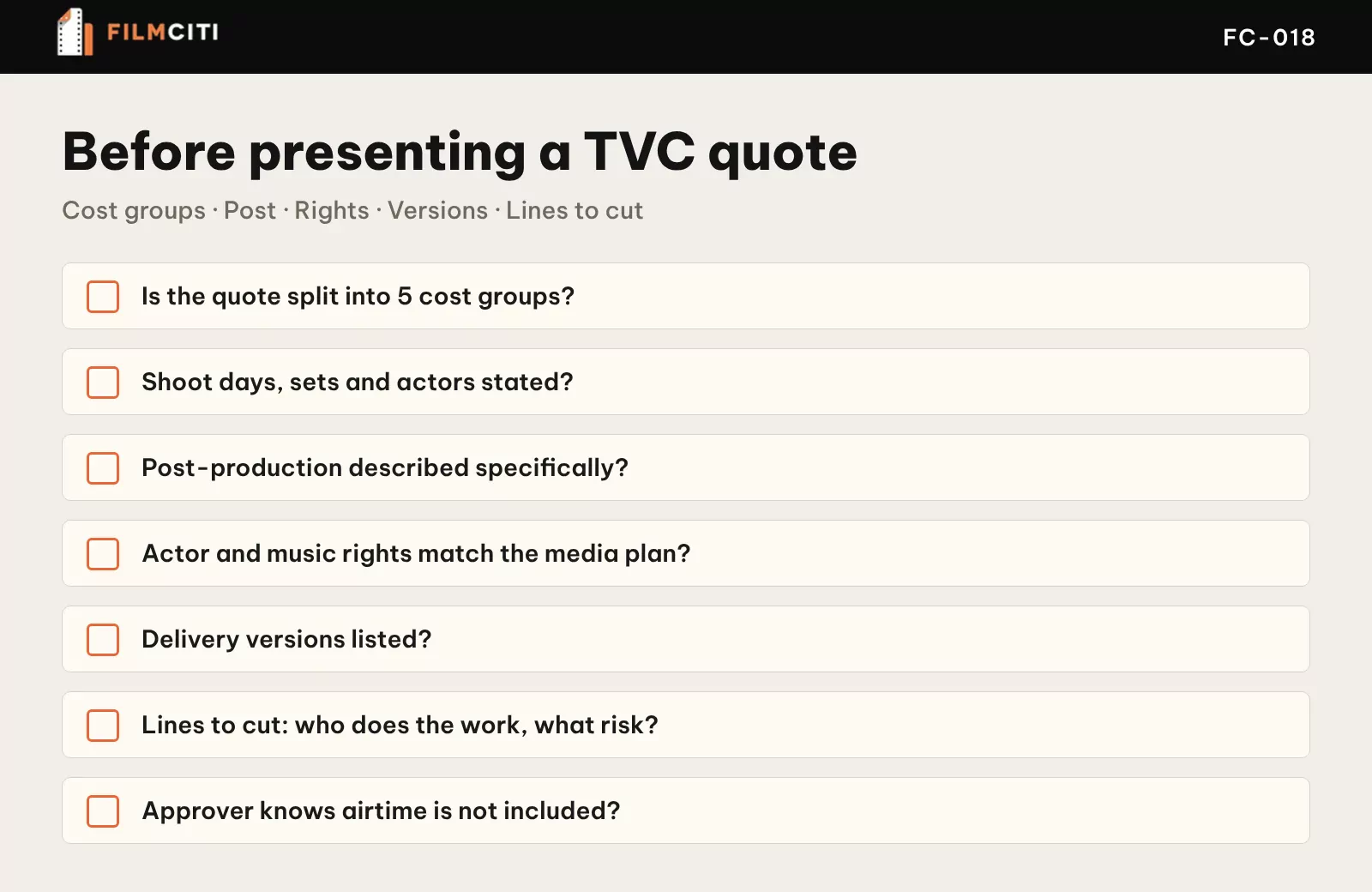
- Is the quote split into 5 cost groups, or is it a single all-in line?
- Does the quote state the number of shoot days, sets and actors?
- Has the amount of post-production been described specifically, including any 3D shots or effects?
- Does the scope of actor and music rights match the media plan?
- Have the delivery versions (30 seconds, 15 seconds, 6 seconds, 9:16) been listed?
- For each line you want to cut, have you asked who will do that work and what the risk is?
- Has the approver been told that this quote does not include the cost of buying airtime?
Ask again if the quote says "usage rights: as agreed" without naming channels and periods, or if two quotes differ a lot while both describe post-production in a single identical line.
Download the TVC quote reading sheet by 5 cost groups — Vietnamese template to check that a quote covers every cost line, and note who takes over and the risk before cutting an item.
Further reading
- TVC production: when a business should invest and what to prepare
- Why film costs still rise after the budget has been approved
- Filmciti's TVC and iTVC production service: pre-production, production, post-production and delivery versions.
If you need a proposal to compare with the quote you already have, send Filmciti a brief with your idea or script (if any), the media plan, the usage rights you need and the versions to be delivered. Filmciti's producer will send a detailed proposal organised by the same 5 cost groups.
Related service: TVC / iTVC production
FAQ
There is no single price, because the cost depends on the idea, the number of shoot days, sets, actors, the amount of post-production and the scope of usage rights. The quickest way to get a realistic figure is to send a brief with the media plan and the versions to be delivered, then ask the production company to quote by cost group.
A TVC is staged almost frame by frame, needs more specialist roles on the shoot day, and usually carries usage-rights costs for actors and music according to the broadcast scope. A company film shoots many scenes as they happen, so the workload per second of film is lower.
Usually by reducing the scale of execution, such as fewer sets, fewer actors or narrowing the scope of rights to match the media plan. Cutting pre-production or specialist roles on the shoot day usually creates bigger costs in later steps. Before cutting a line, ask the production company who will do that work on the shoot day and what the risk on screen is.