




What should the first 3 seconds of a TikTok script include? How to write them for a business
The product video was carefully filmed with beautiful lighting, but the audience retention chart in TikTok analytics drops sharply from the very first second. Usually the problem is not in the middle of the video but in the fact that the first few seconds give viewers no reason to stay, such as a spinning logo, a greeting or a wide shot of the office. No opening line can guarantee viewers will stay, but the first 3 seconds of a TikTok video script need to do two things: tell viewers straight away who the video is for, and make the image, on-screen text and speech say the same thing. This article shows how to write that opening, with 4 openings a business can use and the limits of each one.

In this article
- The first 3 seconds need to tell viewers who the video is for
- Image, text and speech need to say the same thing from the very first frame
- 4 openings a business can use, each with its own limits
- Fixing the first 3 seconds of a script: before and after
- Whatever the opening line promises, the rest of the video has to deliver
- Shortening an opening line to fit 3 seconds can turn it into a promise to customers
- Checklist before approving the first 3 seconds of the script
- Further reading
The first 3 seconds need to tell viewers who the video is for
On the For You page, viewers decide very quickly whether to scroll on or stay, usually before they know which brand the video belongs to. The question they answer in their heads is simple: is this content relevant to me or not?
A business does not need to keep everyone watching, only the right people, such as a homeowner renovating their house, a site engineer or a restaurant owner looking for equipment. An opening line that names that group's exact situation will hold the right viewers and let those it does not concern scroll past. For channels selling high-value products or services, that is a good result, even if total views may be lower. The reason lies in who stays: when the right customers watch to the end, comment to ask about prices or save the video for later, the channel gets signals that actually help sales. By contrast, an opening line that is too broad may bring in many passing views but almost no messages asking to buy.
Compare two opening lines: "Walls turning yellow after the rainy season?" and "Hello, we are X Paint Company." The first tells viewers straight away who the video is for, while the second only tells them who is talking.
Before writing the script, add one line at the top of the page: who is watching this video and what problem they have. The opening line needs to name exactly that problem.
Image, text and speech need to say the same thing from the very first frame
In the first 3 seconds, viewers take in three layers of information at once: the image (what they see), the on-screen text (what they read) and the speech or sound (what they hear). Many people scroll in places where it is not convenient to turn the sound on, so the on-screen text often has to carry the main point. If the three layers say three different things, for example the image is a logo, the text is a campaign name and the speech is a greeting, 3 seconds go by and the viewer still has not received a single point. So when writing the script, decide first which layer carries the main point and how the other two support it. For example, the on-screen text names the problem, the image shows that problem happening, and the speech goes one step further by hinting at the cause.
In addition, if you do not choose a separate cover image, the first frame usually becomes the video's thumbnail on the channel grid. When the first frame makes its point clearly, anyone visiting the channel can tell what it is about just by looking at the grid.
The easiest approach is to start in the middle of the action, while something is happening. For example: a hand scraping flaking paint off a wall, with the text "Repainted twice and still peeling?" and the line "The problem usually isn't the paint." The video needs no set-up shots or lead-in.

When writing the script, split the first 3 seconds into three columns: image, text and speech. Then read each column on its own to check whether all three say the same thing. The logo and greeting should come after the third second or at the end of the video. If you use trending music, the music is only the sound layer; the image and text still have to carry the main point on their own.
4 openings a business can use, each with its own limits
The most effective opening for a business usually comes from customers' real questions, such as inbox messages, comments under older videos, or the question salespeople hear most often. Below are four commonly used openings, with when to use each one and its limits.
| Opening | Example | Works when | Limits |
|---|---|---|---|
| A question customers often ask | "Can water-damaged wood flooring be saved?" | The business has real questions from its inbox or comments | A question that is too general will not filter for the right viewers |
| Result first, method second | A freshly painted wall, then cutting back to when it was still peeling | The product or service creates a visible change | The result must be real; heavy editing easily makes viewers suspicious |
| A common mistake | "Choosing a water tank for a townhouse: many people get the capacity wrong" | Viewers are preparing to buy or to build | Easily read as criticising others; talk only about the mistake, never about competitors |
| Work in progress | A cutting machine running, with the text "How a sheet of aluminium becomes a door frame" | The business has an eye-catching production process | Without an accompanying question, the video easily stays at entertainment level |
A channel does not need to use all four. Choose just one or two that suit your product and stick with them long enough to compare results between videos.
Fixing the first 3 seconds of a script: before and after
The brief: a tile shop wants a TikTok video about bathroom tiles that come loose and crack. The first draft of the script follows the familiar order of an introduction video.
| Seconds | First draft | Revised version |
|---|---|---|
| 0–1 | Spinning logo, background music | Close-up of a cracked bathroom tile at the base of the wall, with the text "Bathroom tiles cracking after a year?" |
| 1–2 | Wide shot of the showroom, with the text "Showroom X, trusted for years" | A hand taps the tile and it sounds hollow, with the line "That sound tells you where the problem is." |
| 2–3 | Staff member: "Hello everyone, today…" | A staff member already holding a trowel: "The problem is the mortar, not the tile." |
The revised version does not drop the showroom or the logo; it simply moves them after the third second. The line "The problem is the mortar" is also a promise, so the rest of the video has to show where the mortar went wrong and how to redo it.
A complication: the shop owner wants the logo to appear from the very first second "so people know it's ours". There are three ways to handle this:
- Put a small logo in the corner of the screen throughout the video and add the shop's name to the final text frame. This keeps brand recognition without taking up the first 3 seconds.
- Let the brand appear naturally in the first frame, for example on uniforms printed with the shop's name or labelled boxes of tiles. This gives clear recognition, but props and clothing need to be prepared before the shooting day.
- Post two versions of the opening a few days apart and compare the view-through rates. This gives you data to discuss with the shop owner, but each video is also affected by posting time and topic, so the results are only indicative; in addition, two near-identical videos on the same channel may have their recommendations restricted.
Whatever the opening line promises, the rest of the video has to deliver
A clickbait opening line can keep viewers past the third second. However, if the rest of the video does not answer what was promised, viewers will leave after a few seconds, comment that they were baited, and skip the channel next time. Views may go up, but trust in the channel goes down.
It helps to distinguish two kinds of opening line. Familiar hooks such as "Don't buy paint until you've watched this video" are understood as attention-grabbers, because the rest of the video usually explains or even contradicts the line itself. By contrast, a line with a specific number, time or result, such as "one coat and the leaks stop" or "dry in 30 minutes", is read by customers as a commitment from the brand and followed word for word. When the result does not match the video, the first people to be questioned are usually dealers and sales staff. Beyond the risk to dealers, there is also a legal risk: under Vietnam's amended Law on Advertising No. 75/2025/QH15, in force since 1 January 2026, advertising content must not mislead about a product's features, quality, uses or effects.
So every number and result that appears in the first 3 seconds should be confirmed by the technical team or the person responsible for the product, even when the line has been shortened to fit the frame. The full answer should appear early, in the first half of the video, rather than at the very end. The trade-off is that an accurate opening line may spark less curiosity, but the business avoids having to deal with complaints afterwards.
Shortening an opening line to fit 3 seconds can turn it into a promise to customers
In early May 2026, a waterproofing paint company in Hanoi is preparing its rainy-season promotion. Hiếu, the executive in charge of the TikTok channel, has a target of three videos a week and 100,000 views per video.
The product's technical guide is clear: the surface must be dry, with one primer coat followed by two top coats. When editing the first 3 seconds, the crew finds this too long and shortens it to the text "Waterproof in one coat, just roll it on", laid over a shot of a roller sweeping across a stained wall. Hiếu, with three videos to deliver that week, approves it at once, because the line is short and can be read in two seconds. Five days later, the video has 400,000 views and the inbox is full of people asking to buy.
In mid-June, it rains for a whole week. The biggest dealer posts three photos of customers' walls that are still leaking in the sales team's Zalo group, with the message: "Customers are coming to the counter with their phones, pointing at the text in the video and saying the brand told them one coat is enough. What do I tell them?" The customers had applied exactly one coat, on walls still damp from the rain, just as they had seen in the video.
Hiếu messages the crew: "Just fix the first line, add 'primer + 2 top coats' and we're done."
However, TikTok does not allow you to replace the file of a published video. The text was burned into the image, so the only options are to delete the video or repost it. Deleting it would lose 400,000 views along with the comments asking to buy; keeping it means the video keeps being recommended to new viewers right in the middle of the rainy season. In the end, the company keeps the video and pins a comment explaining how many coats to apply, the crew rushes out a video on "3 mistakes that make waterproofing fail", and the technical team has to send staff out with dealers to handle each complaint.
The crew shortened the line to fit 3 seconds, Hiếu needed a short line to stay on schedule, and the customers did exactly what the video said: everyone had their reasons. The editing crew also recognises its own oversight: it weighed only the length of the line, when any text that mentions the number of coats needs to go to the technical team before editing.
From the script review onwards, both sides should answer one question together: "Is there any detail in this opening line that customers will follow word for word, and has the technical team confirmed it?"
The story above is a hypothetical scenario, reconstructed from situations that commonly happen in corporate filmmaking.
With the Filmciti crew, we flag every opening line that contains a number, a count of coats, a time or a result at the script stage, and send it with the product's technical guide for the client to confirm before the shoot. If the text later has to be shortened to fit 3 seconds in the edit, the shortened version goes back to the person responsible for the product for approval, rather than being judged on length alone.

Checklist before approving the first 3 seconds of the script
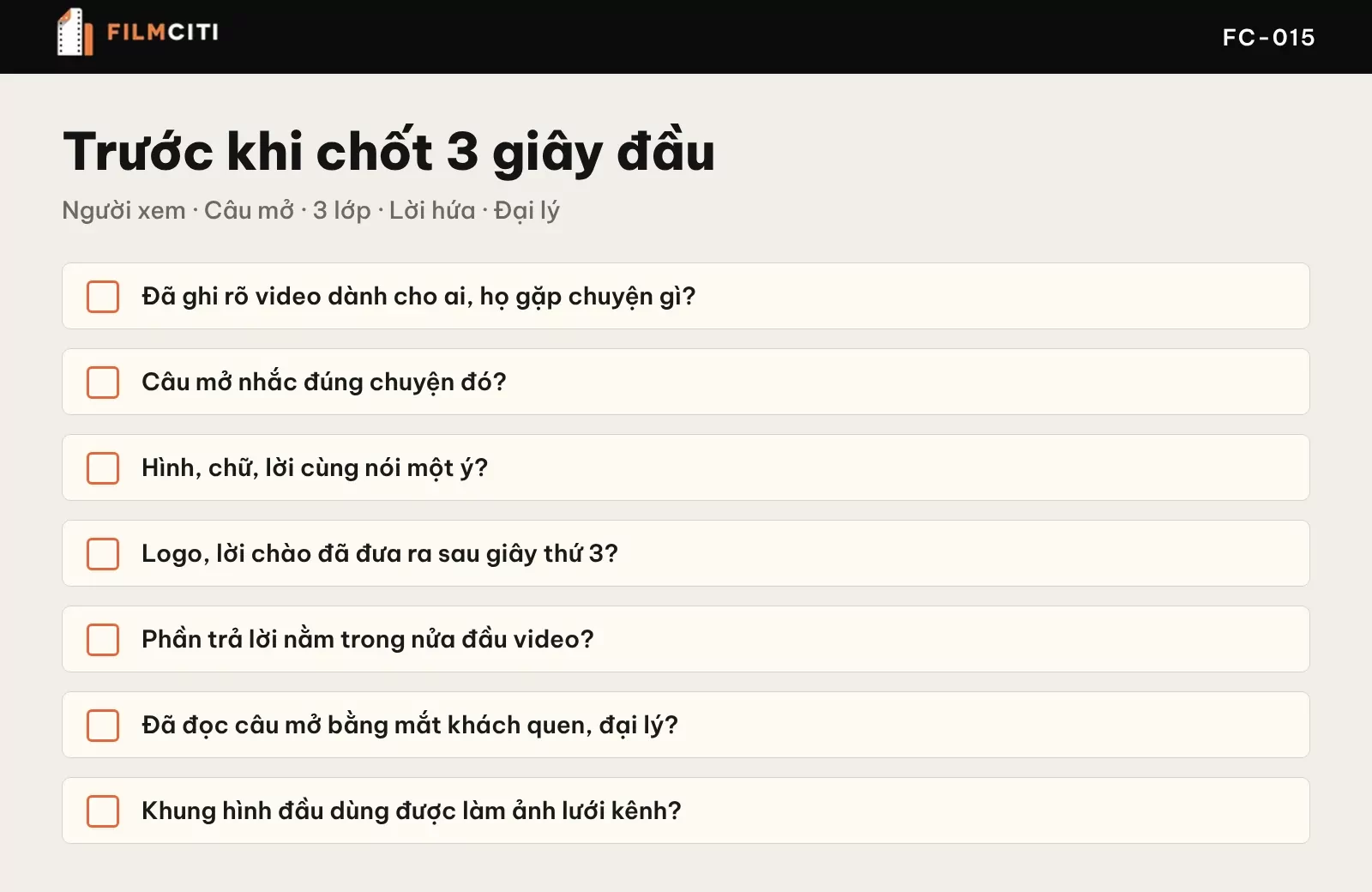
- Have you written down who the video is for and what problem they have?
- Does the opening line name exactly that problem?
- Do the image, text and speech in the first 3 seconds say the same thing?
- Have the logo and greeting been moved after the third second?
- Does the answer to the opening line come in the first half of the video?
- Have the numbers and results in the opening line been confirmed by the technical team?
- Can the first frame work as the thumbnail on the channel grid?
Review the script when the opening line could be used by any brand in the industry, or when the answer to the opening line comes in the last 10 seconds of the video.
Download the First-3-seconds script template for TikTok — Vietnamese template to plan the viewer, problem, spoken line, on-screen text and opening frame for each video in one sheet.
Further reading
- TikTok and short-form video for businesses: where to start
- 6 TikTok content directions for B2B businesses
- Filmciti's TikTok channel-building service: content planning, production and channel management for businesses.
Send Filmciti a brief with 3–5 questions customers often send to your inbox, the product you want to feature and a link to your current channel (if you have one). The Filmciti crew will propose first-3-second scripts for your channel's first videos.
Related service: TikTok channel service
FAQ
There is no such formula. Every channel and every audience reacts differently, so check the retention chart for each video in TikTok analytics to see at which second viewers leave, and adjust step by step.
No. A product shot or a shot of work in progress, with on-screen text, can also make a good opening. A host is useful when the video needs to explain something or answer a specific question.
It should be just long enough to answer what the opening line promised, because there is no standard length for every channel. The simpler the point, the shorter the video; for a topic with several points, split it into a series in which each video fully answers one question. The retention chart will show where a video is running longer than it needs to.