

Factory introduction video: what partners need to see before they commit
A delegation from a foreign group is about to come and audit your plant, and the sales team has been asked to make a factory introduction video to send ahead and play at the welcome meeting. The familiar reflex is to start with the founding year and end with the certificates on the wall. Yet the people watching are the partner's purchasing and quality teams, and they are looking for evidence to answer a very different question: can this plant deliver the right parts, at the right quality, on time, for years to come? A factory introduction video answers that question when it shows 5 kinds of information on screen: capacity and equipment, quality control, lot traceability, people and training, and safety and compliance. This article helps you build the script, shot list and film versions around those 5 kinds.
In this article
- A factory introduction video is watched by people assessing risk, not by people curious about the company
- Partners need to see 5 kinds of information before they trust your production capability
- The script should follow the product's path, not the company's history
- The shot list must be confirmed by the quality and EHS departments before the shoot day
- A beautiful film can still miss the one room the audit team wants to see
- Checklist before making a factory introduction video for partners
- Further reading
Start with the overview: Filming a factory in operation: aligning the shooting schedule with the production plan
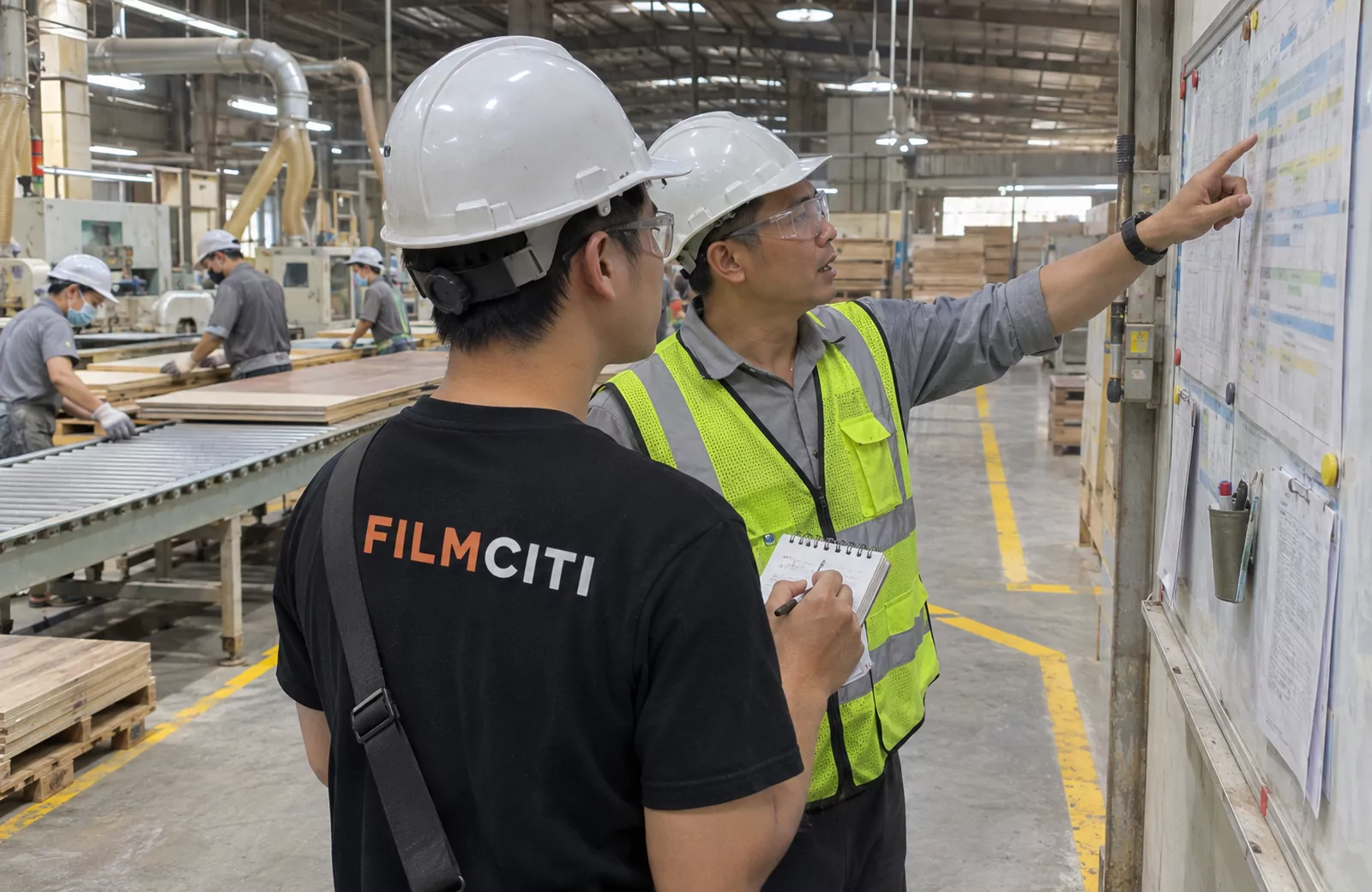
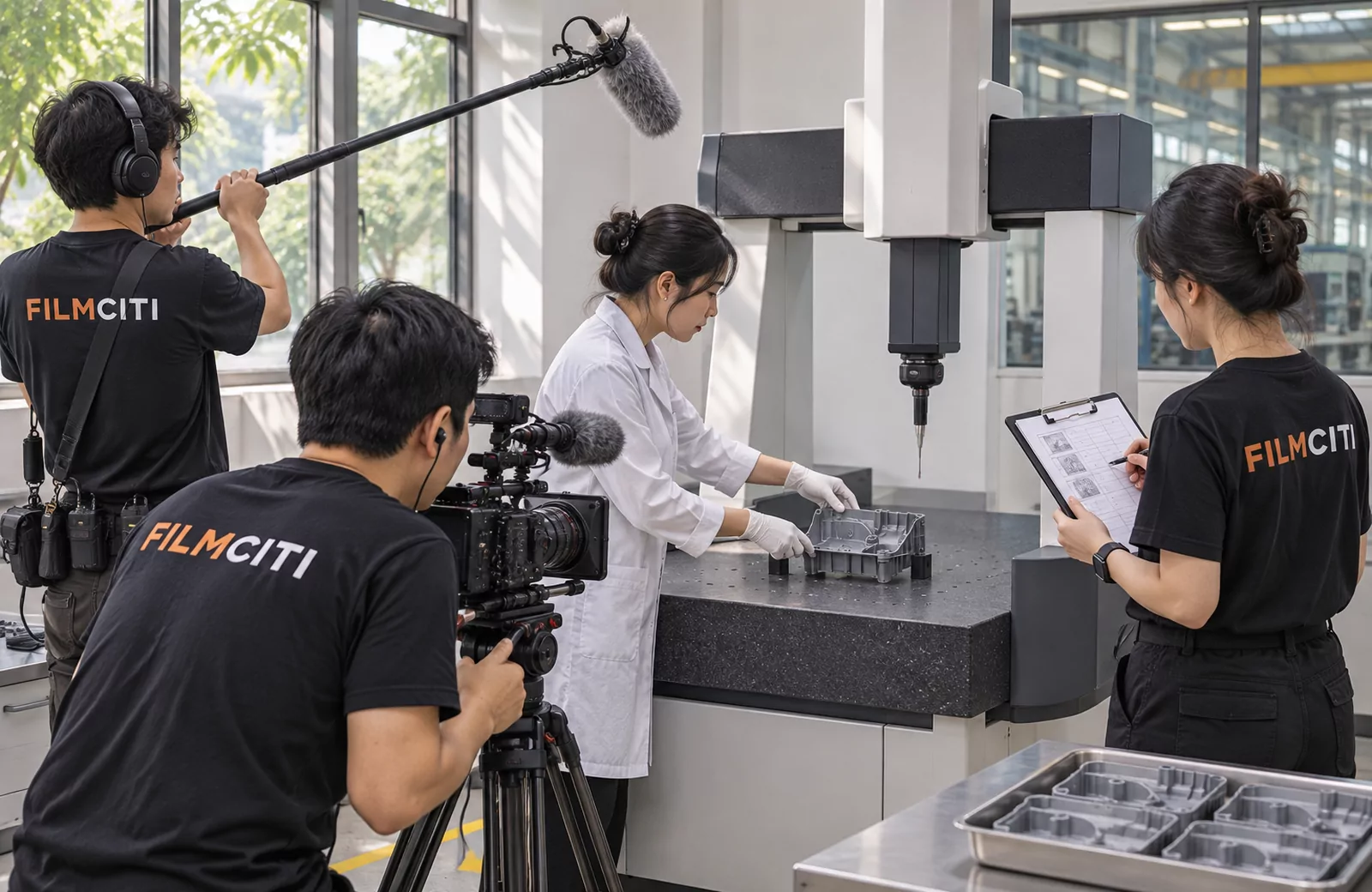
The crew films the metrology room following a shot list already confirmed by the plant's quality department.
A factory introduction video is watched by people assessing risk, not by people curious about the company
Company films are usually made for viewers who know nothing about the business. A factory introduction video made for a manufacturing partnership is different. The viewers are usually the partner's purchasing staff, quality engineers or supply chain managers, and they watch the film while comparing a handful of suppliers on a shortlist. They do not need convincing that your industry is exciting; they need enough facts to fill in a supplier assessment form and explain to their managers why the plant should go through to the next round. So a beautiful drone shot should only open the film, while most of the running time goes to what assessors can check against their criteria: lines in operation, the metrology room, lot records and how defects are handled.
For them, every new supplier is a risk. If the plant delivers late or ships defective parts, the partner's own production line suffers, and the person who recommended the supplier has to answer for it. So they do not need to hear the plant praise itself as modern; they need to see signs that its processes are run with discipline.
When writing the brief, ask the sales team who on the partner's side will receive the film, what stage of supplier selection they are at, and what they will have to decide after watching it. If the plant has never made a film before, you can read how a company film differs from an advertising film to choose the right format from the start.
Partners need to see 5 kinds of information before they trust your production capability
What partners want to see can be grouped into 5 kinds of information, each of which needs evidence that is visible on screen, rather than a claim in the voice-over.
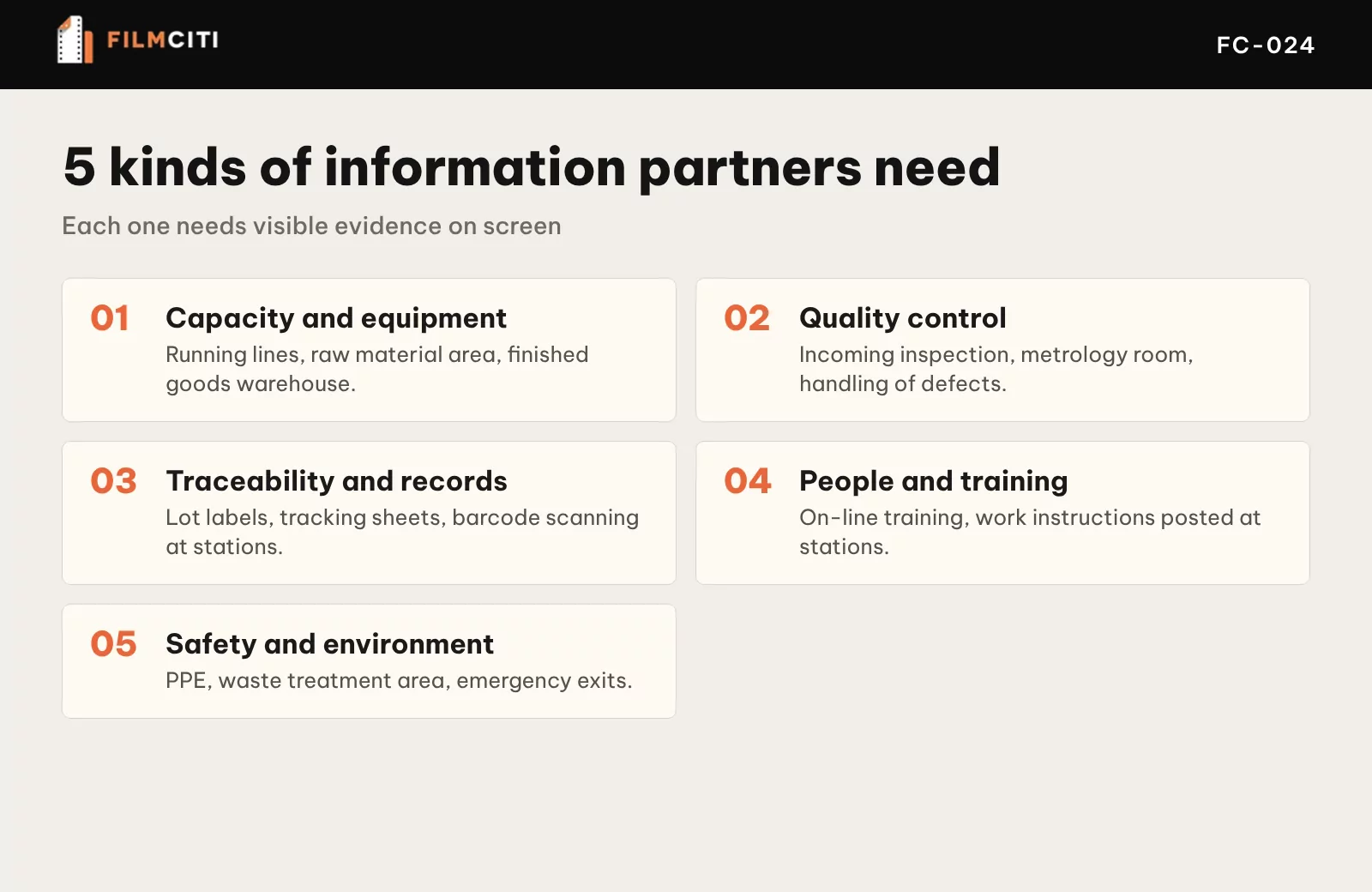
The table below pairs each kind of information with the partner's question, the footage the film should include and who at the plant confirms it.
| Information | The partner's question | Footage the film should include | Who at the plant confirms it |
|---|---|---|---|
| Capacity and equipment | Does the plant have enough capacity for my orders? | Lines in operation, raw material area, finished goods warehouse | Production director |
| Quality control | Where are defects caught and how are they handled? | Incoming inspection, metrology room, defect tracking boards on the line | Head of QA/QC |
| Traceability and records | If something goes wrong, can the plant trace the lot back? | Lot labels, tracking sheets, barcode scanning at each station | Head of QA/QC |
| People and training | Are workers trained and do they follow procedures? | Training on the line, work instructions posted at stations | HR department, line supervisors |
| Safety, environment and compliance | Does working with this plant carry safety or environmental risks? | Protective equipment, waste treatment area, emergency exits | EHS department |
The film does not replace the documentation; it shows the partner that the documentation is alive in the plant's daily work, and every figure in it must be confirmed in writing by the department responsible, because the partner will cross-check. An ISO certificate hanging on a wall is less convincing than a shot of a worker stopping the line, tagging a defective part in red and calling the team leader. The reason lies in how quality teams work: they assess suppliers by comparing procedures on paper with what actually happens on the line, so a shot showing a red tag, a defect log and a named person in charge answers more questions than a claim in the voice-over. If the plant does not yet record things on the line, the film should not stage scenes to cover that gap, because the audit team will check again on site.
The script should follow the product's path, not the company's history
Instead of telling the story chronologically from the founding year, a structure that is easier to follow is the path of the product, from the moment raw material comes through the gate to the moment the cartons are loaded onto the truck.
When the script follows the product's path, viewers know which stage they are looking at and can check it against their own standards, while the crew has a clear order for building the shot list area by area. The company's history usually needs only one line at the opening.
When you receive the script, try reading only the picture column and ask yourself: with the sound off, would a viewer understand which stages the material passes through and where it is checked? If not, the script relies more on voice-over than on images. The article on reading a corporate film script explains this way of reading in detail.
The script also needs to know the number of versions up front, because a factory video is rarely used just once. There is usually a pre-visit version, a welcome meeting version with a statement from leadership, capability cut-downs to attach to emails and a no-dialogue version for the reception lobby. Each version needs its own material, so they belong in the brief for the crew to capture everything in one shoot. According to Filmciti's pricing page, a company film (introduction or documentary) usually runs 3–10 minutes, and a project can choose 1 main 16:9 version or the main version plus a cut-down and a vertical 9:16 version. For a factory video, the pre-visit version usually needs to be shorter than the main film, so order the cut-downs in the brief rather than after approval.
The shot list must be confirmed by the quality and EHS departments before the shoot day
A shot list is the list of every shot to be filmed, specifying the area, content, people on screen and timing. In a factory, it is also the document the relevant departments use to confirm what may appear on screen. The EHS department (environment, health and safety) confirms which areas the crew may enter, the mandatory protective equipment and any equipment that must not be filmed. The sales department checks a risk that is often overlooked: parts, moulds or cartons printed with the logos of current customers, because many contracts contain confidentiality clauses. The order of sign-off matters too: EHS confirms first so the crew knows which areas it may enter, then the quality department approves the content of each shot, and finally the sales department reviews anything that could reveal customer information.
The areas considered "not pretty" are often exactly where partners most want to look, such as the mould maintenance area, the metrology room or the quarantine area for defective goods. The crew's job is to tidy, light and frame these areas so they come across clearly, not to strike them off the list. How to coordinate the shoot schedule with the production plan is covered in the article on filming in an operating factory.
Suppose the plant has 1 shoot day for the pre-visit version, following one production lot. The shot list could be split like this.
| Time slot | Area | Shots needed | Who must be there |
|---|---|---|---|
| 7:00–8:30 | Material receiving gate, resin store | Incoming inspection, lot labelling | Storekeeper, incoming inspector |
| 8:30–10:30 | Moulding floor | Line running, first-article check, red-tagging a defect | Shift supervisor, team leader |
| 10:30–12:00 | Metrology room | Measuring a part on the CMM, results on screen | QA engineer |
| 13:30–15:00 | Mould maintenance area | Cleaning and checking a mould against the maintenance sheet | Mould shop leader |
| 15:00–17:00 | Packing, finished goods warehouse | Scanning lot codes, packing cartons, loading the truck | Storekeeper |
What goes wrong: two days before the shoot, the planning department announces that the CMM is due for routine calibration that very morning, and the moulding floor will only be running orders for a customer with a confidentiality clause. There are three ways to handle it:
- Keep the date and change the order: film the metrology room late in the afternoon once calibration is finished, and ask the plant to run a mould that belongs to no customer for 2 hours. The schedule holds, but production planning is affected, so the production director has to agree.
- Move the shoot day: the content is complete and accurate, but the time for editing, recording the English voice-over and approvals shrinks before the film is due to go to the partner.
- Shoot as planned and show the measuring step with graphics and a photo of the measurement report: the fastest option, but the evidence becomes weaker exactly in the area the partner's quality team cares about most.
To choose well, you need to know which criteria the partner will use the film to assess.
A beautiful film can still miss the one room the audit team wants to see
In mid-February 2026, a plastic injection moulding plant making electronic components in Vinh Phuc received the news: a supplier audit team from a Korean electronics group would arrive on 18 March. If the plant passed, it would be added to the list of suppliers of plastic housings for a new product line. Mr Khải, the sales director, had 4 weeks and one request from the CEO: "Make us a proper factory film to show when the delegation arrives."
Because time was short, the brief was written from the existing capability profile: 15 years in operation, 120 moulding machines, ISO certification, customers in 6 countries. The shoot day went smoothly: a drone glided over the factory roof at dawn, rows of moulding machines ran steadily, and the CEO gave a speech in front of a banner reading "15 years of steady growth". On 6 March, the final cut, 4 minutes 30 seconds long with English subtitles, was approved, and everyone who saw it loved it.
On 9 March, Mr Khải sent the link ahead to Ms Seo-yeon, who leads supplier quality on the partner's side. Two days later she replied: "Thank you, the film is beautiful. During the audit we would like to see your metrology room, your mould maintenance area and how you trace production lots. Does the film have anything on these?"
Mr Khải scrubbed back through the film. The metrology section lasted 6 seconds: a person in a white lab coat leaning over a measuring machine, the music swelling, then a cut to the drone shot. The mould maintenance area was missing, because on the recce day the crew had found it cramped and greasy and put it in the "not pretty" pile.
He called the producer: "Can you slot a bit of the metrology room and the mould area in for me? Just 30 seconds or so, any time before the 18th is fine."
The producer explained that this was not a matter of slotting something in. Filming the metrology room meant booking the QA team to run the machine on a real part and swapping out every part being measured for other customers because of confidentiality agreements. The mould area needed cleaning and lighting, because under the factory lights the layer of oil made every mould look the same. The English voice-over had been recorded around the historical sequence, so the transitions would have to be rewritten, the voice re-recorded and the subtitles corrected. In all, it would take an extra half day of shooting, one recording session and 3 days of editing, with only 7 days left.
Mr Khải was not wrong to rely on the capability profile, the only document leadership had already approved. On the crew's side, the producer had learned during the recce that the film was for a supplier audit, yet never asked what the audit team would be scoring. With that question asked, the mould maintenance area would not have been cut for looking untidy.
In the end, the two sides made an additional 2-minute version following one production lot from the arrival of plastic pellets to the packing of cartons, reusing the moulding footage plus the new half day of shooting. It was ready for the morning of 18 March but had no traceability graphics, so Ms Liên from QA had to stand beside the screen and explain. The 4-minute-30 version moved to the reception lobby.
For the next film, Mr Khải attached one question for the partner to the brief, and Ms Seo-yeon answered it within an afternoon: "Which criteria will the audit team score, and which areas of the plant do they want to see with their own eyes?"
The story above is a hypothetical situation, reconstructed from things that often happen in corporate filmmaking.
With the Filmciti crew, we ask at the site recce which criteria the audit team will score and which areas they want to see with their own eyes, then put those areas into the shot list before thinking about the beauty shots. Places like the mould maintenance area stay in; the crew tidies up with the mould team and sets the lighting so each mould reads clearly on screen.
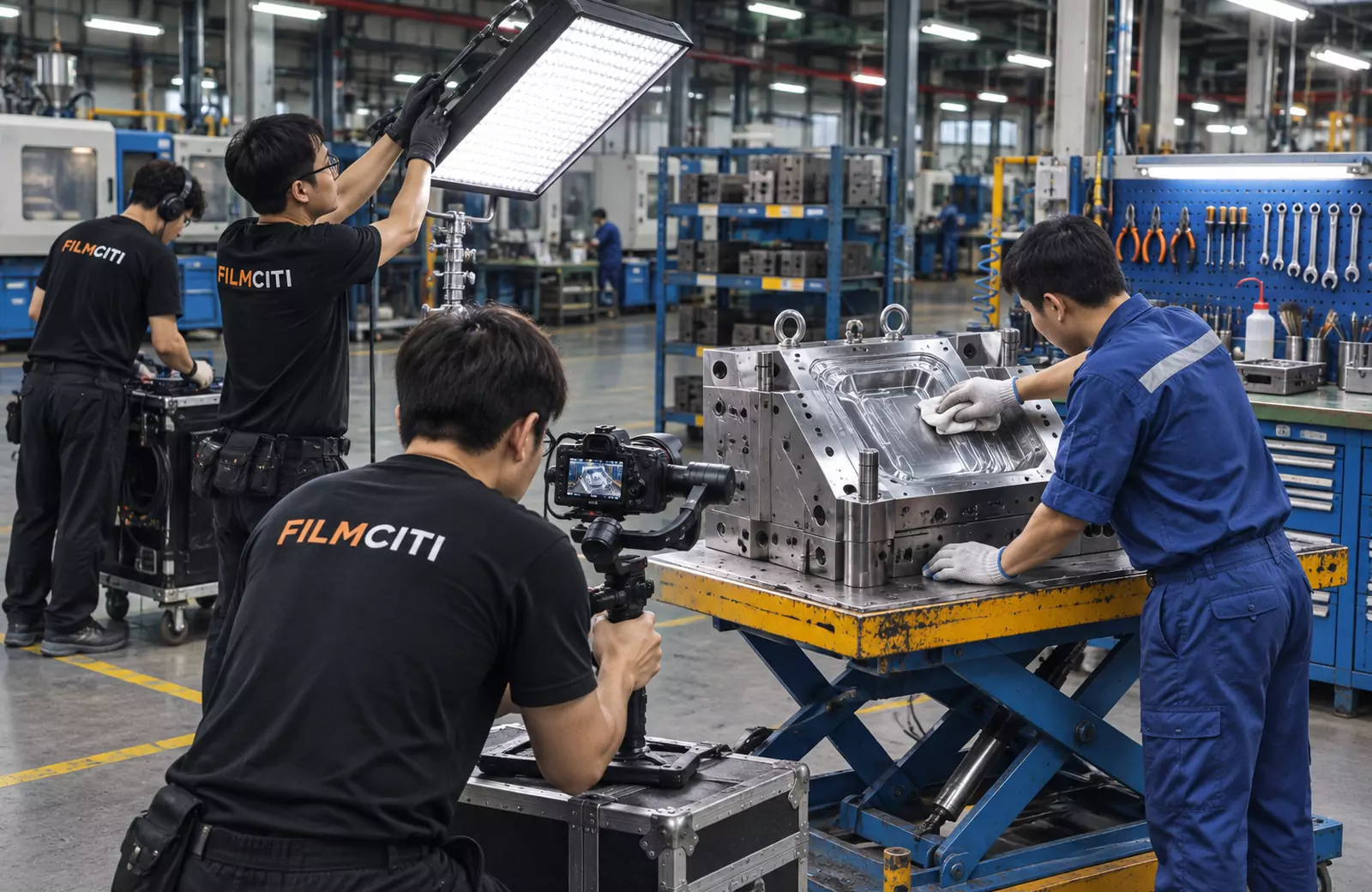
The mould maintenance area is rarely pretty, but with the right light and angle it is the shot partners most want to see.
Checklist before making a factory introduction video for partners
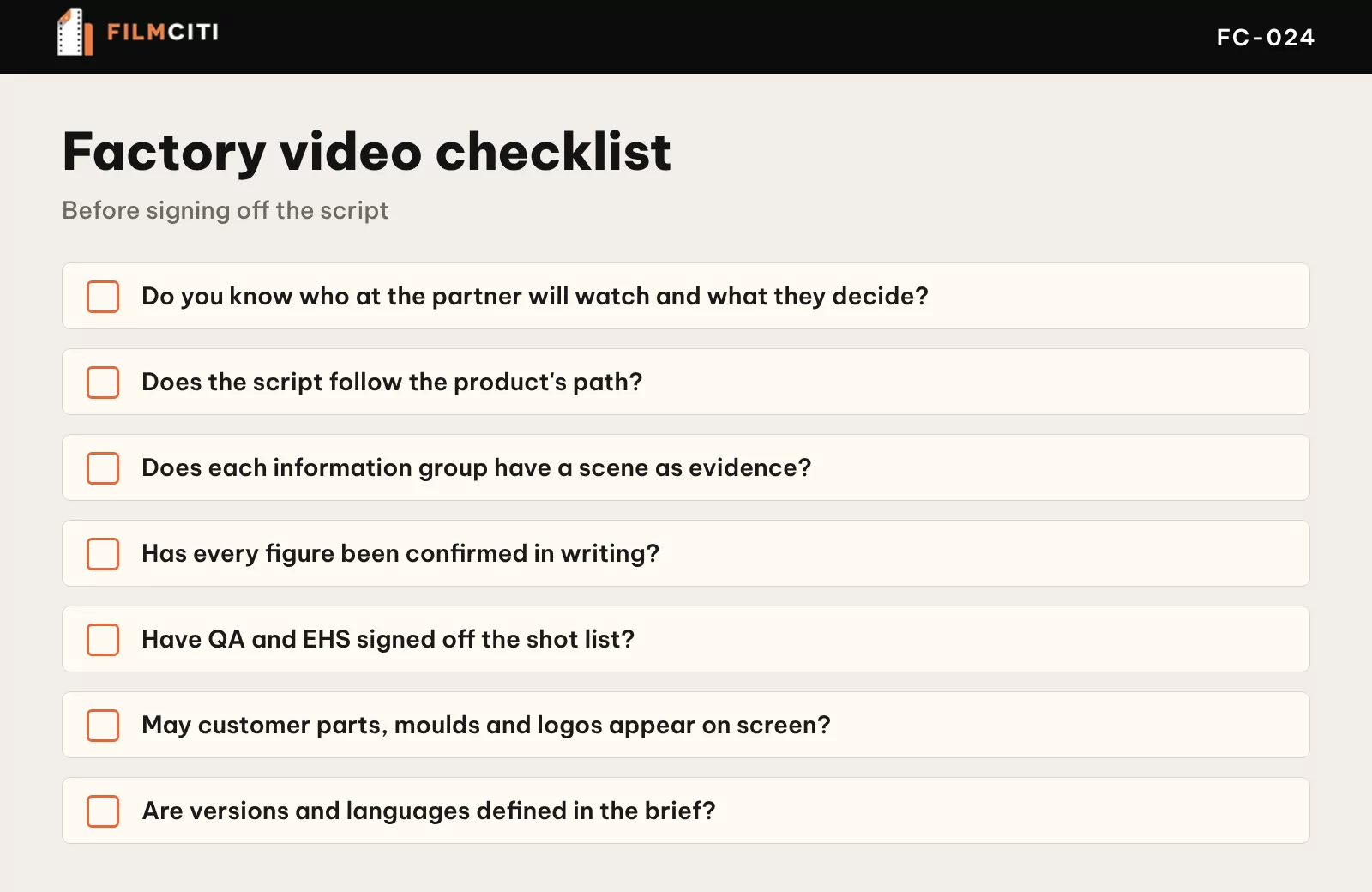
- Do you know who on the partner's side will receive the film and what they need to decide?
- Does the script follow the product's path, from raw material to shipping?
- Does each kind of information the partner cares about have at least one shot as evidence?
- Has every figure in the voice-over and graphics been confirmed in writing by the department responsible?
- Have the quality and EHS departments confirmed the shot list?
- May current customers' parts, moulds and logos appear on screen?
- Have the deliverable versions and the language of each version been defined in the brief?
Go back to the production company with questions when the shooting plan includes only the "pretty" areas and leaves out the metrology room, mould maintenance area or warehouse, or when nobody has asked you which criteria the audit team will assess.
Download the Factory introduction video preparation checklist (Excel) — Vietnamese template to list the partner's questions, filming areas, sign-off owners and film versions before you send a brief.
Further reading
- Filming an operating factory: coordinating the shoot schedule with the production plan
- Filmciti's factory film service: site recce, scripts built around the production process, filming on the shop floor and versions for partners.
If your plant is preparing for an audit visit, use the preparation checklist above to list what the partner needs to see, then send Filmciti a brief with the date of the visit, the departments that will confirm the content and the versions you need delivered.
Related service: Factory films
FAQ
The version sent ahead of a visit usually works best at around 2–3 minutes, because recipients watch it by email among files from several other suppliers. The version played at the welcome meeting can run longer, because the audience is already seated in the meeting room and someone from the plant is presenting. Capability cut-downs attached to emails should be shorter still, each covering exactly one topic.
Yes, as long as the restricted areas are identified in the shot list from the start and confirmed by both the EHS and sales departments. The crew can film with sample parts that belong to no customer, choose angles that avoid drawings and screens, or show processes with graphics. What matters is agreeing this list before the shoot day, rather than discovering it mid-shoot.
Yes, if the statement makes a commitment the partner cares about, such as prioritising capacity for their orders, plans to invest in equipment or how the plant handles quality incidents. A short statement that says one thing is usually remembered better than a long welcome speech, and it belongs in the welcome meeting version rather than the version sent ahead.