

TikTok content creation for B2B companies: 6 video formats that don't need dancing
Leadership wants the company on TikTok, but your business sells equipment, materials or services to other businesses, not cosmetics or snacks. Scroll through the popular channels and all you see is dance trends, comedy sketches and live selling, so it is easy to conclude that B2B has nothing to post. In fact, B2B buyers do use short video to research suppliers, and the best material is already in the daily work of your engineering team, sales team and production floor. To create TikTok content for a B2B business, rely on 6 video formats that need no dancing: process, testing, Q&A, common mistakes, people, and before and after. This article shows how to choose formats, gather material and get many videos out of one shoot.
In this article
- TikTok content creation for B2B starts from customer questions, not from trends
- 6 B2B TikTok formats that draw on the company's everyday work
- The material for short videos sits in the engineering and sales teams' schedules
- A batch shoot has to be prepared format by format, not just location by location
- A trend video can rack up views without answering a single question a B2B customer has
- Checklist for B2B TikTok content creation before scheduling a shoot
- Further reading
Start with the overview: Building a business TikTok channel: what to create and measure in the first 90 days
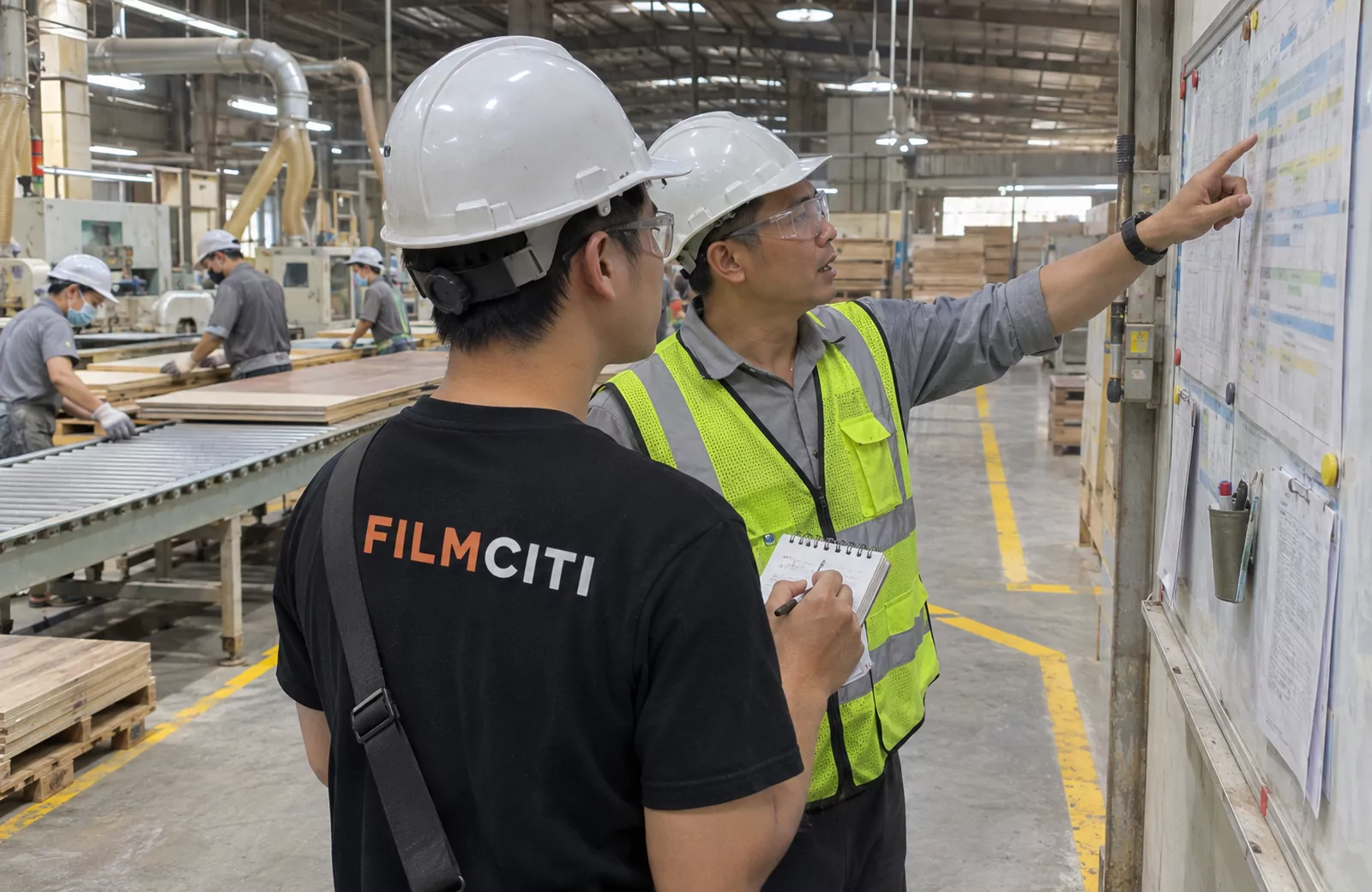
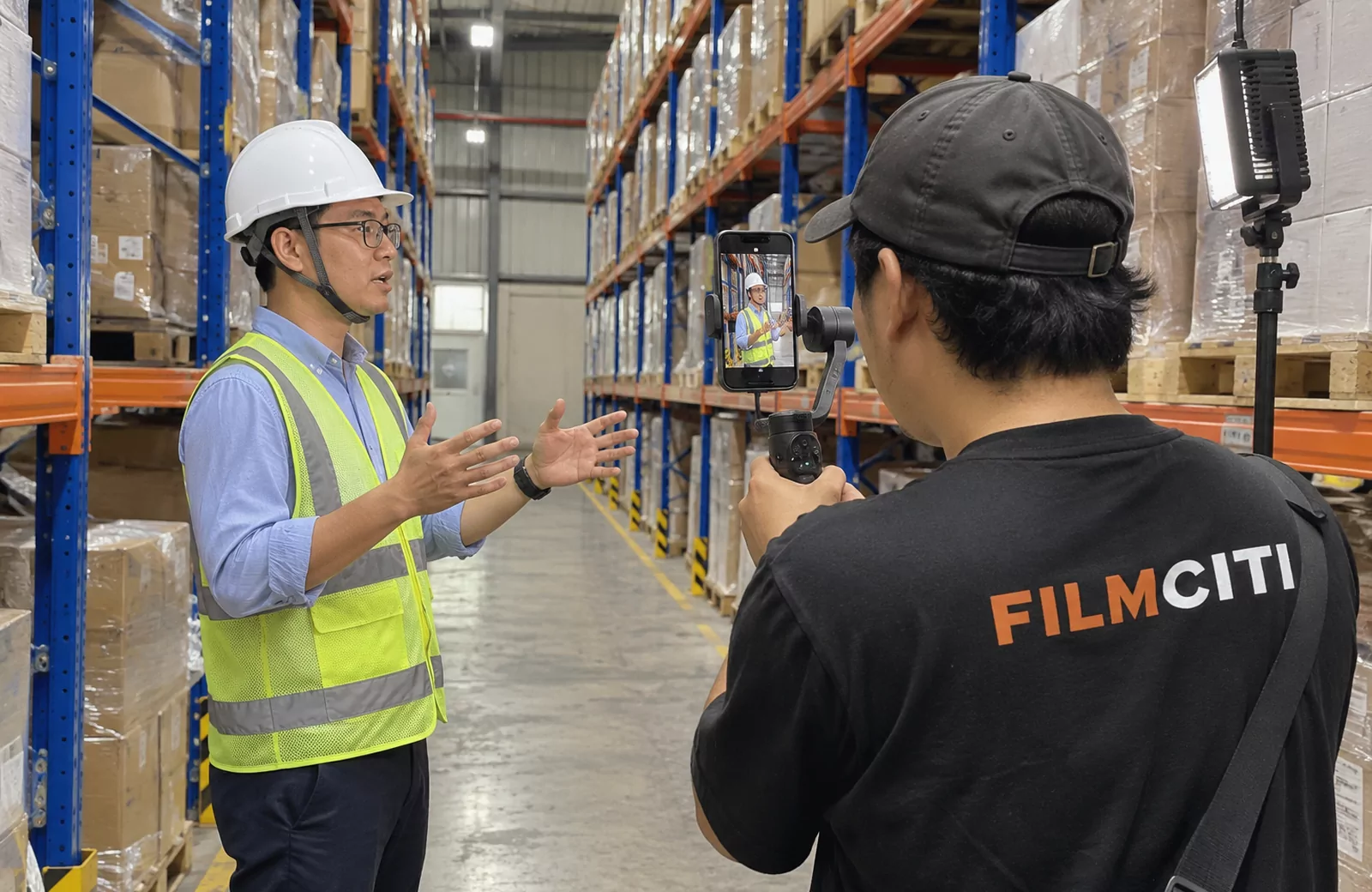
An engineer answers a common customer question on the warehouse floor, filmed vertically for TikTok.
TikTok content creation for B2B starts from customer questions, not from trends
B2B customers are few in number, slow to decide and usually involve several people: the end users, engineering, procurement and leadership. They rarely buy straight after a video, but they watch videos to judge whether a supplier knows the trade, how it works and whether it is worth a phone call. Each person in that group has a different concern: engineering worries about specifications and safety, procurement about delivery schedules and extra costs, and leadership about the risk of switching suppliers. A trend video may get plenty of views, but if it addresses none of those concerns, the channel is not yet serving sales. On the other hand, a video with few views that answers exactly the warehouse manager's question can be sent straight to a customer by the sales team while a quote is in progress.
So the first source of ideas should be the questions your sales and engineering teams hear every week. "How much load can this rack take?", "Does installation mean shutting the warehouse?", "Why is your quote higher than theirs?" are all short-video briefs that buyers care about. If you log questions regularly, you will have an idea bank that lasts for months.
Trends still have a place on a B2B channel, but they work best as a way of telling professional content, such as using a popular sound for a load-test clip, rather than copying a trend first and then trying to fit the product into it.
6 B2B TikTok formats that draw on the company's everyday work
The 6 B2B TikTok formats in this section need no dancing and no professional actors, and suit most manufacturers, equipment distributors and technical service companies.
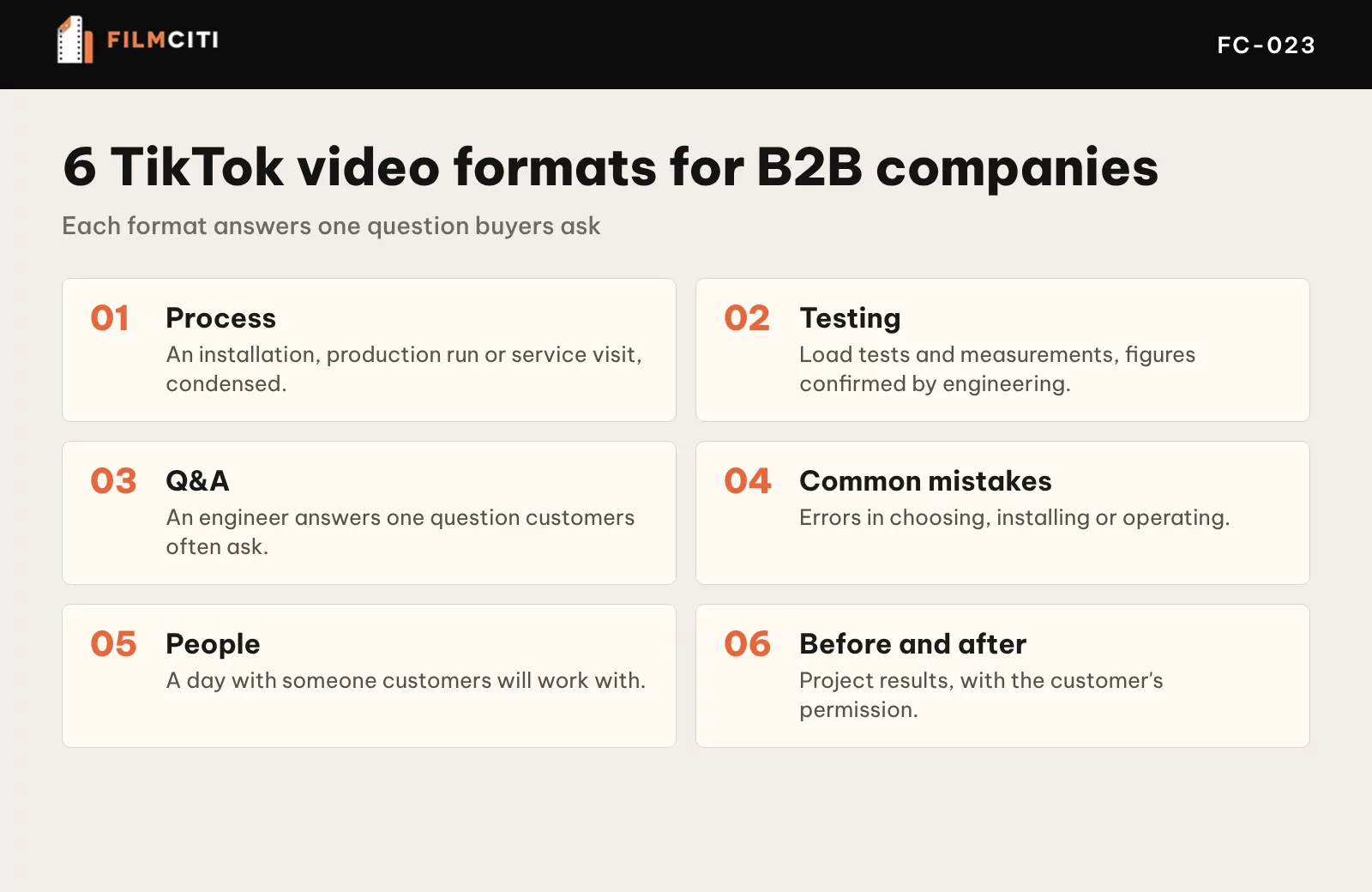
The table below pairs each format with the buyer question it answers, a concrete example and who needs to appear in or approve the content.
| Format | Which buyer question it answers | Example | Who appears or approves |
|---|---|---|---|
| 1. Process | How do they work? | An installation shift condensed into 45 seconds | Installation team lead |
| 2. Testing | Does the product live up to its claims? | A load test on one rack level following the internal procedure | Engineering, QA |
| 3. Q&A | Do they understand my problem? | An engineer answers a question customers often ask | Engineer, sales |
| 4. Common mistakes | Will they help me avoid errors? | Three mistakes when choosing racking for cold storage | Engineering approves content |
| 5. People | Who will I be working with? | A day with the warranty team lead | Staff on camera, HR |
| 6. Before and after | What have they achieved? | A warehouse before and after reorganisation | Customer permission |
Of these 6 formats, 3 and 4 are usually the easiest to start with, because they only need someone who knows the trade and a clean camera angle. Format 6 is highly persuasive but depends on the customer allowing filming, so ask for permission when the contract is signed rather than when the project is finished. Format 2 needs the most care: every figure in the video must be confirmed by engineering, and should not be presented as a promise for every use case. Formats 1 and 5 take more preparation, because they must follow the installation team's real schedule and need the consent of the people on camera, but in return buyers see clearly who will work with them and in what order. If resources are thin, start with the 2 easiest formats and add the others gradually.
The material for short videos sits in the engineering and sales teams' schedules
Material for B2B short videos follows the engineering team's work schedule, so once the formats are chosen, the content person needs to know in advance when that material will happen. An installation shift, a load test or a handover only lasts a few hours; if the content person does not know the schedule, the chance is gone. The effective approach is to ask the engineering team for their work schedule for the next 2–4 weeks and mark the sessions that can be filmed.
Customer questions should go into a shared sheet, with who asked, how often and which format fits. Each month, pick 8–12 questions to shoot in a batch: a half-day session with an engineer and a team lead can produce many short videos if the scripts are prepared in advance. The scripts do not need to be long: each video only needs an opening question, 3–4 answer points in order and a shot to illustrate each point, so the engineer can glance at it and speak in their own words without memorising anything. For each video, the first 3 seconds should carry the question or the key image, as discussed in the article on what should appear in the first 3 seconds.
If the business is just starting a channel, treat the first 90 days as a period for testing which formats suit your audience, and track metrics that reflect potential customers rather than views alone. The article on building a company TikTok channel in the first 90 days explains how to steer and measure this stage in detail.
A batch shoot has to be prepared format by format, not just location by location
Each format needs a different level of preparation and a different approver. When several videos are grouped into one shoot, the producer schedules by who appears and by what needs permission, so the engineer does not have to be called back several times. The number of versions should also be agreed in the brief: according to Filmciti's pricing page, a project can choose 1 main 16:9 version, or the main version plus a cut-down and a vertical 9:16 version, with duration options of 15, 30, 60 and 90 seconds or more. TikTok needs a vertical frame, so if the business wants to reuse the footage in a horizontal company film, the crew has to plan framing for both formats on the shoot day, rather than recropping in post.
Example brief: an air compressor distributor films for half a day at its service workshop and at a customer's plant room, aiming to produce 8 videos.
The table below splits the shoot into 4 time slots, each with its content, format and the conditions needed before filming.
| Time | Content | Format | Conditions needed |
|---|---|---|---|
| 8:00–9:00 | An engineer answers 4 common questions | Q&A | Approved list of questions |
| 9:00–10:00 | Routine servicing of one compressor | Process | Demo unit, team lead present |
| 10:00–11:00 | Three installation mistakes that make compressors overheat | Common mistakes | Engineering approves content beforehand |
| 11:00–12:00 | Plant room before and after the upgrade | Before and after | Written consent from the customer |
The twist: at 10:30 the customer's site manager agrees to filming in the plant room only if their logo and company name do not appear, while a large sign hangs right on the wall. There are 3 ways to handle it:
- Shoot tight angles that avoid the sign. The video still shows before and after, but loses the wide shot that conveys the size of the plant room.
- Shoot every angle and cover the logo in post. The visuals are more complete, but post-production takes longer and the customer still needs to approve the final cut before posting.
- Drop the before-and-after video and replace it with an extra Q&A shot at the workshop. The posting schedule holds, but you lose a highly persuasive format.
What needs doing is to add permission conditions to the preparation list, so the decision is made before the shoot day rather than in the middle of it.
A trend video can rack up views without answering a single question a B2B customer has
In early September 2026, an industrial racking manufacturer with an office in Ho Chi Minh City and a factory in Long An books a stand at a logistics exhibition in mid-October. Ms Diễm, the sales director, wants a QR code linking to the company's TikTok channel printed on the standee. The channel has just 6 videos. Mr Nhật, a marketing executive, is told: "Do TikTok like the retail brands, give the channel some buzz."
Mr Nhật does exactly that. In the first week he hires an outside crew for one session and gets 5 warehouse staff to perform a trending dance between two 9-metre racks. The video passes 200,000 views in 3 days, the whole sales team shares it, and Ms Diễm messages "Nice one". He makes 4 more in the same style.
On 21 September, Ms Diễm forwards Mr Nhật a screenshot from the warehouse manager of a retail chain, a customer currently being quoted: "Do you have any videos of rack installation or load testing? On TikTok I only see your guys dancing." The nearly 300 comments under the videos are all hearts, friends being tagged and job enquiries; not one asks about racking.
Ms Diễm messages: "Just shoot a few product videos for me, that'll do, before the exhibition."
Mr Nhật calls the producer of the crew that shot the first session. The producer explains that catalogue-style product videos struggle to hold viewers, and what the customer is asking for is installation and load-test footage, which only comes from following the team of Mr Hưng, the installation team lead. Mr Hưng's September schedule is full of night shifts at customers' warehouses, and each warehouse needs its own filming permission. Two warehouses agree after 12 days; one refuses because of rules on cargo confidentiality.
Mr Nhật had his reasons for going with trends: he received a one-line request, had no list of customer questions, and views were the only number anyone looked at. The outside crew also skipped a step at that first session: the producer agreed to shoot the dance without asking who the channel was for, and never suggested the sales team send in the 10 questions customers ask most, so the channel kept following a feeling of "buzz".
By opening day, the channel has 5 new videos: 2 condensed installation shifts, 1 load test with an engineer explaining it, and 2 Q&A videos. The new videos get far fewer views than the dance clips. The standee, printed in late September with a QR code to the channel page, has to be reprinted with a new code pointing to a separate playlist of these 5 videos, which takes 2 more days. On the second day of the exhibition, a warehouse manager stops by to ask about the load-test video.
Before the first dance video, Mr Nhật, Ms Diễm and the crew needed to agree on one question: "What questions are our customers asking the sales team, and which videos on the channel will answer them?"
The story above is a hypothetical situation, reconstructed from things that often happen in corporate filmmaking.
With the Filmciti crew, we ask who the TikTok channel is for at the brief stage, and ask the sales team to send the list of questions customers often ask before the first shoot. From that list, the producer picks the installation shifts and load tests worth filming, puts them in the schedule and secures the customer's warehouse permission in advance, so the crew turns up on a real working shift.
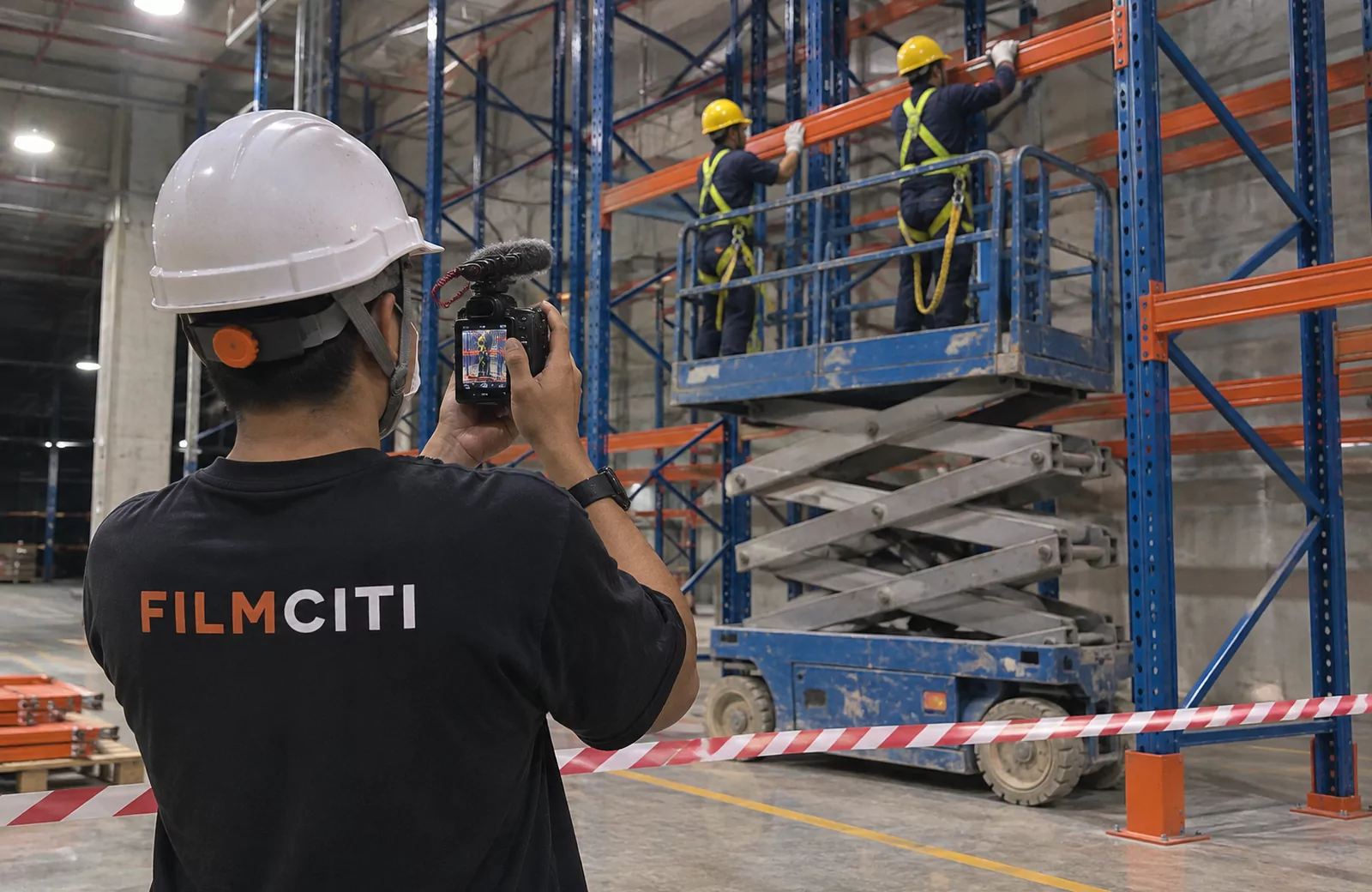
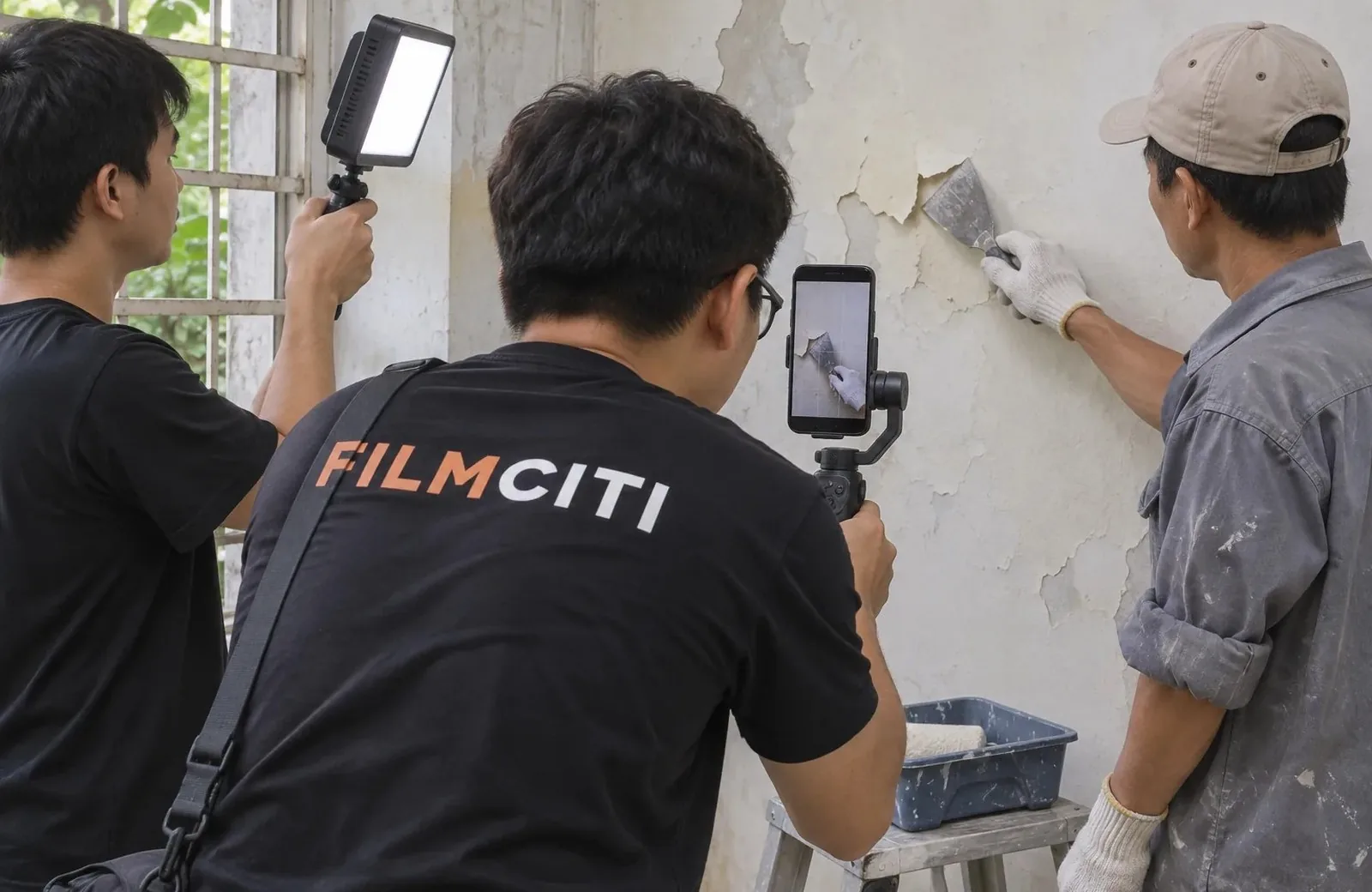
A night installation shift is material for the process format, and needs the customer's warehouse permission in advance.
Checklist for B2B TikTok content creation before scheduling a shoot
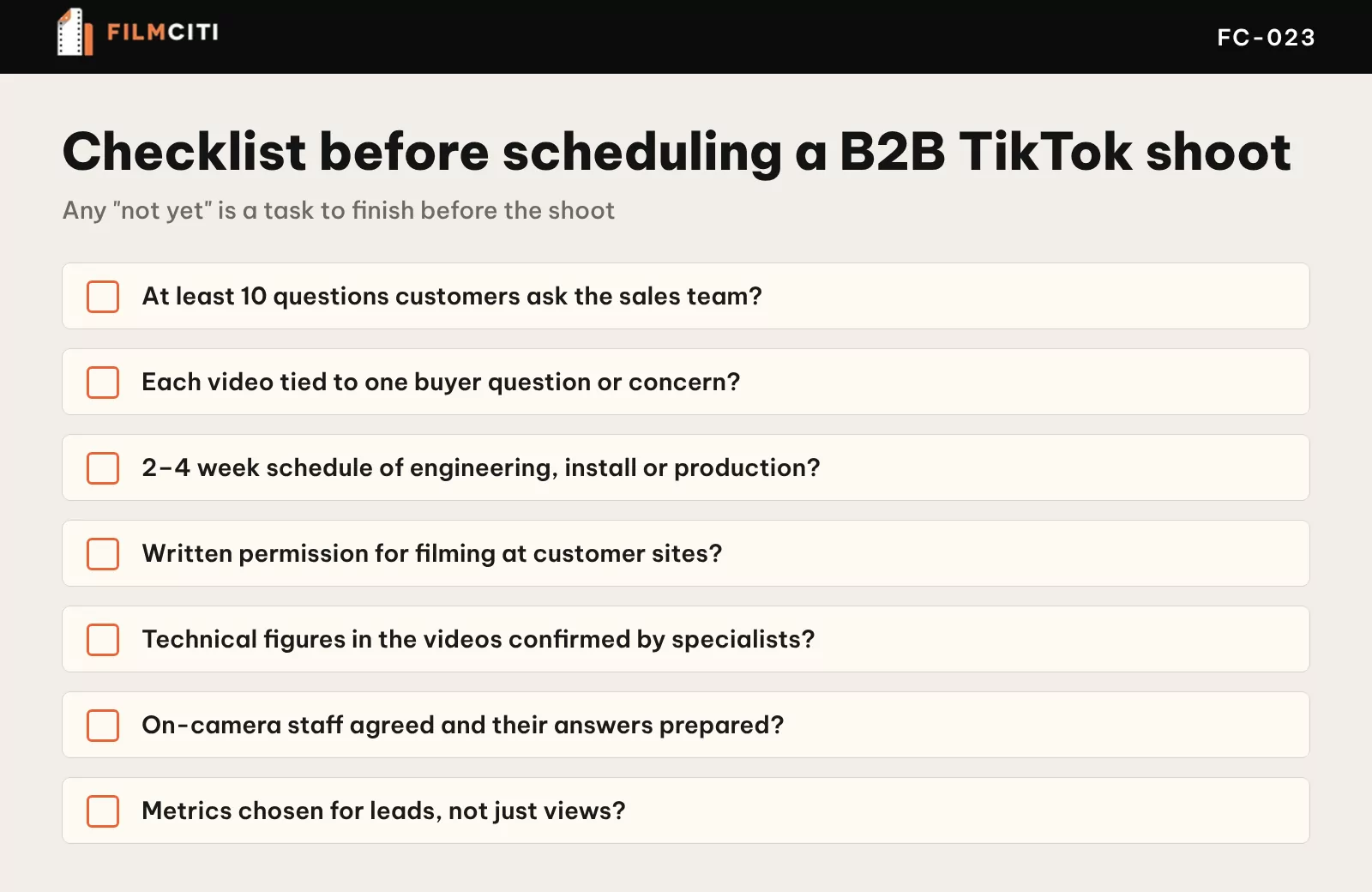
- Do you have a list of at least 10 questions customers often ask the sales team?
- Is each planned video tied to a specific buyer question or concern?
- Do you have the engineering, installation or production schedule for the next 2–4 weeks?
- Have videos filmed at customer sites been given written permission?
- Have technical figures shown in the videos been confirmed by the relevant specialists?
- Have the people on camera agreed and had their answers prepared?
- Have you chosen metrics that measure potential customers, not just views?
Go back to the production company if the content plan only lists trends and effects, without stating which customer question each video answers.
Download the B2B TikTok idea bank — Vietnamese template to log customer questions, match each one to a video format and plan 4 weeks of content.
Further reading
- Building a company TikTok channel: the first 90 days.
- TikTok video services: what to outsource and what to keep in-house.
- Filmciti TikTok channel building service.
If your business is looking for a TikTok content direction for the B2B market, send Filmciti a brief with your main products, target customers and a few questions customers often ask your sales team. A Filmciti producer will propose suitable video formats and a batch shooting schedule.
Related service: TikTok channel service
FAQ
It is not essential, but many buyers and people who influence buying decisions already use short video to research suppliers. If the business has professional content to share and someone to keep the channel going consistently, TikTok can be a supporting channel for the sales team. It is worth testing over a defined period and measuring with metrics tied to potential customers.
Yes. The process, testing and before-and-after formats can be filmed without anyone speaking to camera, using voice-over or on-screen text. For Q&A videos, the person on camera only needs to talk about the questions customers already ask them every day, and the crew will help with how to stand and how to keep it short.
It depends on how much material you have and who is running the channel. Posting 2–3 videos a week consistently over a test period is usually more useful than posting in bursts and then going quiet. Batch shooting gives the business a stock of videos for several weeks without filming all the time, and gives the channel owner time to read comments and log new customer questions.