



Building a business TikTok channel: what to create and measure in the first 90 days
A dance-trend video reaches 1.2 million views, but requests for a quote remain at 0. At the monthly meeting, the person running the channel still cannot answer leadership's question: what should we make next month?

In this article
- Building a TikTok channel starts with choosing the right audience, not a trend
- The first 30 days: test deliberately rather than fill a video quota
- Days 31–60: distinguish views from genuine demand
- A video with 1.2 million views may not bring a single request for a quote
- A 90-day plan needs a decision after each phase
- Day 90: decide whether to keep, change or stop each series
- Checklist before approving the next phase
- Further reading
Building a business TikTok channel takes more than a regular posting schedule. In short, the first 90 days work best in 3 phases: deliberate testing, separating views from genuine demand, then deciding which series to keep or stop. The metrics to track sit on 3 levels: whether viewers watch to the end, whether they show interest in the right problem, and whether they take a contact step such as messaging for a quote.
Start with what the business wants viewers to do after watching: understand a solution, consider a product, apply for a job or send a message asking for advice.
Building a TikTok channel starts with choosing the right audience, not a trend
“People interested in our product” is too broad a group to guide the content. Someone researching for the first time needs a different explanation from an existing equipment owner considering a replacement. Trying to address both in every video can leave you with a long hook that answers neither person's question.
Describe a specific buying situation instead. For example, a factory warehouse manager needs a barcode printer compatible with the labels already in use. They want to know whether it prints clearly, how it works and which specifications to send for advice. The crew can then propose a label-printing test, an operating demonstration or a comparison of consumables.
A trend is worth using when it makes a buyer's question easier to follow. An entertaining presenter, familiar audio or a surprising opening are all creative choices; the reason for a buyer to keep watching still has to come from their problem.
For B2B TikTok, a quick route to useful ideas is to ask sales: what holds customers back before they place an order? The crew turns those questions into videos with visual demonstrations; the business checks the facts and defines what can be disclosed publicly. Record each question with its context: who asked it, at which stage of the buying process, and how the sales team currently answers it. The list then serves both as a pool of script ideas and as a yardstick later, because a video that answers a real question tends to draw follow-up comments about applications or price. Ask the sales team to add new questions every week, so the list keeps pace with what buyers are actually asking. A marketing specialist can organise this approach without a large team.
The first 30 days: test deliberately rather than fill a video quota
Before each group of videos, write down a question you want to answer. Are prospective customers more interested in a practical demonstration or an explanation of common mistakes? That question determines the footage, the opening and the content to keep consistent for comparison.
If the topic, presenter, length, editing style and distribution all change at once, you cannot tell what attracted attention. You could start with 2 hooks for the same question, using the same presenter and similar filming conditions. The result is a signal for the next test, not proof of a formula that always works.
The table below shows, for each question to investigate, what to keep consistent, what to change deliberately and which signals to read beyond views.
| Question to investigate | Keep consistent | Change deliberately | Look beyond views |
|---|---|---|---|
| Which hook makes the problem clear faster? | Topic, presenter and main explanation | Open with a demonstration or a question | Where viewers leave; what they ask again |
| Explain or demonstrate? | Product and buyer need | How evidence is presented | Whether comments show understanding and ask about applications |
| Develop a recurring series? | Audience and series promise | Each episode's question | Which topics prompt requests for another episode |
The posting schedule must allow time to prepare samples, check information and approve the work. Finishing a shoot does not mean every script is ready to go live: an incorrect specification or an unsuitable test can mean returning to film the edit's missing shots. The crew needs to flag what is missing, and the business needs someone available to answer technical questions.
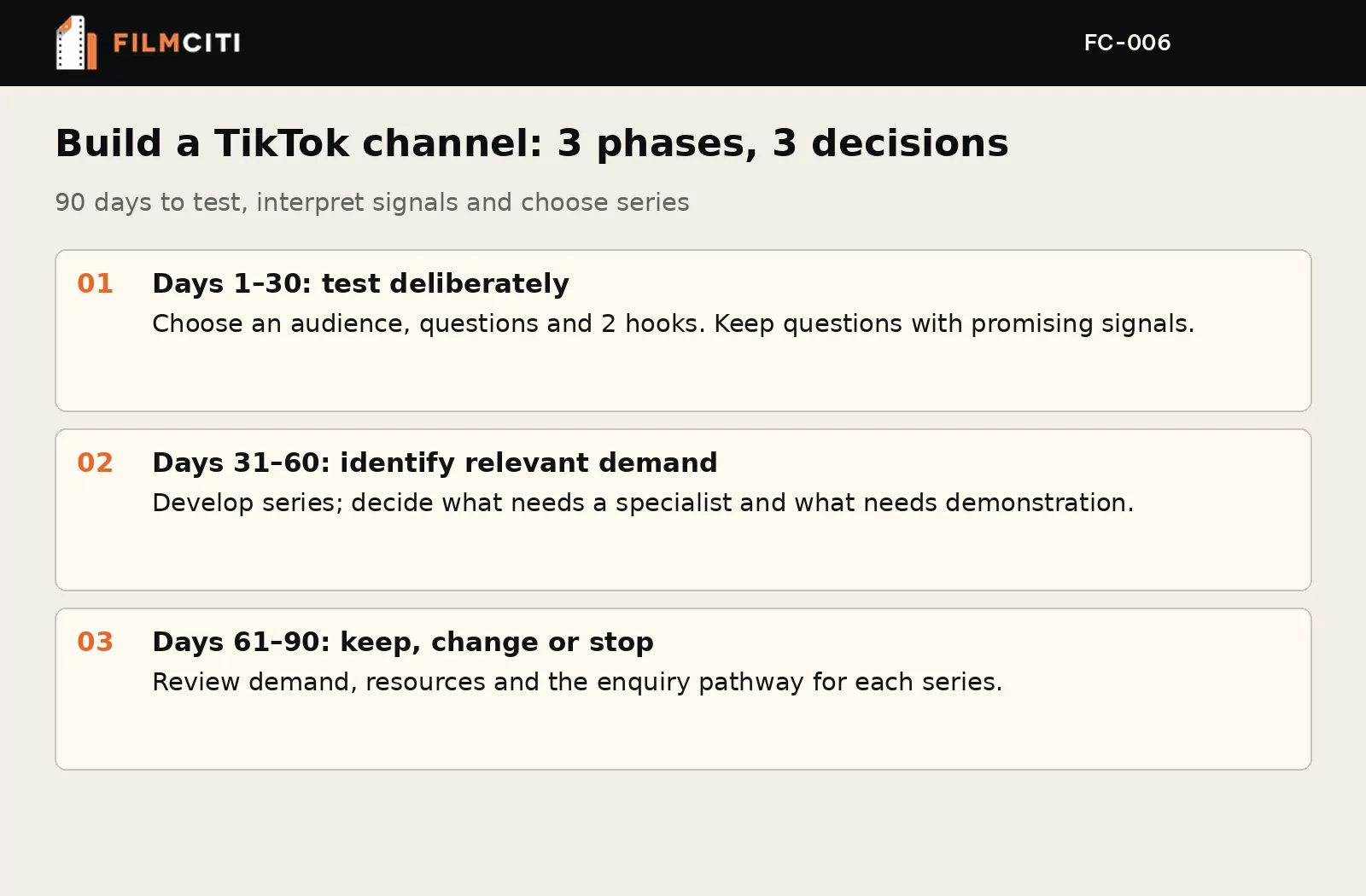
An experimentation framework; agree the pace against available resources.
Days 31–60: distinguish views from genuine demand
A widely viewed video can build awareness without showing whether buyers understand the product. Separate 3 levels when reading the report: did viewers watch the content through, did they show relevant interest, and did they take the next step to learn more?
For content, examine average watch time and where viewers leave, within the capabilities of TikTok's tools. Compare videos of reasonably similar length and posting times; separate paid activity from organic results. The completion rate of a 10-second clip does not by itself prove a better explanation than a 60-second clip.
For interest, read the comments closely. “Will this machine print on our labels?” is quite different from a joke about the presenter. Both have value, but they should not be added together as potential customers.
For business progression, agree a measurable action: visiting a product page, sending specifications or messaging for a quote. If there is no process to record the source of an enquiry and pass messages to sales, state that gap in the report. Do not rush to attribute every order received after a video to TikTok. A useful report also places observations beside hypotheses to test. “Many viewers leave before the demonstration” is an observation; “the hook is too long” is a hypothesis to test with a different opening. Keeping the 2 separate prevents a report from turning one clip into a confident conclusion, and lets the monthly meeting focus on what to test next rather than on which video was better. Write the hypothesis and the next test side by side in the report.
A video with 1.2 million views may not bring a single request for a quote
Binh, the director of a barcode-printer distributor, asks marketing to “get us known on TikTok”. In week 2, Linh from accounting is roped into a dance-trend video, holding a printer as a prop. After 3 days, the video has 1.2 million views.
The office is delighted. Binh sends the link to the directors' Zalo group with a message: “See? TikTok is easy.”
At the end of the month, sales reviews the results. The video has 4,000 comments, mostly along the lines of “Is the woman in yellow single?” and “What's that song?” Messages asking for a printer quote: 0.
That same month, Toan from the technical team quickly films a 40-second clip: he prints a smudged label, then shows how to adjust the printhead temperature. It gets 800 views but brings 3 messages requesting quotes from factory warehouse managers.
Binh settles next month's plan: “Let's have Linh dance in another 10 videos and put the price at the end.” Linh politely declines: she is busy with year-end accounts.
Taken on its own, each video did its job: the viral video helps the channel gain followers, while the technical clip reveals people with a purchase need. The problem is that both videos are judged by a single number: views.
The channel team also missed something: when the brief said “get us known”, they did not propose tracking product questions and requests for quotes alongside views from week 1. On the company side, nobody had been asked to record where enquiries came from whenever sales received a message.
When planning the following month, Binh opened the meeting with a different question: “Who is this video for, and what will they do after watching?”
*The story above is a hypothetical situation, reconstructed from things that often happen in corporate filmmaking.*
A 90-day plan needs a decision after each phase
A 90-day plan for a barcode-printer distributor might aim to start more conversations with factory warehouse managers. The company has sample machines and a technical specialist willing to appear on camera, but he cannot attend every shoot. The content plan needs to make good use of the specialist's time without making the whole channel dependent on one person.
The table below compares the 3 phases by what to organise, what to learn and the decision to make at the end of each phase.
| Phase | What to organise | What to learn | Decision at the end |
|---|---|---|---|
| Days 1–30 | Gather sales questions, film demonstrations and test 2 hooks | Which applications do viewers understand and ask about? | Keep questions showing promising signals |
| Days 31–60 | Develop relevant questions into series; group specialist scenes into 1–2 shoots | Which episodes lead to messages describing a clear need? | Choose what needs a specialist and what only needs demonstration |
| Days 61–90 | Review content, resources and how customer messages are received | Which series are sustainable and help buyers progress? | Keep, change or stop each series |
Suppose the specialist can no longer keep the filming schedule in phase 2. The crew could reuse demonstration footage to explain points already checked, group questions into a short Q&A shoot or postpone the specialist series. Each option involves a trade-off in flexibility, preparation and the detail of the answers.
Protect the quality of the answer rather than insist on the same person appearing in every clip. Any new technical conclusion still needs the business's confirmation before publication. The 90-day framework is a schedule for learning and organising work, not a growth guarantee.
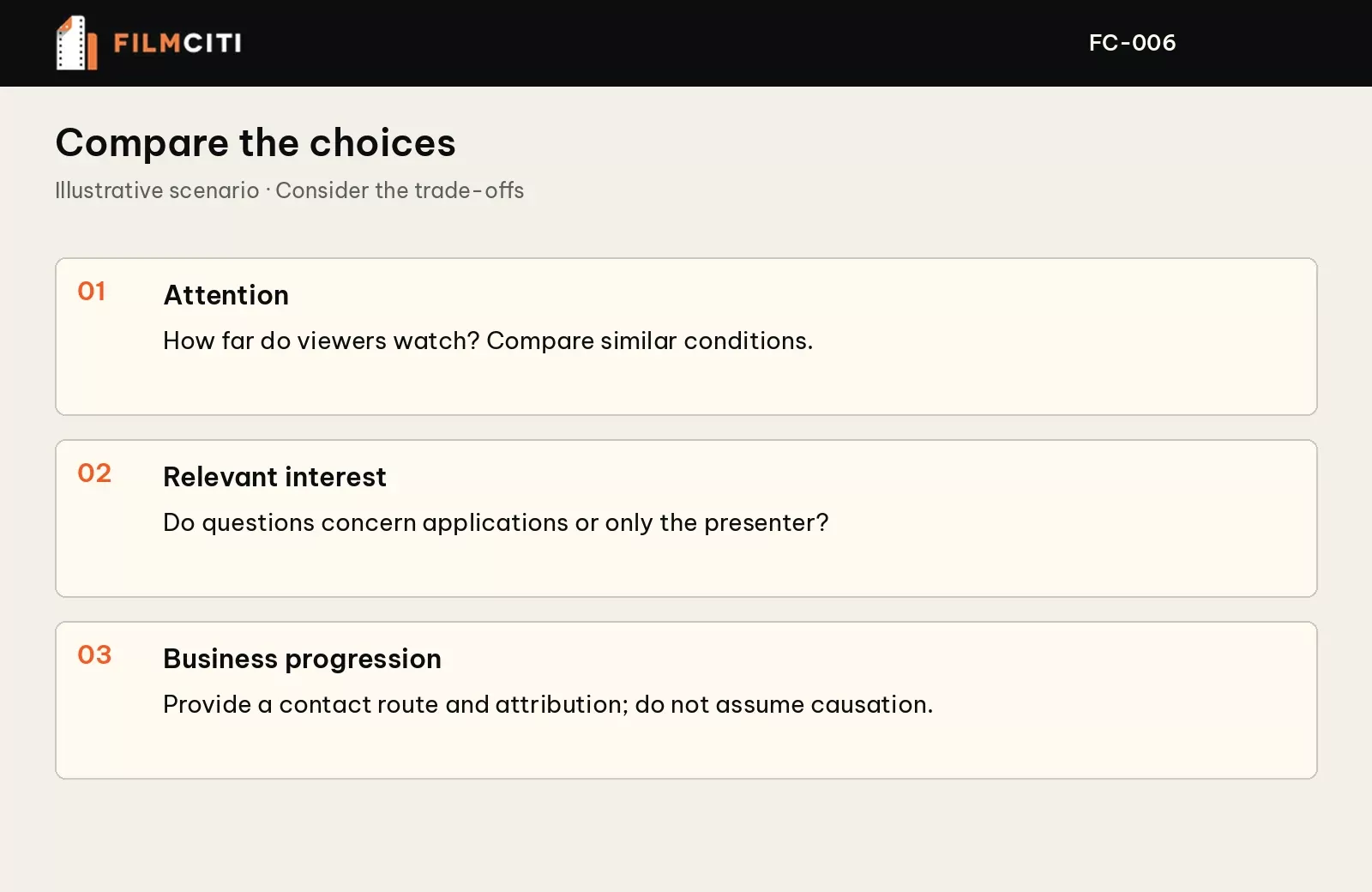
Read the numbers alongside the questions viewers ask.
Day 90: decide whether to keep, change or stop each series
“Does TikTok bring in customers?” becomes easier to answer when you have recorded which video led to an enquiry, what the person asked and how the message was handled. If relevant interest has not led to a consultation, check the profile, landing page and how quickly sales responds. A simple test is to play the customer: watch a video, open the profile, look for a way to send a message or leave a phone number, time how long it takes for someone to reply, and check whether the link in the profile still opens the right page. If any step makes you stop and think, a real buyer will stop there too. If several enquiries stall at the same point, fix that step before planning more videos. Better-looking footage may not solve a contact step that is difficult to use.
For a series with few signals, ask whether there is enough data to judge it and what the latest test changed. You might stop a hook, a group of topics or an overly demanding production rhythm rather than change the channel's entire direction. Recording what you learned prevents the crew and business from starting again the following month.
Continuing a series also depends on resources. A technical series may attract the right questions, yet each episode waits days for a specialist. In that case, group questions into a shoot or reduce the pace rather than approve a schedule nobody can keep. If the channel needs professionally shot footage, group several episodes into one shoot to make full use of the crew and equipment: according to Filmciti's pricing page, all-inclusive production packages start from 70 million VND (excluding VAT) for 1 shoot day, with the option of a short cut and a 9:16 vertical version alongside the main 16:9 film.
Checklist before approving the next phase
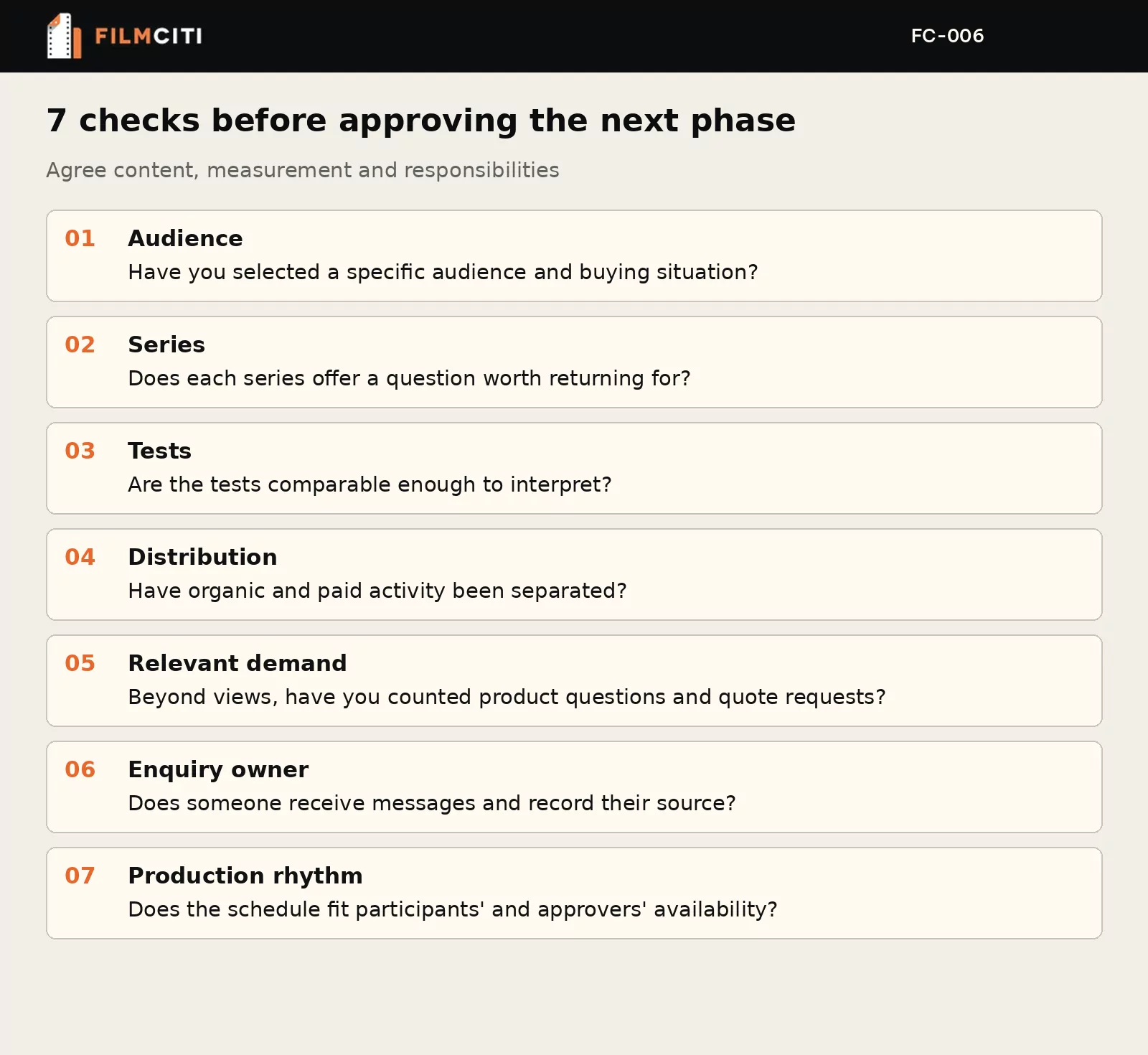
Seven questions to review before approving the next phase.
- Have you selected a specific audience and buying situation?
- Does each series offer a question worth returning for?
- Are the tests comparable enough to interpret?
- Have organic and paid activity been separated?
- Beyond views, have you counted product questions and messages requesting quotes?
- Does someone receive enquiries and record their source?
- Does the production rhythm fit participants' and approvers' schedules?
Revisit the plan when the report only shows views and followers, or when nobody can say which video a request for a quote came from.
Download the 90-day planning and review workbook — Vietnamese template to record hypotheses, observations and decisions for each phase.
Further reading
- 6 TikTok content directions for B2B businesses
- planning a TikTok posting schedule
- Filmciti's TikTok channel building service.
If you are planning the first 90 days, send Filmciti a brief with your channel objective, target buyers, available on-camera participants and existing data, so both sides can build a content plan and a set of metrics that fit.
Related articles
Related service: TikTok channel service
FAQ
For the first 90 days, set KPIs for work completed rather than growth figures: the number of deliberate content tests, recording metrics after each video and classifying viewers' questions. Set growth KPIs once you have a baseline, meaning the channel's own average results, and know what resources you can sustain.
Not necessarily. Choose a posting rhythm that matches your capacity to prepare information, produce, approve content and answer messages, while publishing enough videos to learn something at the end of each phase. A manageable schedule that stays consistent is usually more useful than a busy one that breaks down halfway.
Only when the scope of work and the resources on both sides can support it. Whether you outsource production or day-to-day operations, the business still needs one person to confirm product information and one contact to handle customer messages, because an outside team cannot answer technical questions or quote prices on the business's behalf.