

Filming a factory in operation: aligning the shooting schedule with the production plan
The factory needs a company film to send to customers and partners, but it cannot stop its lines for days to host a crew. The production supervisor worries the crew will slow output, and the safety team worries about equipment entering hazardous areas. In practice, most factory films are shot while the plant keeps producing, provided the shooting schedule is built around the production plan and the safety conditions are confirmed by the factory in advance. This article explains how to film a factory in operation: use the production plan as the framework, recce with the supervisor, agree the safety conditions and prepare fallbacks for when the plan changes.
In this article
- Factory filming starts from the weekly production plan, not from the crew's free dates
- A recce with the production supervisor shows which scenes can be shot while the machines run
- Safety conditions are set by the factory, and the crew needs them in advance to prepare properly
- A shift-based shooting schedule lets the crew move with the rhythm of production instead of cutting across it
- The best-looking line in the factory may be running a product that cannot be filmed
- Checklist for factory filming before locking the date with the crew
- Further reading
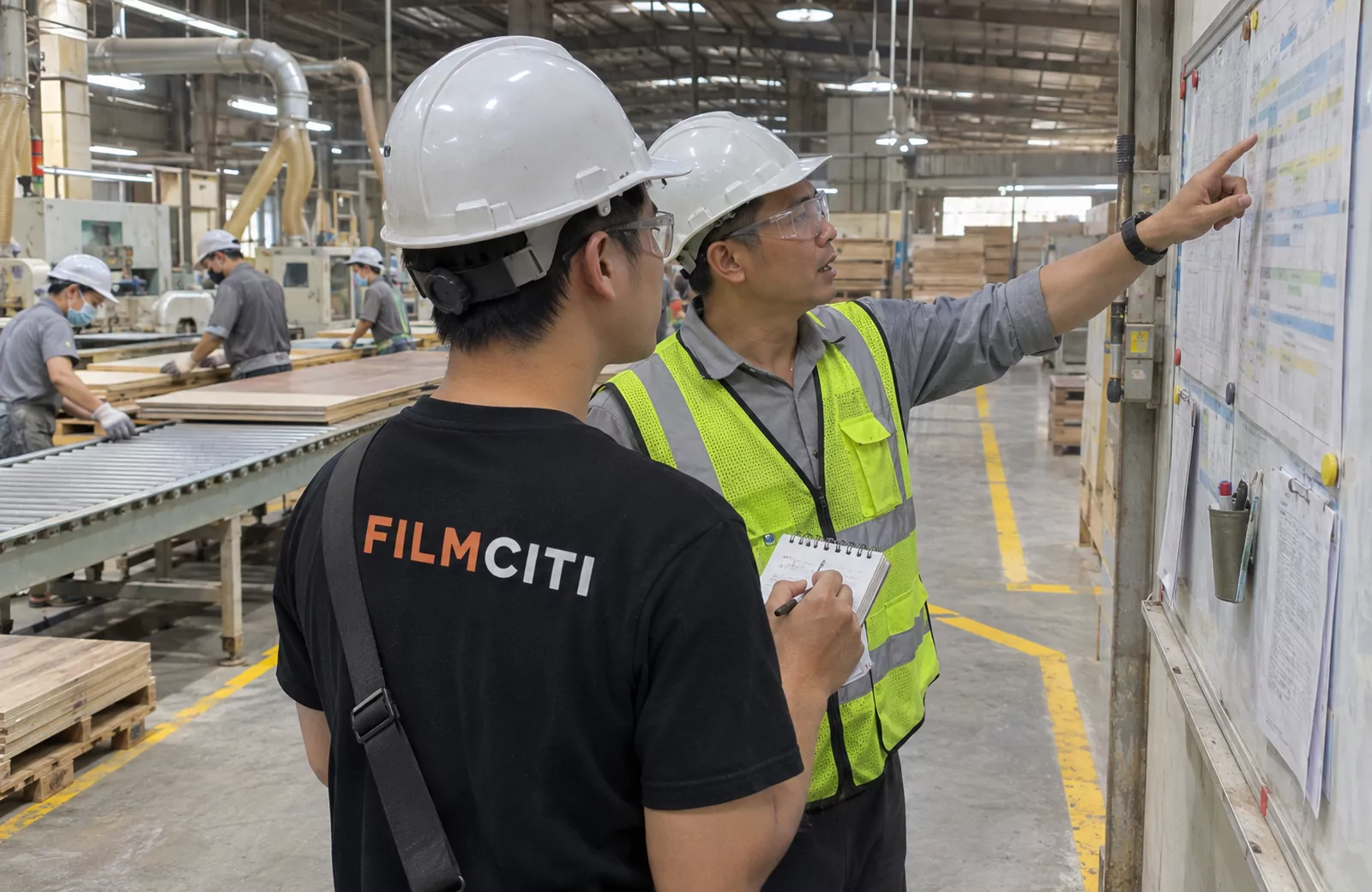
The producer and the production supervisor check the weekly production plan before locking the shoot date.
Factory filming starts from the weekly production plan, not from the crew's free dates
A production line does not always look the same. In the same plant, some days run the flagship product through every stage, some days are changeover days when the line stands still for a few hours while moulds or models are switched, and some days are set aside for maintenance. If the shoot falls on a changeover, the crew films an empty floor, even though on paper the factory is "in operation".
So the first question in factory filming is not "when is the crew free" but "what will the plant be making that week, on which shift, and which stages will be running". The planning department usually works week by week, and this is the document the producer needs to see before proposing a shoot date. It also shows which products will appear on camera, a detail that matters for confidentiality.
The business should appoint someone from production as the crew's contact, usually the production supervisor or a shift leader. This person knows which machine is about to stop and which batch is about to ship.
A recce with the production supervisor shows which scenes can be shot while the machines run
The recce is when the director, producer and camera operator walk every area with the supervisor, about 1–2 weeks before the shoot. The aim is not just to pick good angles but to establish which scenes can be filmed while machines are running, which need to wait for a particular moment and which should not be filmed at all. The table below shows one way to record recce results by area: whether filming is possible while running, the conditions the factory must confirm and who confirms them.
| Area | Filming while running | Conditions the factory must confirm | Confirmed by |
|---|---|---|---|
| Raw material store | Usually possible | Forklift routes, where the camera can stand | Storekeeper, safety |
| Main production line | From fixed positions | Safe distance from machines, when the flagship product is running | Production supervisor |
| Paint and chemical area | Depends on factory rules | Equipment allowed in, respiratory protection, time allowed inside | Safety (EHS) |
| Quality control room | Usually possible | Which samples, records and screens may be shown | QC lead |
| Packing and dispatch | Possible on the dispatch schedule | Truck arrival times, information on cartons | Warehouse, sales |
Recce results make the shotlist far more realistic: if the edge-banding machine runs continuously on the morning shift, that scene belongs in the morning; if the packing area is only busy when the container truck arrives at 14:00, the dispatch scene should wait until then.
Safety conditions are set by the factory, and the crew needs them in advance to prepare properly
Every factory has its own safety rules, and in foreign-invested plants they are usually managed closely by the EHS (environment, health and safety) team. The crew cannot judge for itself which areas are safe for a camera; those conditions must be confirmed by the factory in writing or by email before the shoot.
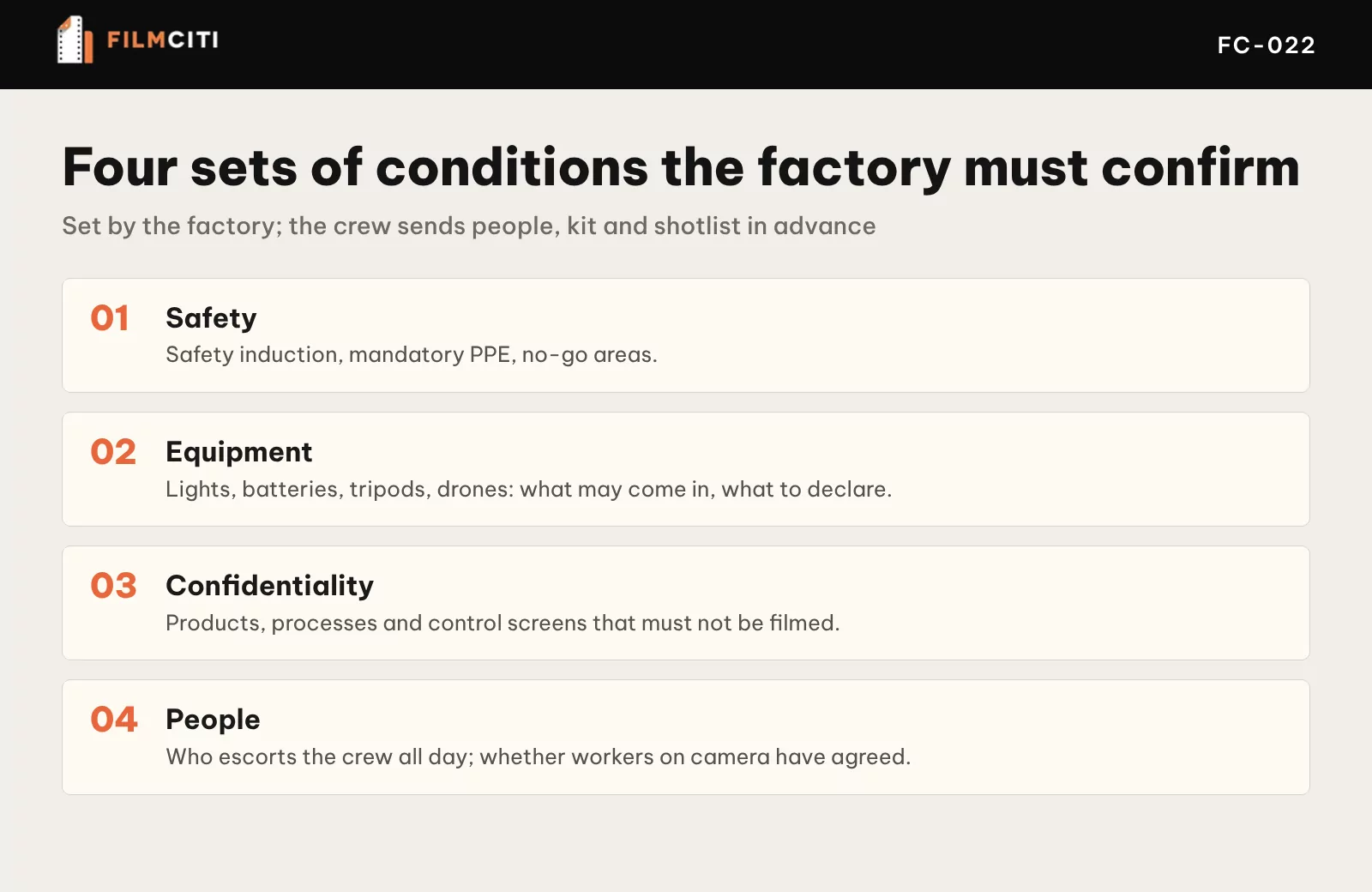
Usually the crew needs to know 4 sets of conditions. First, safety: how long the induction takes, which personal protective equipment is mandatory and which areas are off limits. Second, equipment: whether lights, batteries, tripods and drones may be brought onto the floor, and what must be declared in advance. Third, confidentiality: which products, processes and control screens must not appear on camera. Fourth, people: whether workers who appear on camera need to be asked, and who will escort the crew throughout the day. These four sets depend on one another: an area that bans lithium batteries forces the crew to swap battery lights for mains-powered ones, which in turn needs power points and cable routes the factory has to approve. The earlier the answers arrive, the more time the crew has to change equipment and adjust the shotlist.
The crew should send its list of people, list of equipment and a shotlist with camera positions in advance, so the safety team can assess them. Some shots with the camera close to a conveyor may need the line to stop or slow down for a few minutes; that decision belongs to the factory, and if it cannot stop, the director will choose another angle. No filming approach can guarantee zero impact on production, but mapping it out in advance means the impact is calculated and agreed beforehand. In practice, the safety team usually reviews this list with the production supervisor, marking the camera positions that are allowed and the shots that need a factory person standing nearby. The approved version should be printed and brought on the shoot day, so that when something comes up, both sides are looking at the same document.
A shift-based shooting schedule lets the crew move with the rhythm of production instead of cutting across it
Once the production plan and recce results are in hand, the producer builds the schedule around the plant's shifts. The general rule is to film machine-dependent scenes when the machines run most steadily, and to place interviews and office scenes at shift changes or breaks.
Example brief: a plastic pipe plant films a 1-day company video covering the extrusion line, the automatic cutter, the packing area and an interview with the plant director. The table below sets out each time slot with its scene, the state of the floor at that time and the fallback if a machine stops.
| Time | Scene | Floor status | Fallback |
|---|---|---|---|
| 7:30–8:15 | Safety induction, PPE issue | Start of morning shift | None, mandatory |
| 8:15–11:00 | Extrusion line and automatic cutter | Running the main order | Close-ups of pipe surfaces if the automatic cutter stops |
| 11:00–12:00 | Interview with the plant director | Plant office | Move to 13:00 |
| 13:00–15:30 | QC room, packing area | Afternoon shift, truck at 14:00 | Film packing after the truck leaves |
The twist: at 9:30 the automatic cutter throws a fault and maintenance needs about 2 hours to fix it. There are 3 ways to handle it:
- Move early to the QC room and the interview, and return to the automatic cutter once it is running again. The schedule holds if the repair is done before 15:00, but every later scene shifts.
- Film the technicians repairing the machine, if the factory agrees to it being shown. The scene can demonstrate maintenance capability, but the supervisor must confirm the footage may be used.
- Keep the automatic cutter scene for a short pick-up shoot. The film gets every scene, but there is an extra cost and post-production slips.
That is why the factory person escorting the crew should be someone with authority to make adjustments with production, not just a guide. When choosing between the three options above, that person also needs to weigh the cost of a pick-up shoot. According to Filmciti's pricing page, all-inclusive production packages start from VND 70 million (excluding VAT) for 1 shoot day; only Package B (VND 200 million) and Package A (VND 300 million) include 1 standby day when weather or other events beyond anyone's control affect the main shoot, and filming outside Hanoi and Ho Chi Minh City is quoted separately. For a factory in a provincial industrial park, a pick-up shoot caused by a machine fault may also bring the crew's travel and accommodation costs, so ask about this before signing the contract.
The best-looking line in the factory may be running a product that cannot be filmed
In early January 2026, a Taiwanese-invested furniture export factory in Bình Dương needs a 3-minute company film for its stand at a furniture fair in early March. The factory closes for Tết from 12 February and only returns to full capacity after 24 February, so the shoot is fixed for 15 January. Ms Loan, assistant to the director and in charge of marketing, takes on the project while also organising the year-end party and closing the year's accounts. Mr Lin, the plant director, has just one instruction: "We must have the UV coating line, that's what customers ask about most."
The recce on 6 January goes smoothly. Mr Toàn, the production supervisor, walks the crew along the whole line and shows them a safe camera position beside the UV coating line, where glossy white cabinet panels glide under violet curing lamps. The director picks this line for the opening shot, and the script is approved on 9 January.
On the afternoon of 13 January, Mr Toàn posts in the project's Zalo group: "Heads up everyone, this week's plan has changed. On the 15th the UV line is running samples for a US customer, and the contract bans photos and video of the samples. The crew can't go into that area."
Ms Loan calls the producer straight away: "Can we still film the UV line and just blur the product? It's only a small fix, customers ask about that line all the time."
The producer explains that a no-filming clause applies to the act of filming, not just to publishing the film. Even if the samples are blurred in post, the raw footage would still sit on the crew's drives, and that is something Ms Loan would need the sales team to confirm, not something the crew can decide. On top of that, the UV line appears in about 9 scenes; blur them all and the opening shot becomes smudges sliding under violet light. Sales replies within 20 minutes: no filming.
Ms Loan had reasons not to check the production plan again after the recce: the date was fixed, the script approved, and she was juggling all the year-end work. The sample order was only confirmed on 12 January. The crew also missed a step: the producer treated the 6 January recce findings as fixed, never asked whose products the UV line would be running in the week of 15 January, and never asked planning to resend the weekly plan 2 days before the shoot.
On 15 January the crew films the older coating line, running the factory's own products, and every other area as scheduled. The opening shot temporarily uses the woodworking floor. On 26 February, once the factory is back up, the crew does a half-day pick-up shoot on the UV line with a batch of the factory's own brand, adding cost and squeezing post-production into 8 days. The film is ready for the fair, but the English version for overseas buyers only goes out 2 days after opening day.
After the 6 January recce, the question that mattered most was about the production plan, not camera angles: "In the shoot week, whose products will each line be running, and are any of them restricted from filming under a customer contract?"
The story above is a hypothetical situation, reconstructed from things that often happen in corporate filmmaking.
With the Filmciti crew, we ask the planning department to resend the production plan 2 days before the shoot and check whose products each line will be running and whether any of them are restricted from filming. On the shoot day, the crew only sets up at positions the factory has approved, behind the safety line and with a factory safety officer alongside.
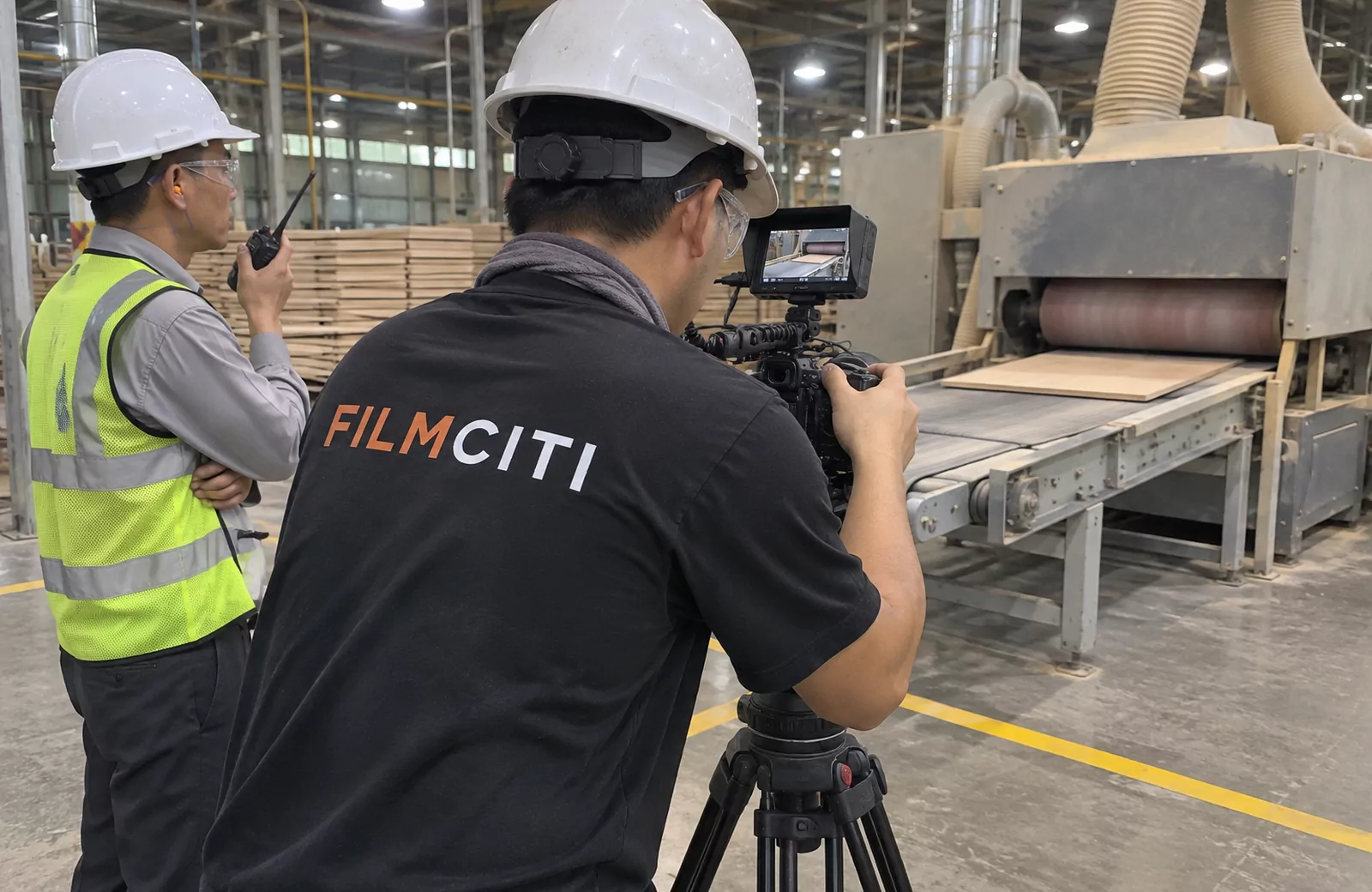
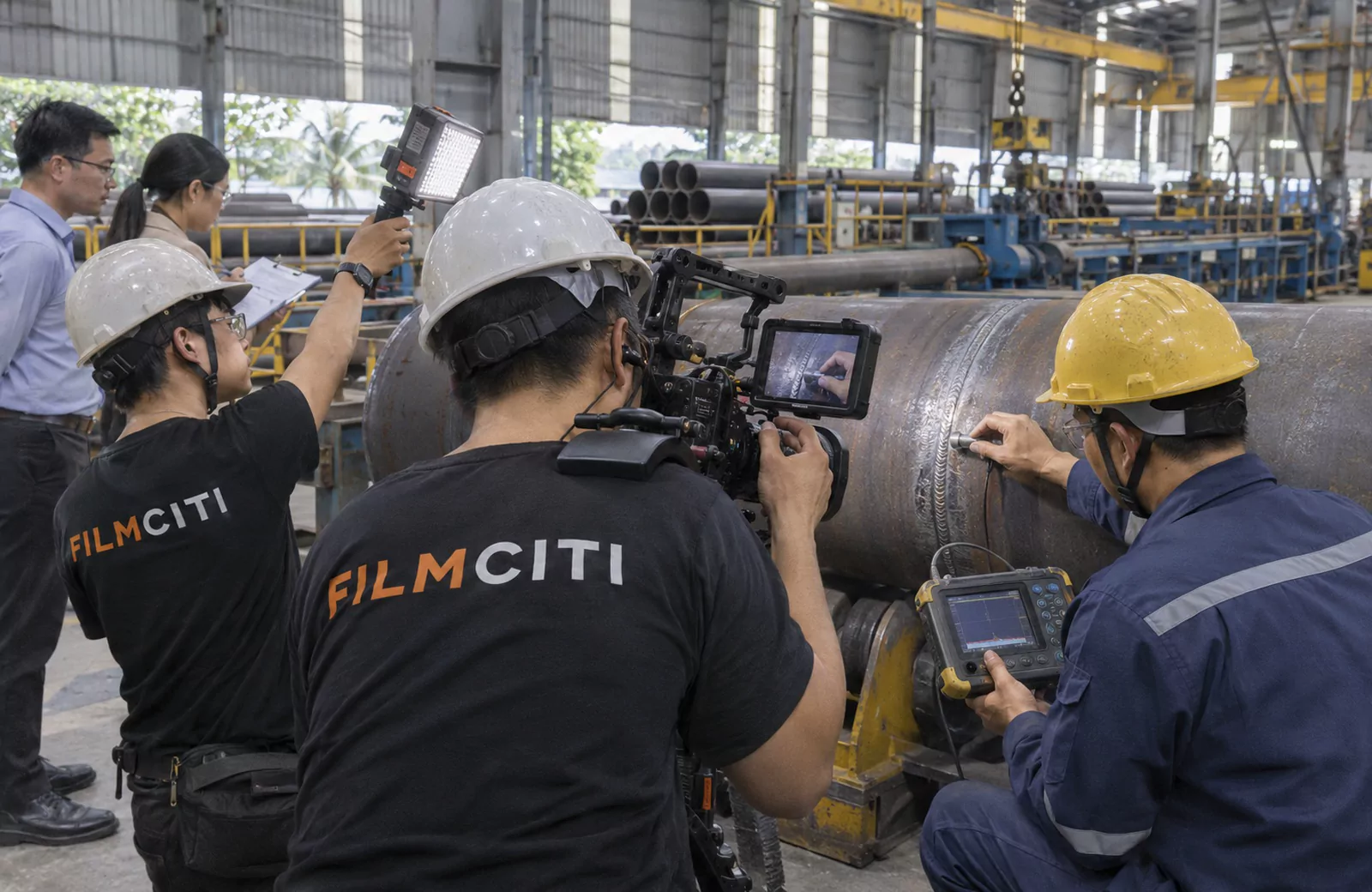
The crew films from behind the safety line, with a factory safety officer escorting them throughout the shoot day.
Checklist for factory filming before locking the date with the crew
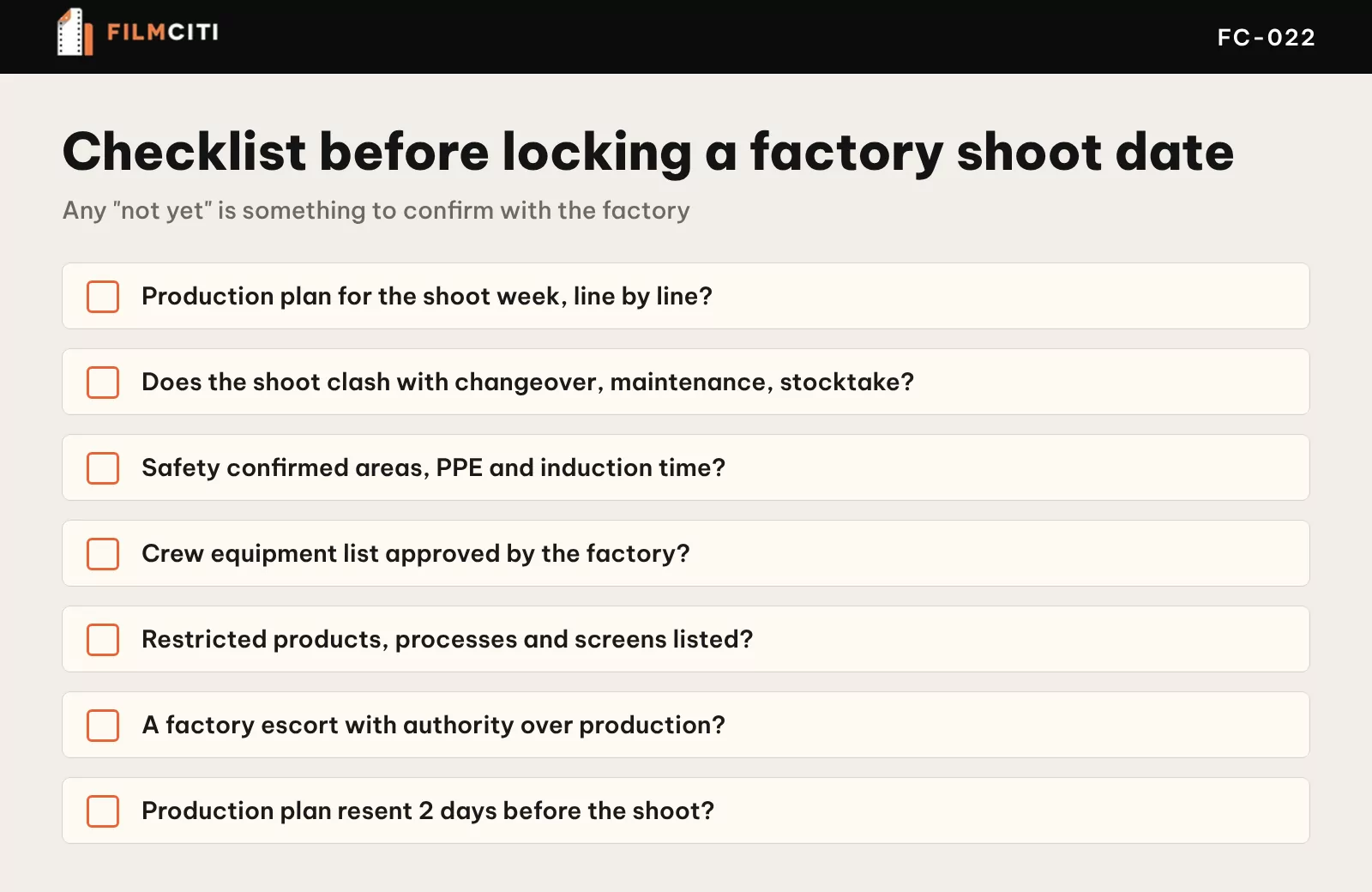
- Do you have the production plan for the shoot week, showing what each line will be running?
- Does the shoot day clash with a changeover, maintenance or stocktake in the main areas?
- Has the safety team confirmed accessible areas, mandatory PPE and the induction time?
- Has the factory approved the list of equipment the crew will bring in?
- Have products, processes or screens restricted from filming been listed?
- Is there a factory escort for the crew with authority to make adjustments with production?
- Will the production plan be resent to the crew 2 days before the shoot?
Go back to the production company if the proposed schedule is not based on the factory's production plan, or if the shotlist does not give camera positions for areas where machines will be running.
Download the Factory filming preparation list — Vietnamese template to record recce results by area, track the safety conditions to be confirmed and plan the shoot by shift.
Further reading
- Corporate video shoot checklist: 7 things to tell your team.
- Factory introduction videos: what partners need to know.
- Filmciti factory film services.
If your factory is preparing to film a company video, you can use the preparation list that comes with this article to get the conditions ready, then send Filmciti a brief with the factory address, the areas you want to film and the expected production schedule. A Filmciti producer will propose a recce date and a shift-based shooting schedule.
Related service: Factory films
FAQ
Most scenes can be filmed while the line keeps running, if the schedule follows the production plan and the camera positions are approved by the factory. Some close-up shots may need a brief stop or slowdown, and that decision belongs to the factory. If it cannot stop, the director will choose another angle.
The factory sets and confirms the safety conditions, and the crew is responsible for following them in full, from the safety induction to PPE and permitted areas. Each side's specific responsibilities should be written into the contract or minutes before the shoot, in line with factory rules and current regulations.
It is possible if the factory allows it and the space is safe enough, but flying inside a plant with running machinery and people at work needs a separate assessment by the safety team. For outdoor drone shots, the business should also check the rules on flying zones under current regulations.