

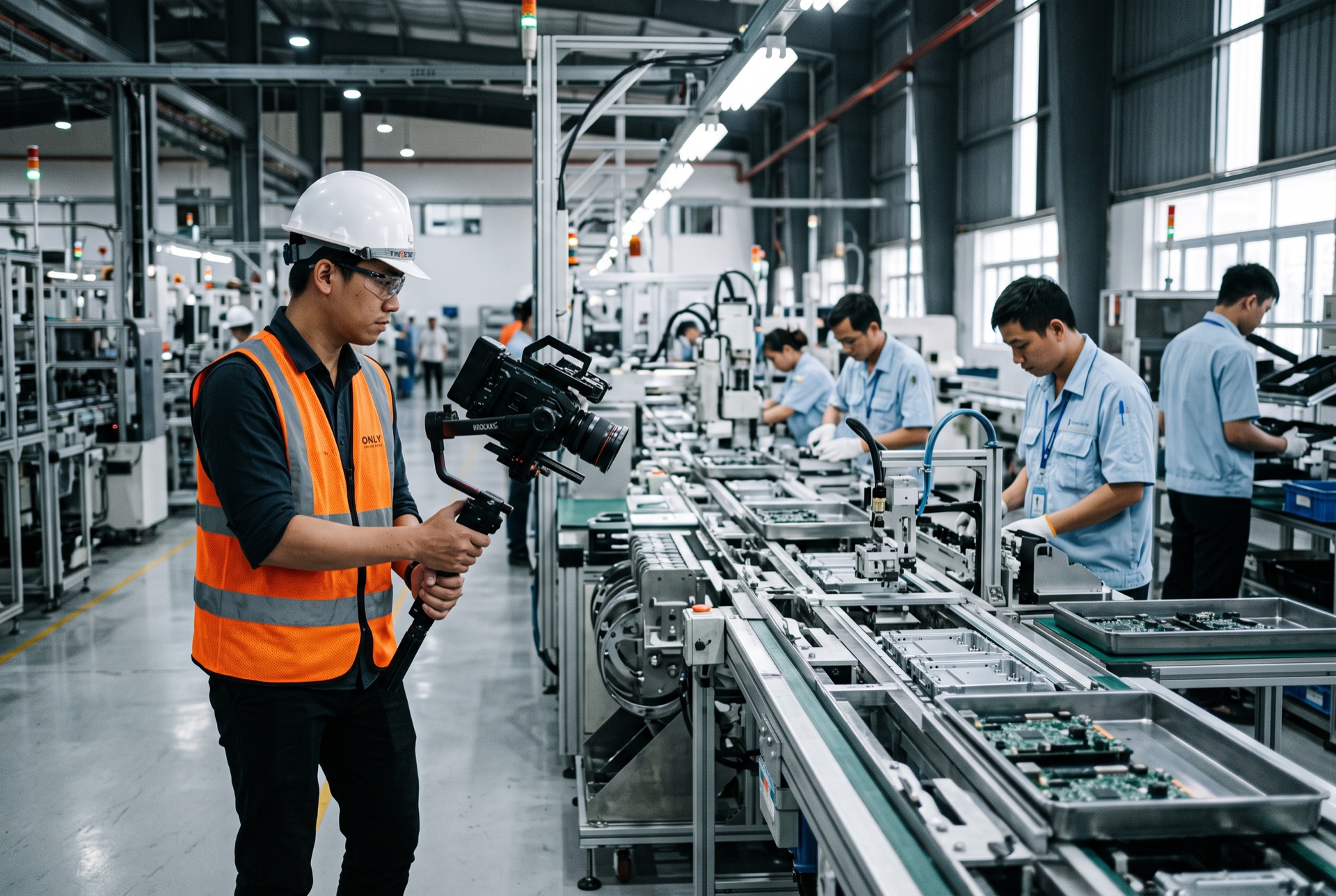
Corporate video script: how to read it so you can picture the film before approving
The production company has just sent the script, leadership has messaged "read it and approve it, please", and you have one evening to reply. Most reviewers read a corporate video script the way they would read an essay: which sentences flow, which words need changing. But a script describes what will be filmed, said and shown on screen, so the things worth questioning usually sit in the picture column, in the length of the voice-over and in the lines written for other people to say. This article shows how to read a script layer by layer, which questions to put to the crew, and how to flag the content that needs confirming before the shoot day.
In this article
- A corporate video script describes what will appear on screen; it is not an essay to proofread
- Read the picture column first and ask where each scene is shot, who appears and what they are doing
- Voice-over should be measured with a stopwatch, not by page count
- Interview lines in a script are only planned content, and every figure needs a source
- An interview line written into the script does not guarantee the customer will say it
- Checklist before approving a corporate video script
- Further reading
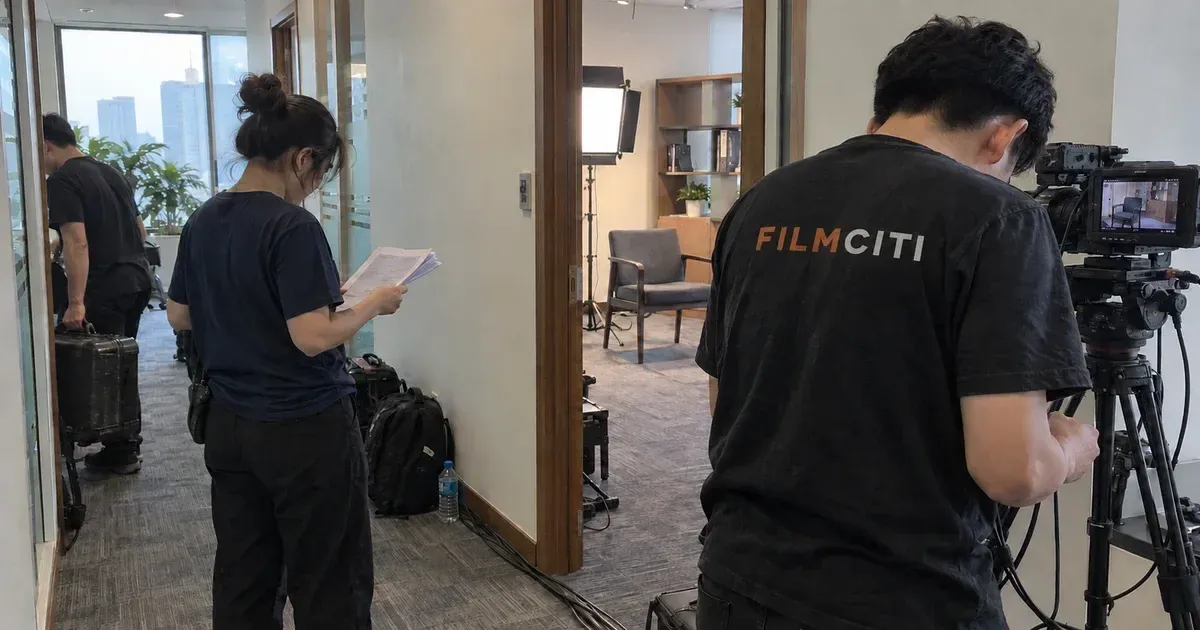
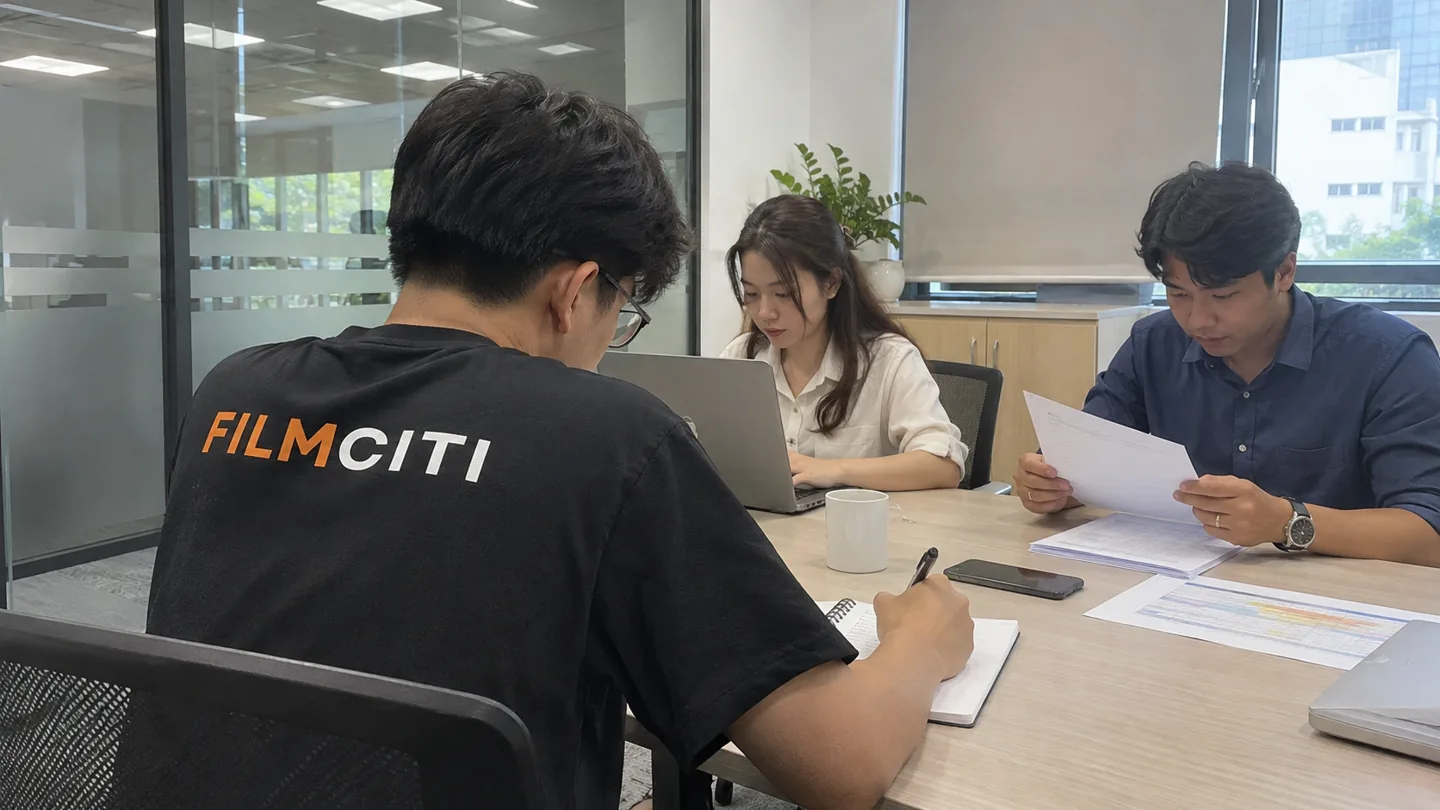
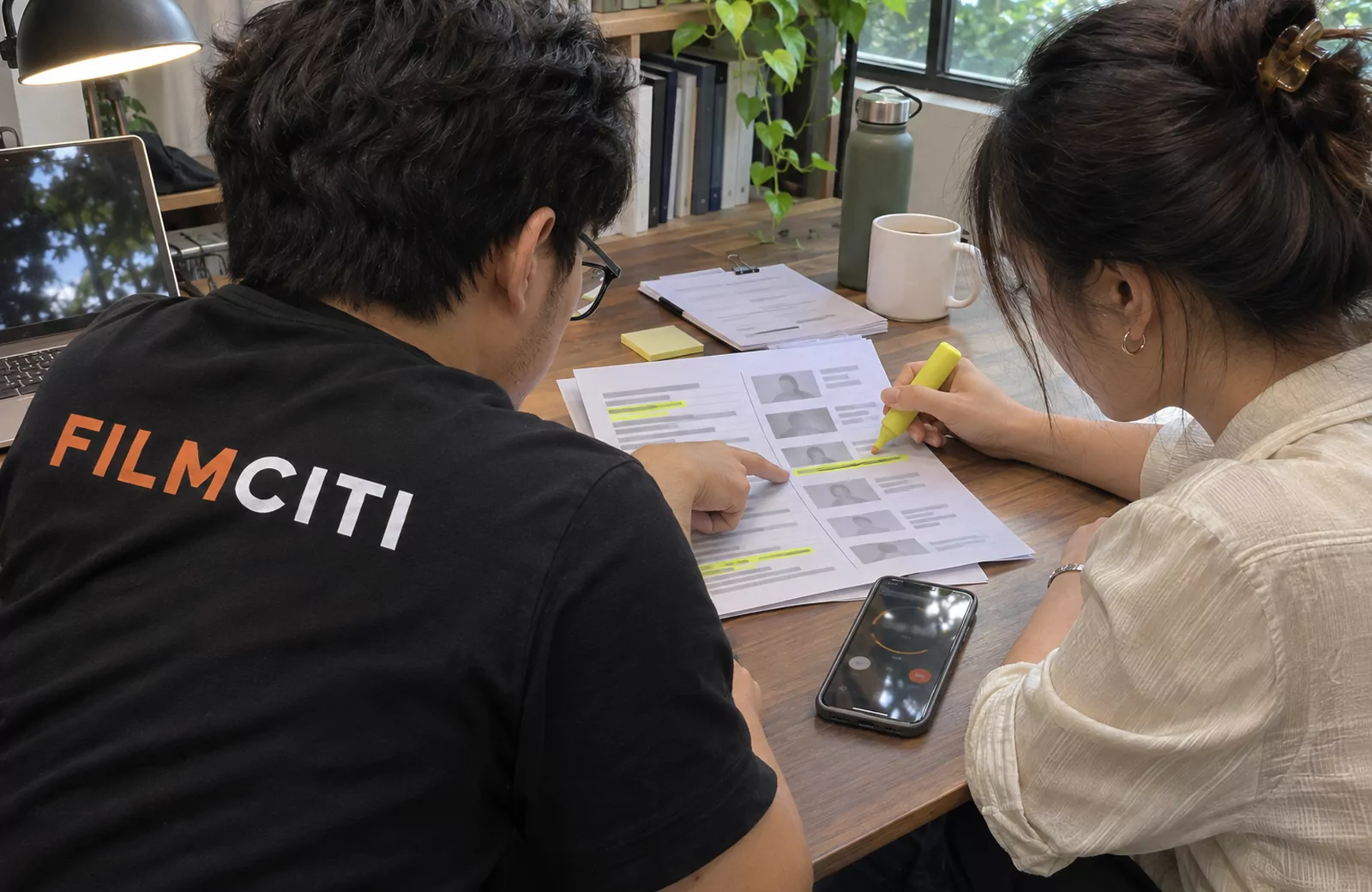
Reading the script with the scriptwriter, starting from the picture column, helps spot early the scenes each side is imagining differently.
A corporate video script describes what will appear on screen; it is not an essay to proofread
A corporate video script is usually laid out in two columns: the picture column describes the shots, and the words column contains the voice-over, planned interview lines and on-screen text. When you approve a script, you are agreeing to both columns, which means agreeing to what the crew will film, who will appear and what viewers will hear.
The trouble is that the words column is far easier to read than the picture column. A well-written voice-over line reassures the reviewer, while the description next to it, such as "the team working professionally", may be imagined one way by the crew and another way by the business. That gap usually only shows up in the first cut, when reshooting has become much more expensive. The reason is that each line in the picture column determines how many people must be on set, what equipment is needed and how many shoot sessions are booked. According to Filmciti's pricing page, all-inclusive production packages start from VND 70 million (excluding VAT) for 1 shoot session, and only packages from VND 200 million upwards include a backup session when weather or an event outside anyone's control disrupts the shoot. A scene reshot because the two sides pictured it differently does not count, so it usually brings extra cost and a later schedule.
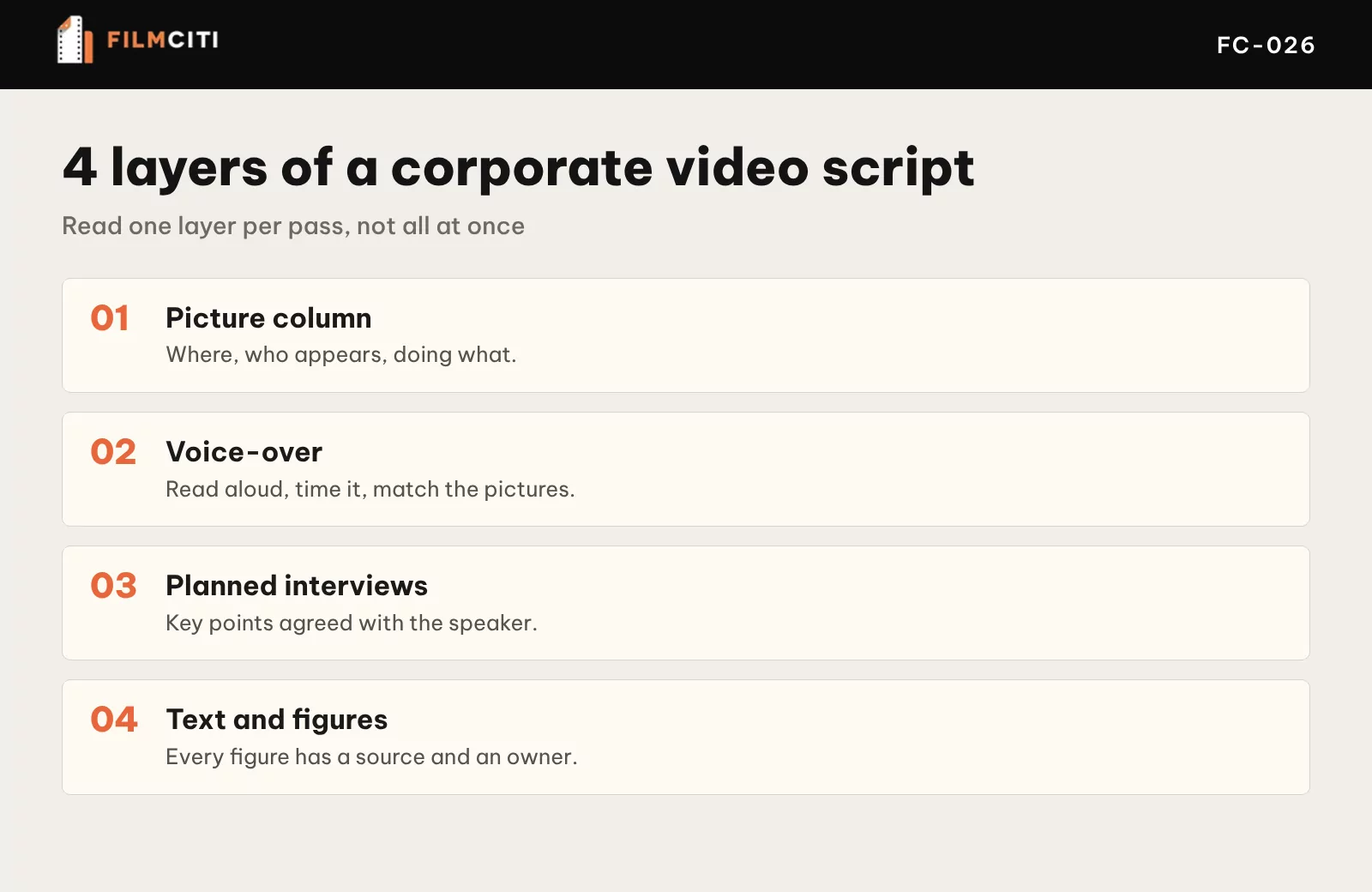
That is why you should read the script in 4 layers, one pass per layer: pictures, voice-over, planned interviews, and on-screen text or figures. If the script was written from a brief that did not define the audience and the venue, it is worth revisiting the article on writing a corporate video brief before giving detailed feedback.
Read the picture column first and ask where each scene is shot, who appears and what they are doing
A clear picture description has to answer three questions: where the scene is shot, who appears, and what that person is doing that the camera can capture. Phrases like "dynamic", "professional" and "modern" describe a feeling rather than an image, so whenever you see them, ask the crew what exactly they will film. The table below sets common picture descriptions against the question to put to the crew and the reason for asking it.
| Line in the script | Question to ask | Why it matters |
|---|---|---|
| The team working professionally | Which department, how many people, doing what? | People, wardrobe and work schedules must be arranged in advance |
| A satisfied customer using the product | Which customer, where, and have they agreed to appear? | Filming customers needs their consent and a separate appointment |
| Aerial view of the factory | Is drone flying allowed in this area? | Some areas require permission or are no-fly zones |
| The CEO shares the vision | Scripted statement or interview, and where? | The two approaches need different preparation and time |
| Graphics explaining the process | Who supplies the figures and the original diagram? | Graphics are only as accurate as the data behind them |
Where possible, ask the crew to attach reference images or a rough storyboard for the key scenes. A single sample image of the framing or the location lets both sides check how they are picturing the scene far faster than an exchange of written comments.
Voice-over should be measured with a stopwatch, not by page count
The voice-over is the easiest part to comment on, so it is also the part most likely to grow with every review round. Each reviewer adds a point, the script gains a few sentences, while the film's length was agreed at the start. When the voice-over is longer than the pictures, the narrator has to rush, the film feels crammed and viewers struggle to remember any one message.
The simplest check is to read the voice-over aloud at a natural pace with a stopwatch, then compare it with the planned length of each picture section. Read it the way the narrator will, pausing at the punctuation, because reading silently is always faster than the real thing and makes the text seem to fit. You should also leave gaps with no narration, because the film needs room for ambient sound, music and shots that give viewers time to look. Wherever a section runs over its picture length, write the number of seconds next to it in the script: that figure shows reviewers that every added point has to be paid for with a shorter shot or a cut sentence. If you have not yet agreed how long the film should be, the article on how long a company film should be can help you decide based on where it will be shown.
Suppose the film runs about 3 minutes and the narrated part is split into 4 sections. After one read-through with a stopwatch, the table might look like this.
| Section | Planned picture length | Voice-over when timed | Difference |
|---|---|---|---|
| Opening: the client's problem | 25 seconds | 31 seconds | 6 seconds over |
| Solution and process | 60 seconds | 72 seconds | 12 seconds over |
| Client interview | 50 seconds | No voice-over | None |
| Close: commitment and invitation | 25 seconds | 22 seconds | 3 seconds spare |
What goes wrong: at that very moment, leadership asks for a section introducing 5 certifications, which takes about 20 seconds to read. There are three ways to handle it:
- Extend the film by about half a minute: every point stays, but you need to check whether the venue or channel accepts that length.
- Show the certifications as a graphic card for a few seconds, without narration: the length holds, but viewers only glance at the names.
- Drop a secondary point from the solution section to make room: the film stays tight, but the approver has to accept losing a point signed off in an earlier round.
When the voice-over has to be cut, cut by idea rather than by word. Dropping one secondary point entirely usually works better than trimming every sentence, because trimming breaks the flow without making the text much shorter.
Interview lines in a script are only planned content, and every figure needs a source
An interview line in a script is what the crew hopes the speaker will say, not dialogue they are obliged to read. On the shoot day, people answer in their own words, and in a corporate film that is a good thing, because natural speech is more credible than prepared lines. If the business needs a speaker to mention a specific point, that point has to be discussed with the speaker before the shoot day; it cannot simply sit in the script. A properly written interview column has three parts: the question the director will ask, the key point you hope the speaker will make, and a clear note that this is planned content. Before the shoot day, the crew sends the questions or calls the speaker to find out which points they are happy to make and which they need to check with their own management. For customers and partners this step matters even more, because they speak for their own company.
Figures need even stricter treatment. Every number that appears in the voice-over, an interview or a graphic should carry a note of its source, the period measured and the person who confirms it. Figures linked to a customer's or partner's name need their written consent, because putting them in a film means publishing them on their behalf. The table below classifies script content by who decides the final wording and what needs doing before the shoot day.
| Type of content | Who decides the final wording | What to do before the shoot day |
|---|---|---|
| Voice-over | The business and the crew | Approve the voice-over text and time it |
| Interviews with staff or leaders | The person being interviewed | Agree the key points; do not ask them to memorise lines |
| Interviews with customers or partners | The customer or partner | Get consent to appear and agree the points they will make |
| Figures and claims on screen | The department that owns the data | Confirm the source in writing |
If the film includes several staff interviews, the article on interviewing employees in a corporate film explains how to prepare people so they speak naturally while still covering the right points.
An interview line written into the script does not guarantee the customer will say it
In early October 2026, a company supplying industrial wastewater treatment systems in Dong Nai was preparing a 3-minute company film to show at an environmental industry conference on 14 November. On 15 October, Ms Uyên, a marketing executive, received the second draft of the script along with a message from Mr Thịnh, the director: "Read it and approve it, please. I trust the production team."
The script read smoothly. In the middle section, the interview column said: "Mr Dũng, plant manager at a textile dyeing factory (customer): Since the system was installed, operating costs have fallen by 40% and our wastewater always meets the standard." The line had been lifted from the sales team's slide deck. Ms Uyên changed a few words in the voice-over and replied "OK" at 10 pm.
On the shoot day at the textile factory, 24 October, Mr Dũng spoke very candidly: "The system runs well, we haven't been fined once in all these years, and whenever there's maintenance their people come out quickly." When the director prompted him about the 40% figure, he shook his head: "I can't say that, you'd have to ask accounting, and my company doesn't publish that number anyway."
The first cut, sent on 4 November, had a voice-over line straight after the interview: "That figure is proof of how effective…", but there was no figure before it any more. Mr Thịnh watched it and messaged: "Where did the 40% bit go? Just put a big 40% on screen and it'll be fine."
The producer explained that the figure was tied to the customer's name and factory; putting it on screen without the customer's confirmation would mean saying on their behalf the very thing they had just declined to say on camera. The number in the slide deck also had no clear basis: which plant it was measured at and over what period. To keep the cost-saving message, they would need data from the company's own operations monitoring system, the customer's consent by email, a rewritten voice-over, a new recording and a re-edited middle section, with only 10 days left.
Ms Uyên had not been careless: the script read smoothly, leadership had asked for a quick approval, and the interview line sounded reasonable because it came from the company's own sales material. The crew's scriptwriter, for their part, had copied the line into the interview column as if it were dialogue, without labelling it as planned content or flagging the figure as needing the customer's confirmation before the shoot day. That was a lapse the crew had to own.
In the end, the two sides dropped the 40% figure and rebuilt the middle section around Mr Dũng's words about never being fined and fast maintenance, with a new voice-over recorded on 7 November. The film was ready for the conference, but the sales team lost the highlight they had planned to use, and the sales deck had to drop the 40% figure until verified data was available.
For the following year's conference script, Ms Uyên marked up the printout in three highlighter colours before replying to the crew, guided by one question: "In this script, which lines are voice-over we write ourselves, which will the interviewees have to say in their own words, and which figures need confirming by whom before the shoot day?"
The story above is a hypothetical situation, reconstructed from things that often happen in corporate filmmaking.
With the Filmciti crew, we mark the interview column of the script as planned content rather than dialogue, and flag each figure that needs confirming by whoever owns the data. Before the shoot day, the director talks the key points through with each interviewee, so what they are willing to say on camera is already clear when the script is approved.
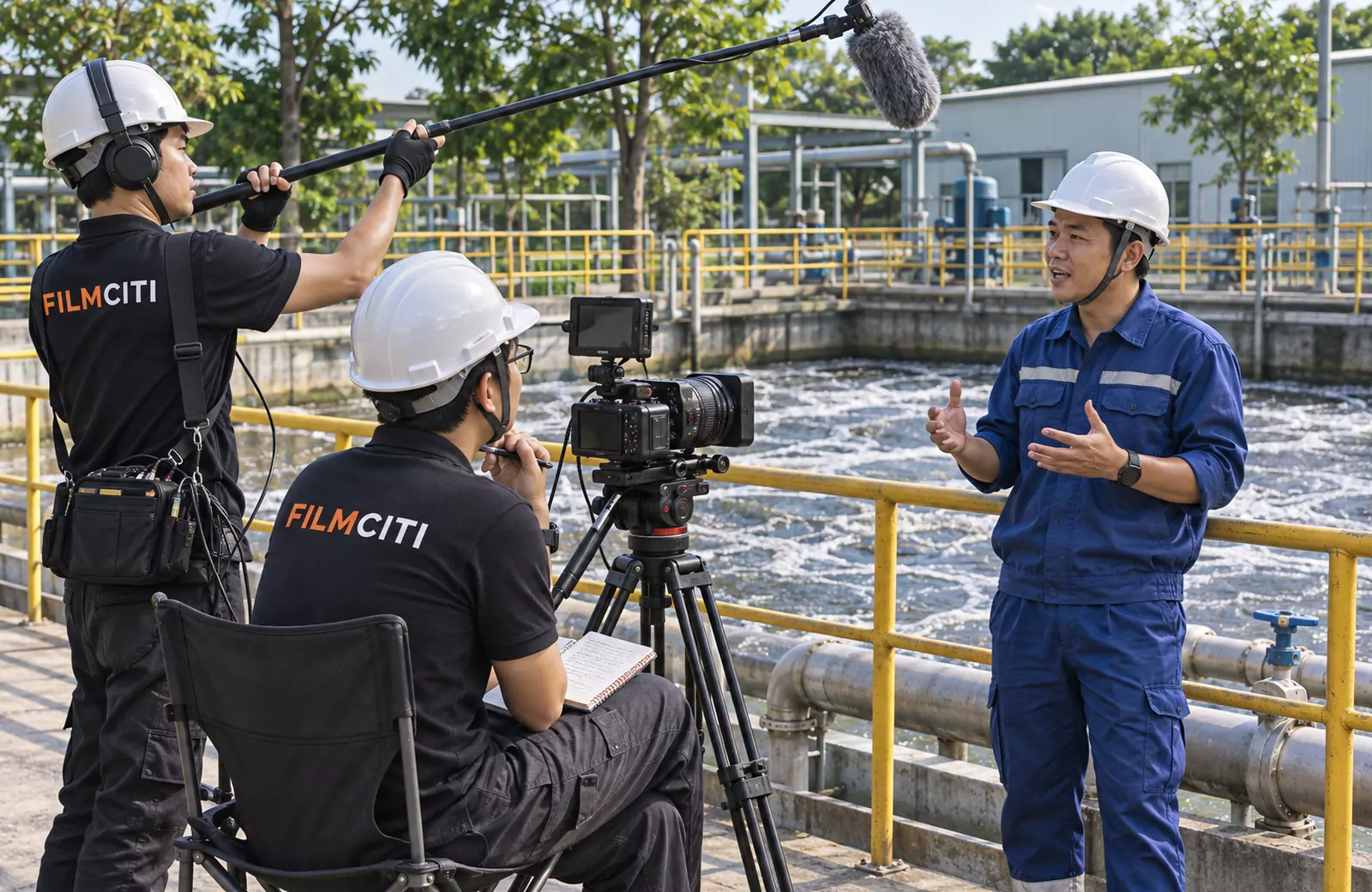
Interviewees speak in their own words, so the key points need to be discussed before the shoot day.
Checklist before approving a corporate video script
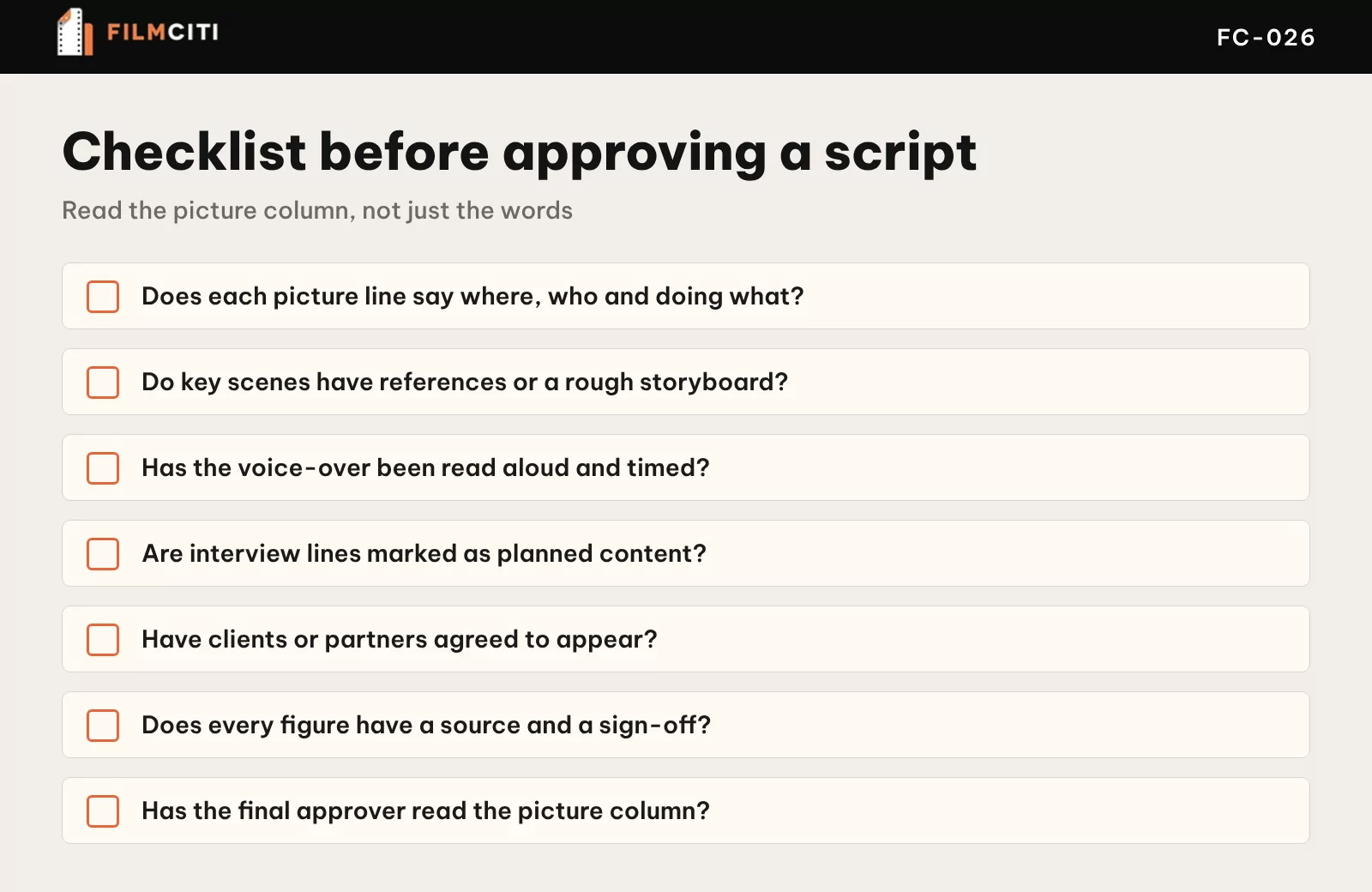
- Does each line in the picture column say where the scene is shot, who appears and what they are doing?
- Do the key scenes have reference images or a rough storyboard?
- Has the voice-over been read aloud and timed against the planned length?
- Are the interview lines clearly marked as planned content?
- Have customers or partners who appear agreed to take part and know the points to be discussed?
- Does every figure in the script have a source and a person who confirms it in writing?
- Has the final approver read the picture column, not just the words column?
Go back to the production company with questions when the picture column contains only feelings such as "professional" or "dynamic", or when a customer's interview line in the script is identical to a sentence from your sales material.
Download the Corporate video script review sheet (Excel) — Vietnamese template to read the script scene by scene, time the voice-over and flag the content that needs confirming before the shoot day.
Further reading
- How long should a company introduction film be?
- Filmciti's corporate video production service: from brief and script to shoot day and post-production.
If your business is preparing a film, use the script review sheet above on the first draft, and send Filmciti a brief with the audience, the venue and any figures that already have a source, so the crew can write a script built on what can actually be filmed and confirmed.
Related service: Corporate film production
FAQ
The most common format is a two-column script: the picture column describes the shots, and the words column holds the voice-over, planned interviews and on-screen text. Some crews add a storyboard or reference images for the key scenes so reviewers can picture them more easily.
Yes, but the cost and time grow with every stage. Changing the voice-over before recording is usually simple, while changing a shot after the shoot day may mean reshooting, so changes to the pictures should be settled at the script stage.
No, because memorised lines usually sound stiff and make the film less credible. A better approach is to agree the key points with the speaker beforehand, let them say it in their own words, and use the voice-over to carry the film's thread.