




3 approval rounds for a corporate film: concept, script, edit – who signs off and when
Three approval rounds belong on the timeline from the kick-off meeting: concept, script with filming conditions, and the edit. Each round needs a clear decision, a named approver and a feedback deadline.
In this article
- Concept approval: settle the storyline before writing the script
- Script approval: only sign off once the filming conditions are confirmed
- Edit approval: combine feedback into one set and send it to one approver
- Requests added after approval: count the extra work involved
- Before agreeing a delivery deadline, check that all 3 rounds have an approver
Start with the overview: How long does a corporate film take? What determines production time?
Anyone who makes corporate films has seen a file name like this: Phim_FINAL_chot_v7_sua_lan_cuoi.mp4. The word FINAL appeared in version 3, "last edit" in version 5, and the film still has not been approved.
Most rounds of revisions that drag on like this are not caused by a slow crew or a demanding client. The cause is usually a decision nobody has signed off: what the film is saying, which scenes can be filmed and whose opinion is the final word.
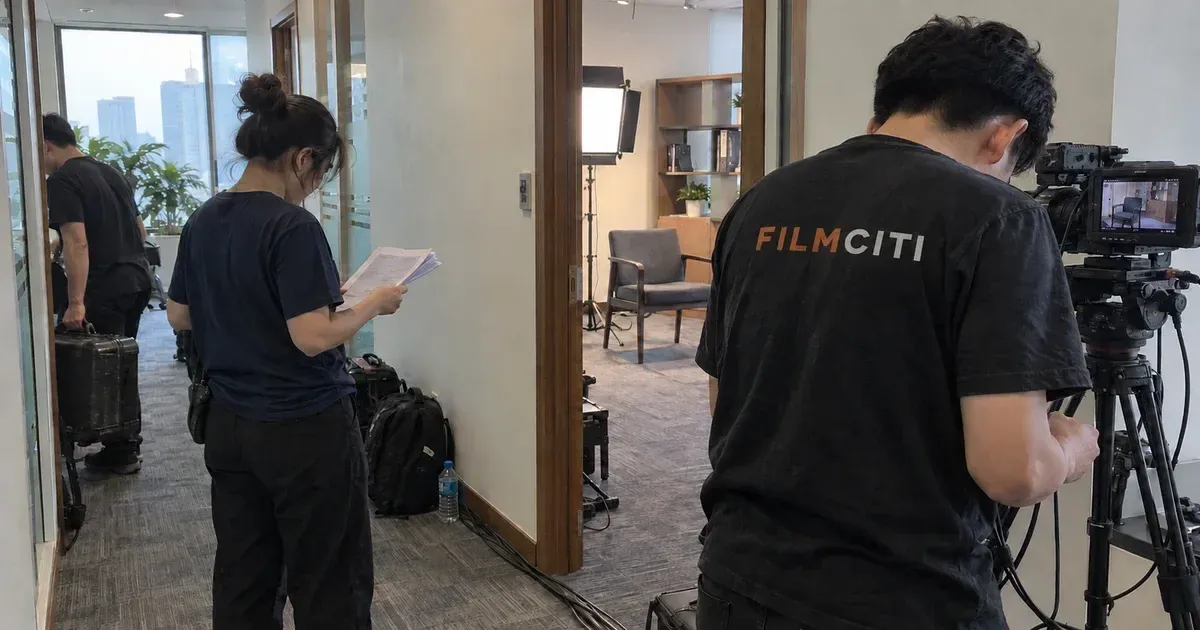
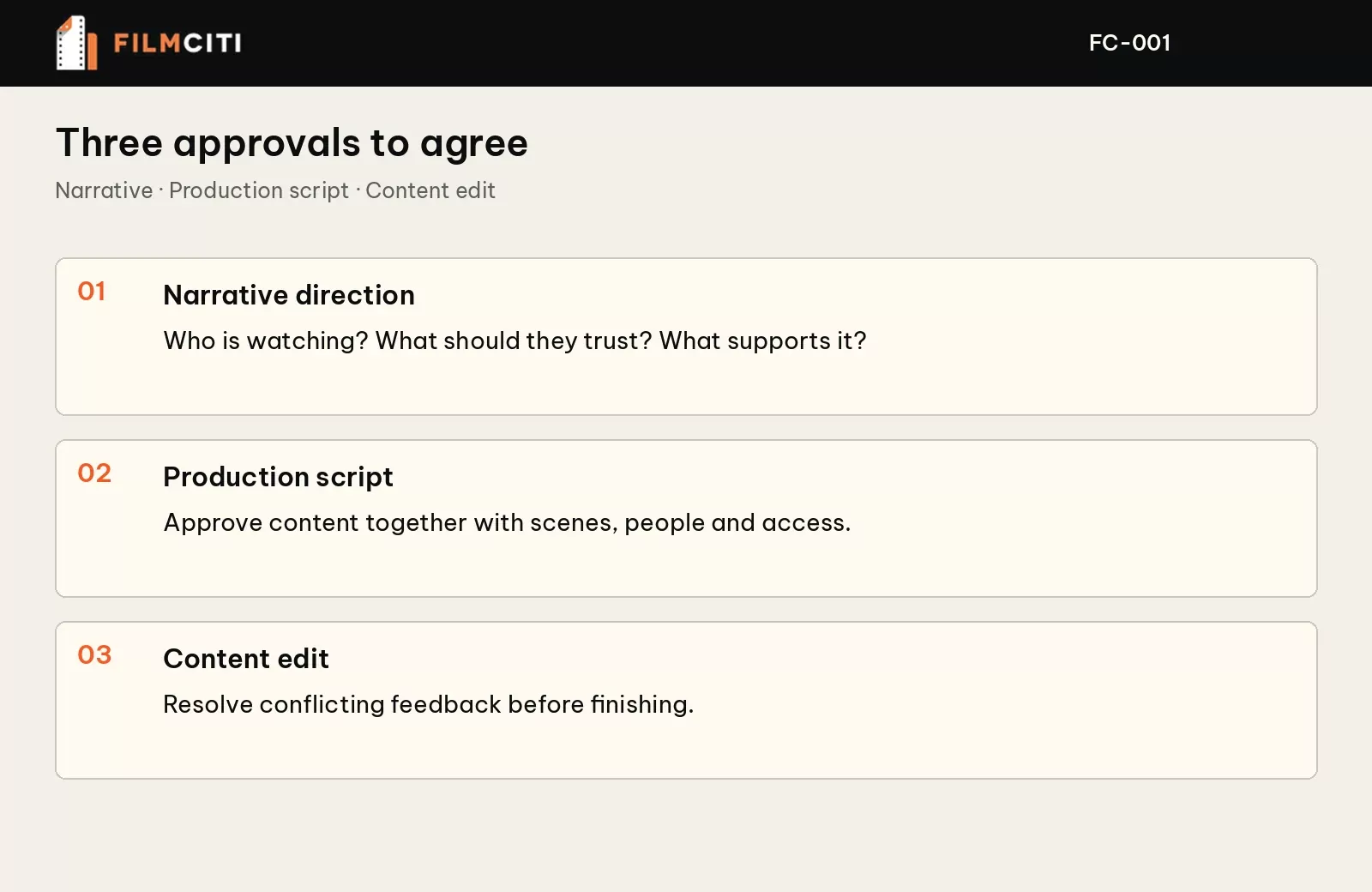
There are 3 approval rounds for a corporate film that should go on the timeline from the kick-off meeting: approving the concept, approving the script together with the filming conditions, and approving the edit. For each round, both sides need to agree 3 things: what is being decided, who has the authority to sign it off and the date feedback is due.
The table below summarises the 3 approval rounds: what each round decides, who signs it off and what happens if it is skipped.
Approval round | What to decide | Who signs off | If skipped
- Concept | The main audience, what they need to understand, the evidence the film offers | The leader who will put their name to the film | You only find out the direction is wrong after the script is written
- Script & filming conditions | Narration, shotlist, people on camera, locations, who confirms the figures | The project lead and the departments involved | You only find out a scene cannot be filmed on the shoot day
- Edit | Structure, order of information, accuracy of the narration | One final approver, receiving one consolidated set of feedback | Revisions go round in circles across many versions
The 3 approval rounds and who needs to be present at each.
Concept approval: settle the storyline before writing the script
The concept approval decides what the film will say, so it needs to be settled before the crew writes the script. A brief such as "Make me a film showing what the company can do" sounds clear, but it can lead to 2 completely different films.
Illustrative scenario — The company leader wanted to show quality control; the script was all drone shots
With 5 weeks to go before a supporting-industries trade fair, Mr Tuấn, director of an engineering company, sends marketing exactly that one sentence and flies to Japan to meet clients. Worried about the deadline, the head of marketing skips the concept stage and asks the crew to go straight to the script. She takes "capability" to mean scale: drone shots over the whole factory, rows of CNC machines, a fleet of container trucks waiting to load. The crew writes a 4-page script in that direction, with a shotlist as polished as a property TVC.
Mr Tuấn returns, and the script reading is booked for the next morning. On page 2 he asks: "So where's the part about how we handled the batch returned by the Japanese client?"
It turns out what he wanted clients to see was how the company checks every single bolt before delivery, because the target customers are FDI factories looking for new suppliers. For them, however beautiful the drone shots, none of it answers the question "does the product meet the standard?" The 4-page script is moved into a folder called "Reference", and 1 of the 5 precious weeks has gone.
Nobody was entirely wrong: the concept stage was skipped to save time. But if the crew had presented 2 concept directions on half a page, each with a few typical scenes, Mr Tuấn would have needed only 10 minutes to choose.
At the concept approval round there is no need for narration or a detailed storyboard. Both sides only need to answer 3 questions: who the main audience is, what they are unsure about and what evidence the film offers in reply. For a partner choosing a supplier, scenes of product inspection are usually more convincing than a list of achievements. If the goal is to present a branch network, the spread of locations matters more. A concept should be kept short, usually half a page per direction, because the job of this round is to compare and choose a storyline, not to judge the wording. The chosen storyline then drives everything that follows: which people to invite on camera, which areas need filming permission and which figures need confirming by which department. That is why changing the storyline after the script is written usually means rewriting almost the whole script and shotlist.
The person who signs off the concept should be the person who will present the film, usually the company's leader. If they cannot attend the meeting, they still need to see the concept proposal and reply in writing.
Script approval: only sign off once the filming conditions are confirmed
An approved line of narration does not mean the scene illustrating it can be filmed. The person on camera may not have confirmed their schedule, access to the production area may not yet be granted, and the figures may still be waiting for confirmation from accounts.
Getting into the factory does not mean the line will be running either. One crew was once scheduled to film during the lunch break "so it would be quieter", while the script needed exactly the scene of workers operating the line. Any scene that must show real activity should be marked as such in the script, together with the name of the person in charge on site. The reason is that a factory's operating schedule is set by the production department, not by marketing, so whoever books the shoot often does not know which shifts run the machines and which are for maintenance. When the script states that a scene needs the line running, the person in charge on site has grounds to arrange the shift, prepare protective gear for the crew and warn the team leader in advance. In return, the shoot has to follow the production schedule, so the shoot day may run longer or be split into 2 time slots.
So in the second round, read the script alongside the shotlist. For each important scene, you need to be able to answer:
- What is filmed, where and in which time slot?
- Does the scene only need the space, or must people and machines be working?
- Who appears on camera, and have they confirmed their schedule?
- Who confirms the figures, product names and job titles in the narration?
Anything still open needs someone to take it on and a deadline for an answer before the shoot day. "We'll sort it out on set" usually costs the project an extra shoot day as well as extra money.
Edit approval: combine feedback into one set and send it to one approver
The edit approval is the round where things most easily spiral, because by now anyone in the company can watch the film and everyone has an opinion.
Illustrative scenario — 7 rounds of revisions to end up back at the first cut
Ms Hà, who runs marketing, is asked to make a company film to screen at a customer conference. The director is not in the project's Zalo group; he only says: "Filter it and let me know." The first edit is posted in the group at 9 a.m. By lunchtime there are 12 messages of feedback.
The deputy sales director wants to add shots of the delivery fleet. The chief accountant points out that the founding year is wrong. The factory manager finds the music "too sad, like a documentary". Someone from HR likes all 3 comments.
The crew makes the changes. Version 2 has the delivery fleet and brighter music; the deputy director is pleased, but the factory manager feels the factory section has been cut short. Version 3 lengthens the factory section. Version 4 changes the music back, because someone says it is "too upbeat, like a soft-drink ad". By version 7 the file is called Phim_FINAL_chot_v7_sua_lan_cuoi.mp4 and Ms Hà knows every second by heart.
2 days before the deadline, she takes the film to the director. He watches it on his phone and nods: "Not bad. But the one you sent me on Monday was better, lighter music, tighter. Let's use that."
On Monday, she had only forwarded him the first cut, "so you can have a look first".
Nobody did their own job badly: every comment made sense, and the crew made exactly the changes requested. It is just that the person with the authority to sign off watched last, through a different channel, and never saw the 6 versions in between.
The production crew also missed a step: at the kick-off meeting, the producer should ask who gives final approval and at which round they will watch, propose combining feedback into one set before it is sent, and agree how versions will be named. On the company side, all it would have taken was asking the director to spend 5 minutes watching the first edit.
The question to raise at the kick-off meeting: "Who watches this film last, and can their opinion override every other comment?"
At the edit approval round, viewers need to answer: does the film tell the right story, is the information in the right order, do the scenes prove enough and is the narration accurate? Colour grading, sound mixing and finished graphics come later. If the structure is still changing, grading now only means that work has to be done again.
Feedback such as "this part isn't convincing" is much easier to act on with a reason attached: images that prove the point are missing, information arrives too late, or the narration promises more than the images show. The person collecting feedback needs to resolve conflicting comments before sending them to the crew. The crew needs to ask about anything unclear and confirm how it will make the change before starting the edit. A reason tells the crew how to fix the problem: missing images can be found in the footage already shot, information that arrives too late can be moved by reordering scenes, and narration that promises too much can be rewritten to match the images. With only a general impression to go on, the crew has to guess, and every wrong guess produces another version.
A simple feedback table, filled in for Ms Hà's situation, would look like this:
Version · timecode | What is not working | Agreed decision | Confirmed by
V02 · 00:15 | Founding year shown as 2009 | Change to 2011 | Chief accountant
V02 · 01:40 | Factory section too short, no quality control shown | Add 8 seconds of existing quality-control footage, drop 1 drone shot | Factory manager
V02 · whole film | Music: one says "sad", one says "too upbeat" | Keep the lighter music from V01 | Director (final approver)
Agree a naming format for versions from the start, for example ProjectName_V03_0611. Then nobody has to guess which file is the real "final".
Requests added after approval: count the extra work involved
The concept and script have been signed off. When watching the edit, the company wants to add "10 seconds of the chairman speaking". The request is one line in an email, but the work can include booking a time, setting up lights, filming an interview, reworking the structure, redoing subtitles and rechecking every version.
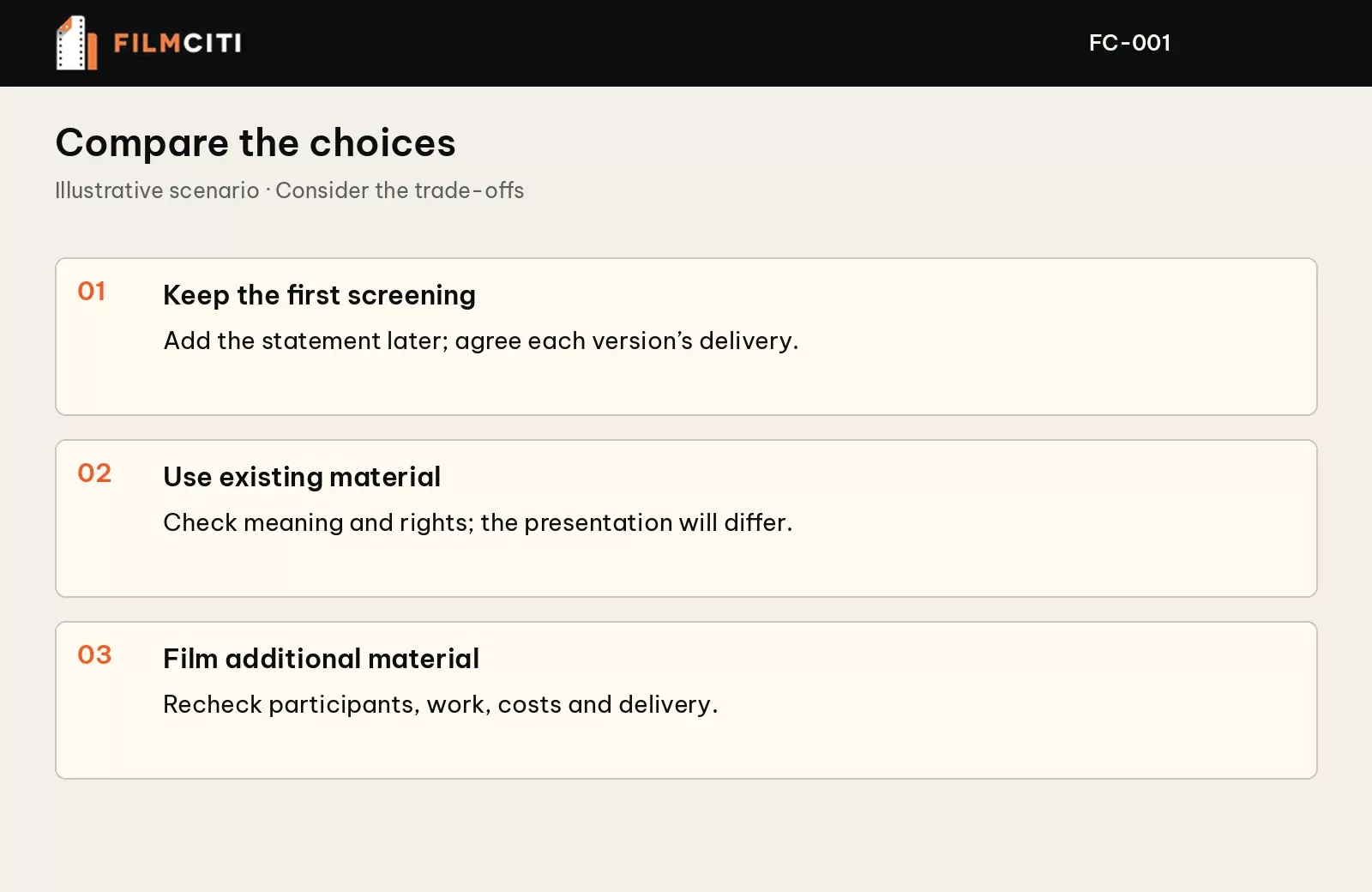
Before accepting the change, the producer needs to spell out the extra work. The company then chooses 1 of 3 options:
Option | Suitable when | What you accept
Keep the main version, add it in a later version | The new statement is not essential for the first screening | Agree the order and delivery date of each version
Use existing footage or approved narration | The footage carries the meaning and may be used | The result looks different from a new interview
Film additional material and rework the timeline | The statement is an important part of the story | Recheck crew, costs and the delivery date
Not every request should be treated as the same kind of "revision round". Fixing a typo is entirely different from adding a new person to the film. Equally, do not assume every change means going back to film: existing material is often enough. When an extra shoot is unavoidable, the cost depends on how many shoot days the production package already covers. According to Filmciti's pricing page, the Starter package at VND 70 million and the Standard package at VND 100 million (excluding VAT) cover 1 shoot day, while the Professional package at VND 200 million adds 1 standby day, but that standby day is reserved for weather or other unforeseen events affecting the main shoot. A new scene that comes from a change in content therefore needs its scope and cost agreed before the crew schedules it.
Before agreeing a delivery deadline, check that all 3 rounds have an approver
A corporate film schedule that only shows the shoot day and the delivery date is not enough. The timeline needs both the crew's working time and the company's time to watch and decide. Before the kick-off meeting, you can use these questions:
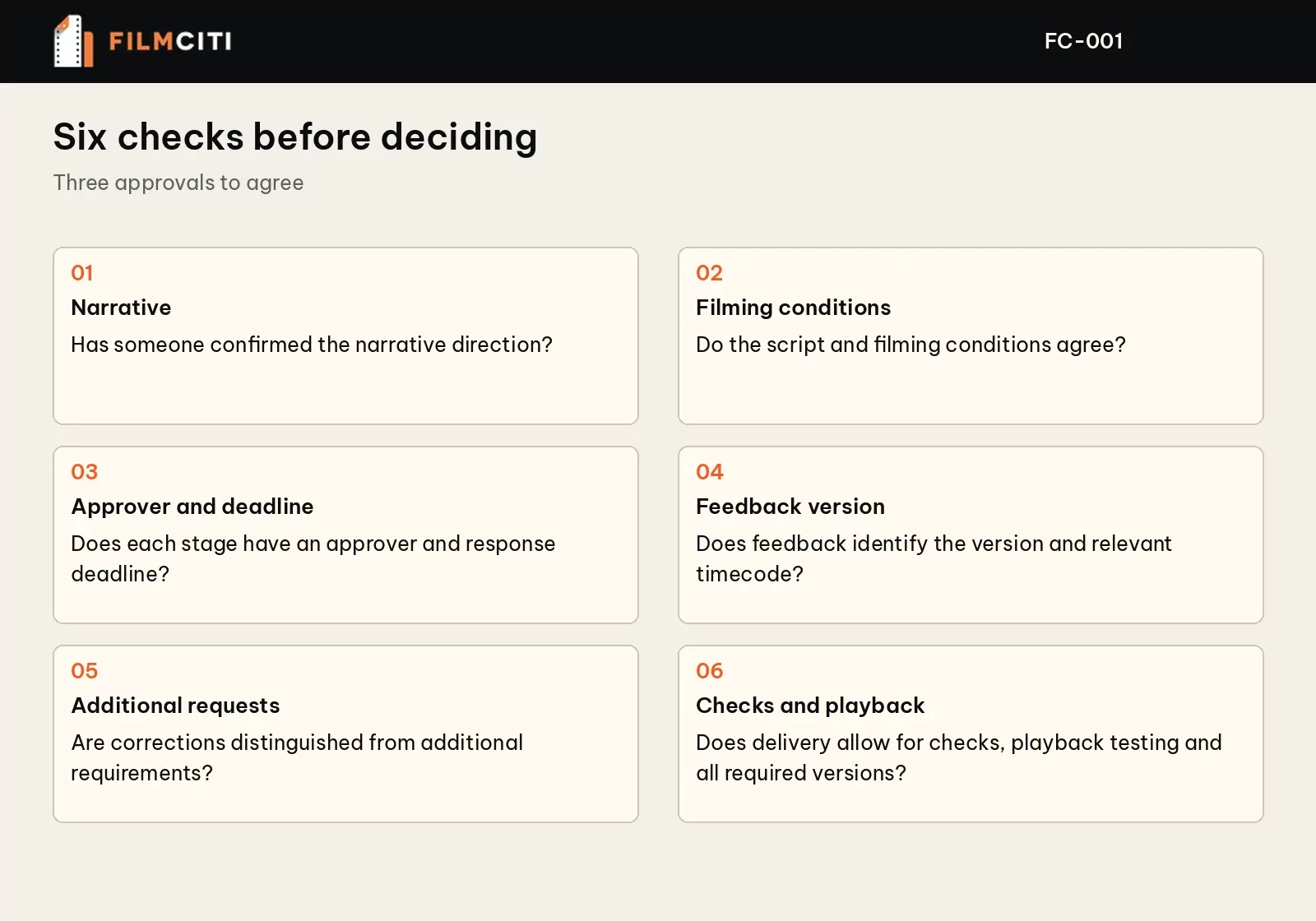
- Who is the final approver, and at which rounds will they watch?
- Has someone confirmed the concept in writing?
- Do the script and the filming conditions match?
- Does each round have a specific feedback deadline?
- Will feedback be combined into one set, with the correct version name and timecode?
- Have both sides distinguished fixing errors from adding new requests?
- Does the delivery date allow for finishing, checking, a test run and every version you need?
If the timeline has no time for approvals, or the person collecting feedback has no authority to resolve conflicting opinions, clarify this before promising any delivery date. Download the approval round tracker — Vietnamese template to fill in for your own project.
To work out which date each round should fall on, see how to plan a corporate film schedule backwards from the release date.
See also Filmciti's corporate film production service to decide which versions to include in the timeline.
You can send Filmciti a brief with the screening date, the name of the final approver, the material you already have and the decisions still pending, so both sides can build a timeline that holds.
Related service: Corporate film production
FAQ
Not necessarily. The person who collects feedback combines the comments into one agreed version. The final approver is the person with the authority to decide the message and to choose when opinions still differ. The two roles can be held by one person, but this needs to be stated clearly.
Yes. The most effective way is to invite the decision-makers to watch together in one session, rather than sending the file to each person. Even when time is short, key figures and filming conditions still need to be confirmed before work goes ahead.
Not yet, if that is only the content approval. Colour grading, sound mixing, graphics finishing, technical checks and a test run of the file on the actual screening system still follow. For a film shown at a conference or event, test the file on the actual screen and sound system at least 1 day before the screening, so there is time to fix any problem.